What is Woopra?
Woopra is a customer journey analytics platform that tracks how individual people interact with a business across its website, product, emails, sales and support touchpoints. Instead of only showing anonymous totals, it builds a profile for each user that lists their visits, feature usage, email opens and payments. Teams then use journey, funnel, retention and cohort reports to see where people convert or drop off.
Woopra also lets teams act on that data through triggers that send emails, post Slack messages or update Salesforce records when someone does something specific. It is designed for non-technical staff, with a visual interface that answers most questions without SQL. The pricing points to mid-size and larger companies, with plans starting at $999 per month and a 30-day free trial.
Woopra at a glance
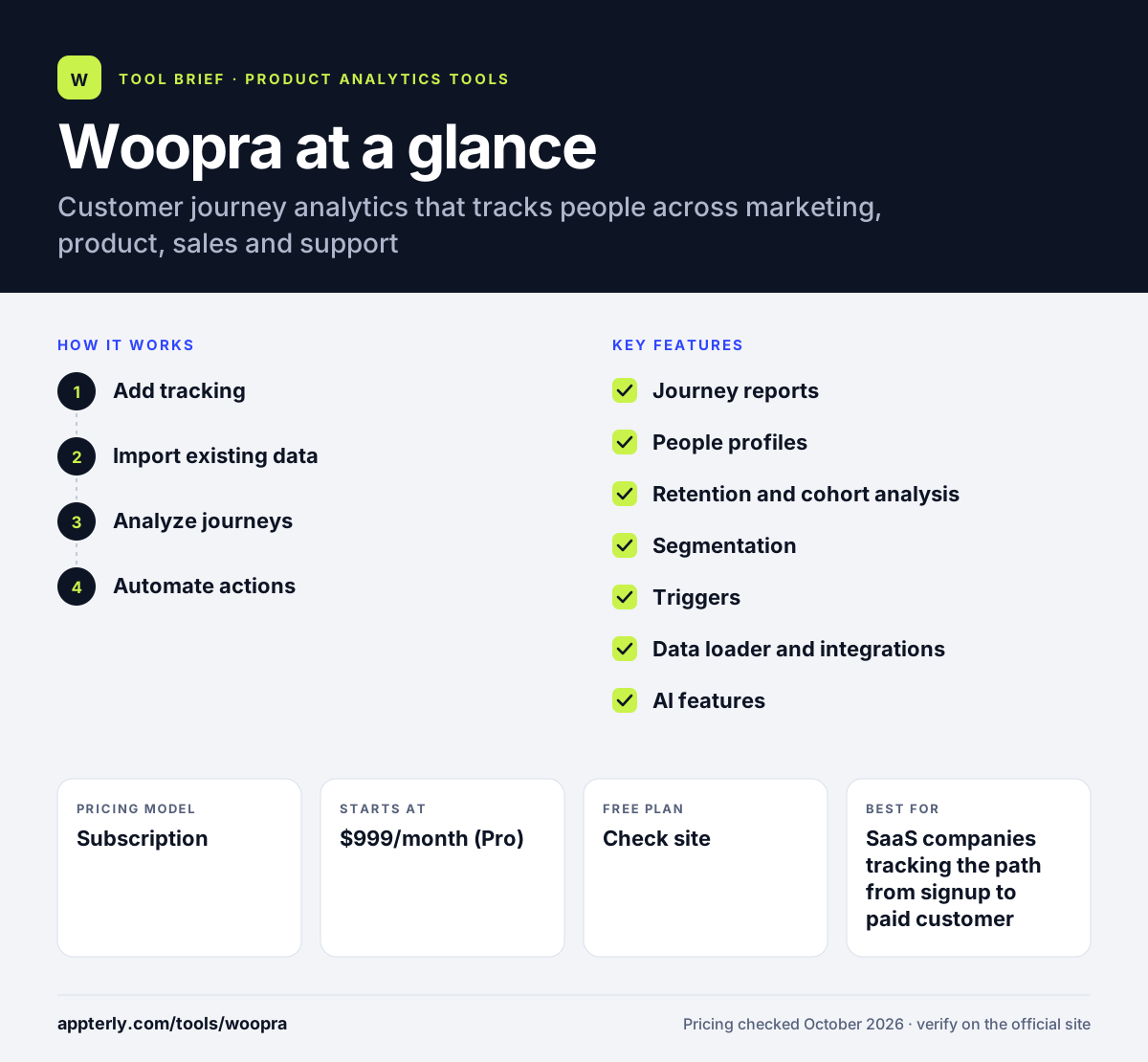
How does Woopra work?
- Add tracking
You install the Woopra tracking code on your site and app, or send events through an SDK or API. Each action is tied to a visitor and later to a known user.
- Import existing data
The data loader pulls in records from databases and SaaS tools, including historical data, so profiles include more than web activity.
- Analyze journeys
You build journey, trend, retention and cohort reports in the visual interface to see how people move from first visit to purchase and beyond.
- Automate actions
Triggers watch for specific behaviors and respond automatically, such as sending an email, alerting a team in Slack or updating a CRM field.
Woopra key features
Journey reports
Map the steps people take across channels and see where they convert or drop out. Useful for onboarding, checkout and sales funnels.
People profiles
Each user gets a timeline of website visits, product actions, email activity and payments, which helps sales and support teams see full context.
Retention and cohort analysis
Track how groups of users who signed up at the same time keep using the product, and compare cohorts after product or marketing changes.
Segmentation
Build segments from behavior and attributes and reuse them across reports and automations.
Triggers
Behavior-based automations that send emails, post to Slack or update Salesforce without developer work.
Data loader and integrations
Connects to more than 50 tools with one-click integrations and imports historical data from databases and SaaS services.
AI features
The Pro plan includes an AI copilot and suggestions, while Enterprise adds AI predictions, summaries and an audience agent.
Why use Woopra?
- It connects marketing, product and support activity to the same person, which most web analytics tools do not do.
- Non-technical team members can answer journey questions without writing SQL.
- Triggers turn insights into actions such as alerts and CRM updates.
- Data collection continues if you go over your event limit, so tracking is not cut off mid-month.
- The 30-day free trial gives enough time to test real reports on your own data.
Who is Woopra best for?
A good fit for
- SaaS companies tracking the path from signup to paid customer
- Ecommerce and subscription businesses analyzing repeat behavior
- Marketing and product teams that share one view of the customer
- Companies already using Salesforce and Slack for customer workflows
Less suited to
- Small businesses or startups, since paid plans start at $999 per month
- Teams that only need basic website traffic reports
- Companies that want warehouse sync or SSO without an Enterprise contract
Woopra pricing
| Pricing model | Subscription |
|---|---|
| Free plan | Not confirmed |
| Free trial | 30 days |
| Starting price | $999/month (Pro) |
Pro starts at 5 million events per month with 50 seats and 24 months of data retention, and overage fees apply above your event tier. Enterprise is custom priced and adds data warehouse sync, B2B account tracking, SSO, AI predictions and dedicated support.
Prices checked October 2026. Vendors change plans often, so confirm on the official Woopra pricing page before you buy.
Woopra pros and cons
Pros
- Person-level profiles that span marketing, product and support
- Visual reporting that does not require SQL
- Built-in automation through triggers
- Generous seat count on the entry plan
Cons
- High starting price compared with many product analytics tools
- Warehouse sync, SSO and account-level tracking require Enterprise
- Overage fees can raise costs if event volume grows quickly
Woopra integrations and platforms
Works with
Available on
Woopra alternatives
See the full shortlist in Best Product Analytics Tools.
Woopra FAQ
Is Woopra free?
Woopra offers a 30-day free trial. According to its pricing page, the first month is free and billing begins in month two, renewing every 30 days, and you can cancel anytime. Paid plans start at $999 per month for Pro, while Enterprise pricing is quoted by the sales team based on your needs.
What is Woopra used for?
Woopra is used to understand the full customer journey. Companies use it to see how visitors become signups and paying customers, which features drive retention, and which campaigns lead to revenue. Its people profiles and triggers also help sales and support teams respond to what individual customers are doing.
Is Woopra good for beginners?
Woopra's reports are built with a visual interface, so marketers and product managers can use them without SQL. Setting up tracking still needs some technical work, such as installing the script and planning which events to send. Beginners with a small budget may find the starting price too high for their needs.
Woopra vs Mixpanel: what's the difference?
Mixpanel focuses on product analytics, with event-based funnels, retention and flows mainly for digital products. Woopra places more emphasis on the end-to-end customer journey across marketing, product, sales and support, with person-level profiles and built-in triggers. Mixpanel offers a free plan, while Woopra paid plans start at $999 per month.
Does Woopra integrate with Salesforce?
Yes. Woopra can update Salesforce fields automatically through its triggers, based on what users do. It also posts alerts to Slack and says it offers more than 50 one-click integrations, plus a data loader that imports records from databases and other SaaS tools without developer help.
Sources
This overview is based on Woopra's official website and documentation, checked October 2026.