What is Amplitude?
Amplitude is a digital analytics platform that helps teams understand how people use their websites and apps and what drives conversion and retention. It tracks user events, then lets you analyze funnels, retention, paths and cohorts without writing SQL. Around that analytics core, it adds session replay, heatmaps, feature and web experimentation, in-product guides and surveys, and AI agents that answer questions about your data.
Amplitude also includes data management features, sometimes called Amplitude CDP, for identity resolution, governance and activation. These let teams sync behavioral cohorts and user properties to ad platforms, email tools and warehouses. The company was part of Y Combinator's Winter 2012 batch. Pricing starts with a free plan of 2 million events per month, with Plus, Growth and Enterprise tiers above it. Expanded packages such as extra replay retention or experiments are priced on top of the platform plan.
Amplitude at a glance
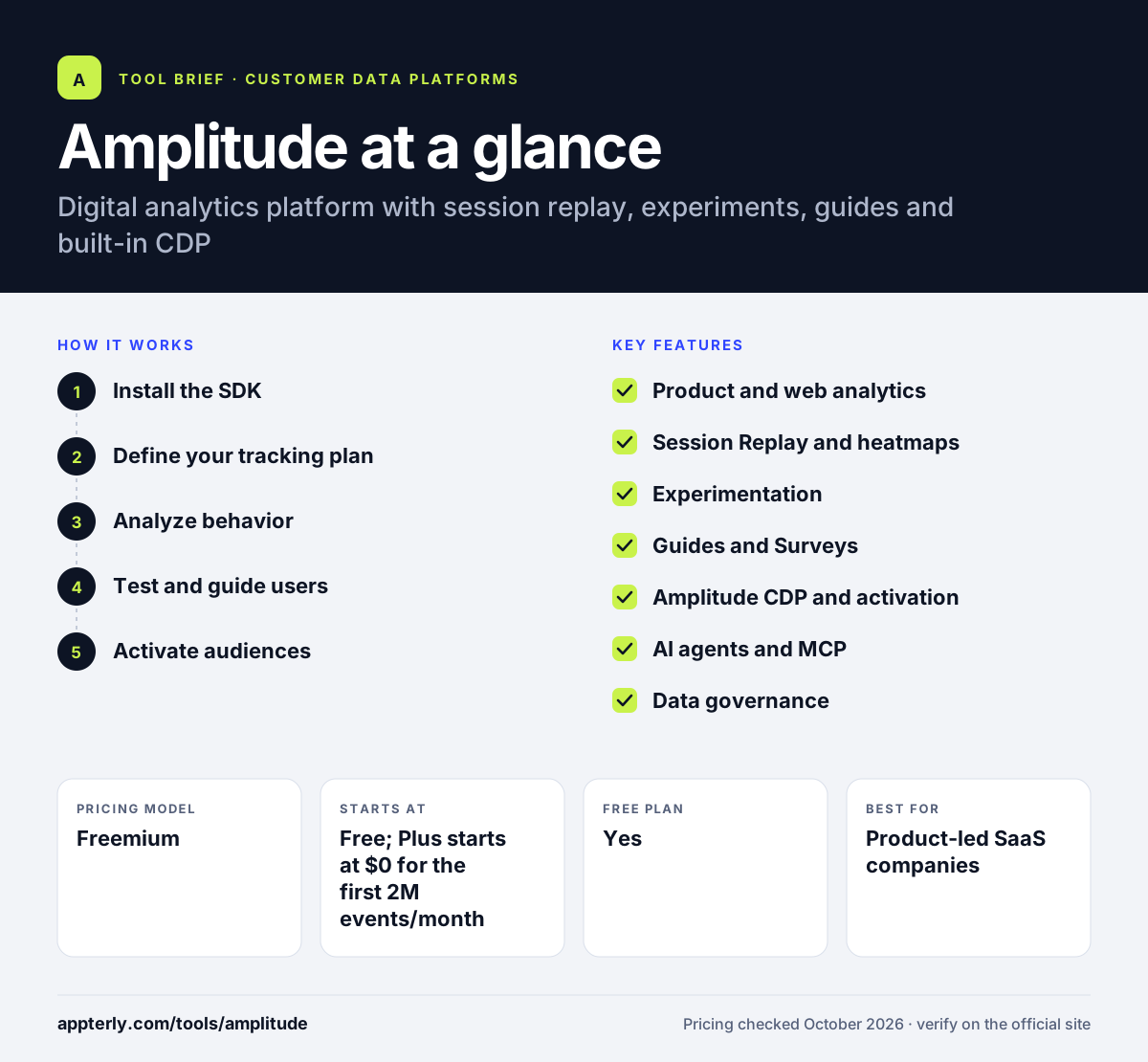
How does Amplitude work?
- Install the SDK
Add Amplitude's browser or mobile SDK, or send data from a warehouse or another source, to start capturing user events.
- Define your tracking plan
Set up events and properties, and use governance tools to keep naming clean and schemas protected.
- Analyze behavior
Build funnels, retention charts and user journeys, and watch session replays to see where people get stuck.
- Test and guide users
Run feature or web experiments and launch in-product guides and surveys based on what the data shows.
- Activate audiences
Sync behavioral cohorts to marketing and advertising destinations for targeting and personalization.
Amplitude key features
Product and web analytics
Funnels, retention, journeys, cohorts and marketing attribution in a self-serve interface.
Session Replay and heatmaps
Recordings of real sessions and visual heatmaps that explain the numbers behind charts.
Experimentation
Feature flags, feature experiments and web A/B tests tied directly to analytics data.
Guides and Surveys
In-product messages and surveys targeted using behavioral data.
Amplitude CDP and activation
Identity resolution, unlimited sources and destinations, derived properties and cohort syncs to other tools.
AI agents and MCP
An AI assistant and agents that analyze data and suggest actions, plus an MCP server for tools like Claude and Cursor.
Data governance
Tracking plans, protected schemas and data mutability tools keep event data accurate as products change.
Why use Amplitude?
- A generous free plan with 2 million events per month and unlimited team members.
- Analytics, replay, experiments and guides share one data set.
- Self-serve charts let marketers and product managers answer questions without SQL.
- Built-in CDP features reduce the need for a separate tool to activate audiences.
- Eligible early-stage startups can get a year of the Growth plan free.
Who is Amplitude best for?
A good fit for
- Product-led SaaS companies
- Growth and product marketing teams
- Mobile app businesses tracking retention
- Startups that want enterprise-grade analytics early
- Marketing teams measuring web conversion and campaign impact
Less suited to
- Small sites that only need basic traffic stats
- Teams without time to plan event tracking
- Buyers needing predictable pricing at very high event volumes
Amplitude pricing
| Pricing model | Freemium |
|---|---|
| Free plan | Yes |
| Free trial | Not confirmed |
| Starting price | Free; Plus starts at $0 for the first 2M events/month |
Plus is self-serve and scales with event volume up to 70 million events per month, while Growth and Enterprise are custom-priced with advanced analytics, data controls and support SLAs. Session replay, experiments and guides have add-on capacity on higher tiers.
Prices checked October 2026. Vendors change plans often, so confirm on the official Amplitude pricing page before you buy.
Amplitude pros and cons
Pros
- Strong free plan
- Deep behavioral analytics without SQL
- Analytics, replay, experiments and activation in one platform
- Active AI and MCP features
Cons
- Advanced features sit in custom-priced tiers
- Requires careful event tracking setup
- No customer support on the free plan
Amplitude integrations and platforms
Works with
Available on
Amplitude alternatives
See the full shortlist in Best Customer Data Platforms.
Amplitude FAQ
Is Amplitude free?
Yes. Amplitude's free plan includes 2 million events per month, unlimited team members, 10,000 monthly session replays and limited experiments and guides, with no credit card and no time limit. It does not include customer support. Paid Plus, Growth and Enterprise plans add volume, features and support.
What is Amplitude used for?
Amplitude is used to measure how people use digital products and what drives conversion and retention. Teams use it to analyze funnels and user journeys, watch session replays, run A/B tests, launch in-app guides and send behavioral audiences to marketing and ad tools for targeting.
Is Amplitude good for beginners?
Amplitude's chart builder is self-serve and its AI assistant can answer questions in plain language, so non-analysts can get useful insights. The harder part is planning and implementing event tracking correctly. Teams that invest in a clear tracking plan up front get much more out of it.
Amplitude vs Mixpanel: what's the difference?
Both are event-based product analytics tools with funnels, retention and cohorts. Amplitude bundles more in one platform, including session replay, experimentation, guides and surveys and CDP-style activation. Mixpanel is often seen as simpler and leaner. The best choice depends on whether you want an all-in-one suite. Many teams use both at different stages.
Does Amplitude have a CDP?
Yes. Amplitude includes customer data platform features, often called Amplitude CDP, covering identity resolution, unlimited sources and destinations, data governance and cohort syncing. Higher tiers add scheduled syncs, derived properties, protected schemas and data access controls for larger teams.
Sources
This overview is based on Amplitude's official website and documentation, checked October 2026.