What is FullStory?
FullStory is a digital experience analytics platform that captures how people use websites and mobile apps, then helps teams find friction with session replay, heatmaps, funnels and product analytics. Its capture technology records interactions automatically, so you do not need to tag every event in advance. The company now styles its name as Fullstory and has offices in Atlanta, London, Sydney and Singapore.
On top of that data sits StoryAI, an intelligence layer with agents that flag anomalies, answer questions about user behavior and estimate the revenue impact of drop-offs. Fullstory sells three suites: Analytics for customer experience, Anywhere for sending behavioral data to warehouses and personalization tools, and Workforce for internal employee apps. A permanent free plan covers 30,000 sessions a month. The free plan includes up to 10 users. Fullstory Workforce extends the same capture to internal employee apps, with app adoption scoring and workflow mapping.
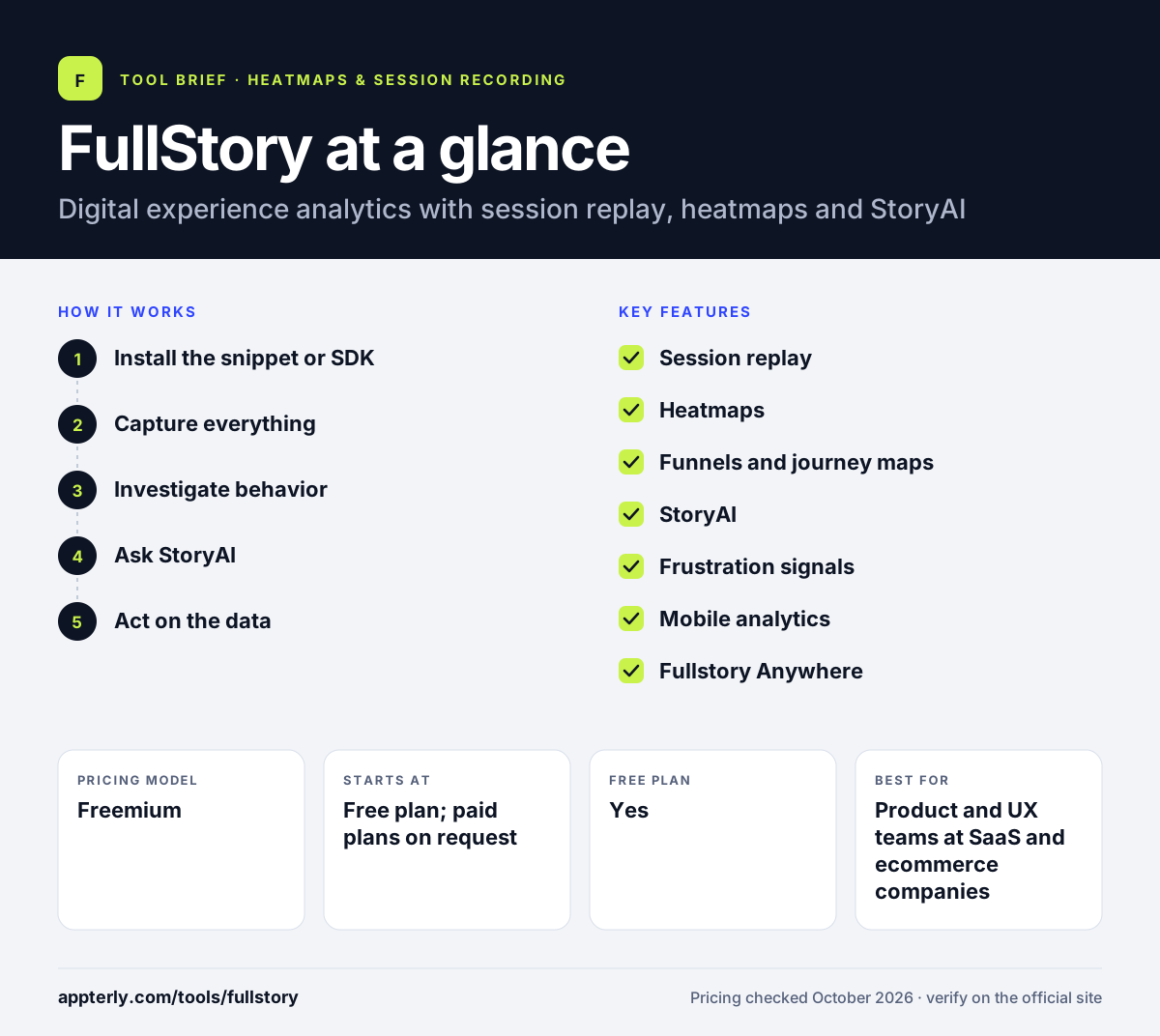
FullStory at a glance
How does FullStory work?
- Install the snippet or SDK
Add the Fullstory script to your site or the mobile SDK to your app. The free plan supports up to 10 users.
- Capture everything
Fullcapture records clicks, scrolls and page changes automatically, with privacy-by-default masking.
- Investigate behavior
Search sessions, watch replays and use heatmaps, funnels and journey maps to find problems. User segments and dashboards help you track groups over time.
- Ask StoryAI
Use StoryAI to surface opportunities, detect friction such as rage clicks and answer questions in plain language.
- Act on the data
Share findings, send data to your warehouse with Anywhere, or trigger personalization in real time.
FullStory key features
Session replay
High-fidelity replays of user sessions, searchable by events and user attributes.
Heatmaps
Click and scroll heatmaps that show where users interact on each page.
Funnels and journey maps
Track conversion steps and the paths users take across your site or app.
StoryAI
AI agents and chat that detect friction, flag anomalies and size revenue impact, plus an MCP server.
Frustration signals
Rage clicks, error clicks and sentiment signals highlight sessions with problems.
Mobile analytics
An add-on that brings replay and analytics to native mobile apps.
Fullstory Anywhere
Sends behavioral data to warehouses and activates real-time signals for personalization.
Guides and Surveys
An add-on for in-product tours, NPS and surveys.
Why use FullStory?
- FullStory captures interactions automatically, so you can answer new questions without adding tracking first.
- StoryAI shortens the time spent hunting through replays for problems.
- Frustration signals point you to sessions where users struggled.
- The free plan offers 30,000 sessions a month with 12 months of data retention.
- Anywhere lets data teams reuse behavioral data in their warehouse and other tools.
Who is FullStory best for?
A good fit for
- Product and UX teams at SaaS and ecommerce companies
- Engineering and support teams debugging user-reported issues
- Enterprises in retail, travel, finance and gaming
- Data teams that want behavioral data in their warehouse
Less suited to
- Small businesses that need public, self-serve pricing for paid tiers
- Teams that want built-in A/B testing
- Marketers who only need a basic heatmap
FullStory pricing
| Pricing model | Freemium |
|---|---|
| Free plan | Yes |
| Free trial | Not confirmed |
| Starting price | Free plan; paid plans on request |
Paid Analytics plans are Business, Advanced and Enterprise, priced through sales. Mobile, StoryAI, Guides and Surveys and multi-org management are add-ons.
Prices checked October 2026. Vendors change plans often, so confirm on the official FullStory pricing page before you buy.
FullStory pros and cons
Pros
- Automatic capture reduces manual event tagging
- Strong session search and frustration signals
- AI agents through StoryAI
- Permanent free plan with 12-month retention
Cons
- No published prices for paid plans
- Mobile analytics and StoryAI are paid add-ons
- No native A/B testing
FullStory integrations and platforms
Available on
FullStory alternatives
See the full shortlist in Best Heatmap Tools.
FullStory FAQ
Is FullStory free?
Yes. Fullstory offers FullstoryFree, a permanent free plan with no credit card required. It includes 30,000 sessions per month, 12 months of data retention, up to 10 users, session replay, basic analytics and debugging tools. Dashboards, StoryAI and higher session limits require a paid plan.
What is FullStory used for?
FullStory is used to understand how people use websites and apps. Teams watch session replays, read heatmaps and analyze funnels to find bugs, confusing design and drop-off points. Support and engineering teams also use it to reproduce issues users report. Its StoryAI agents can also flag anomalies and estimate the revenue cost of friction.
How much does FullStory cost?
Fullstory does not publish prices for its paid plans. Analytics comes in Business, Advanced and Enterprise tiers, and you request pricing through a demo. Cost depends on session volume and add-ons such as mobile analytics, StoryAI and Guides and Surveys. A free plan is also available. The free plan is a permanent option rather than a time-limited trial.
FullStory vs Hotjar: what's the difference?
Both offer session replay and heatmaps. FullStory captures every interaction automatically and adds product analytics, StoryAI and data export for larger teams. Hotjar is now part of Contentsquare, which offers a large free plan and a self-serve Growth plan focused on experience analytics and surveys. Pricing differs as well: FullStory's paid plans are quoted by sales, while Contentsquare publishes its Growth price.
Does FullStory work on mobile apps?
Yes. Fullstory supports native mobile apps through its Mobile Analytics add-on, which brings session replay and analytics to app experiences. The add-on is available across the Business, Advanced and Enterprise tiers, and pricing is part of your sales quote.
Sources
This overview is based on FullStory's official website and documentation, checked October 2026.