What is Tray.ai?
Tray.ai is an enterprise integration and automation platform for connecting business systems, building workflows and deploying AI agents under central governance. It offers more than 700 connectors and lets teams build visually with low-code tools or through code-first development. The platform covers process automation, data integration, API management and managed MCP servers in one place. Teams can work visually or hand the build to developers and AI coding assistants.
The product targets IT, operations and revenue operations teams at mid-size and large companies rather than individual marketers. Its Merlin Agent Builder creates AI agents with guardrails, and Tray Helix provides a governed runtime for internal apps built with AI. Pricing is usage-based, measured in tasks, with no charges per user or per connection, and quotes are sized to each customer.
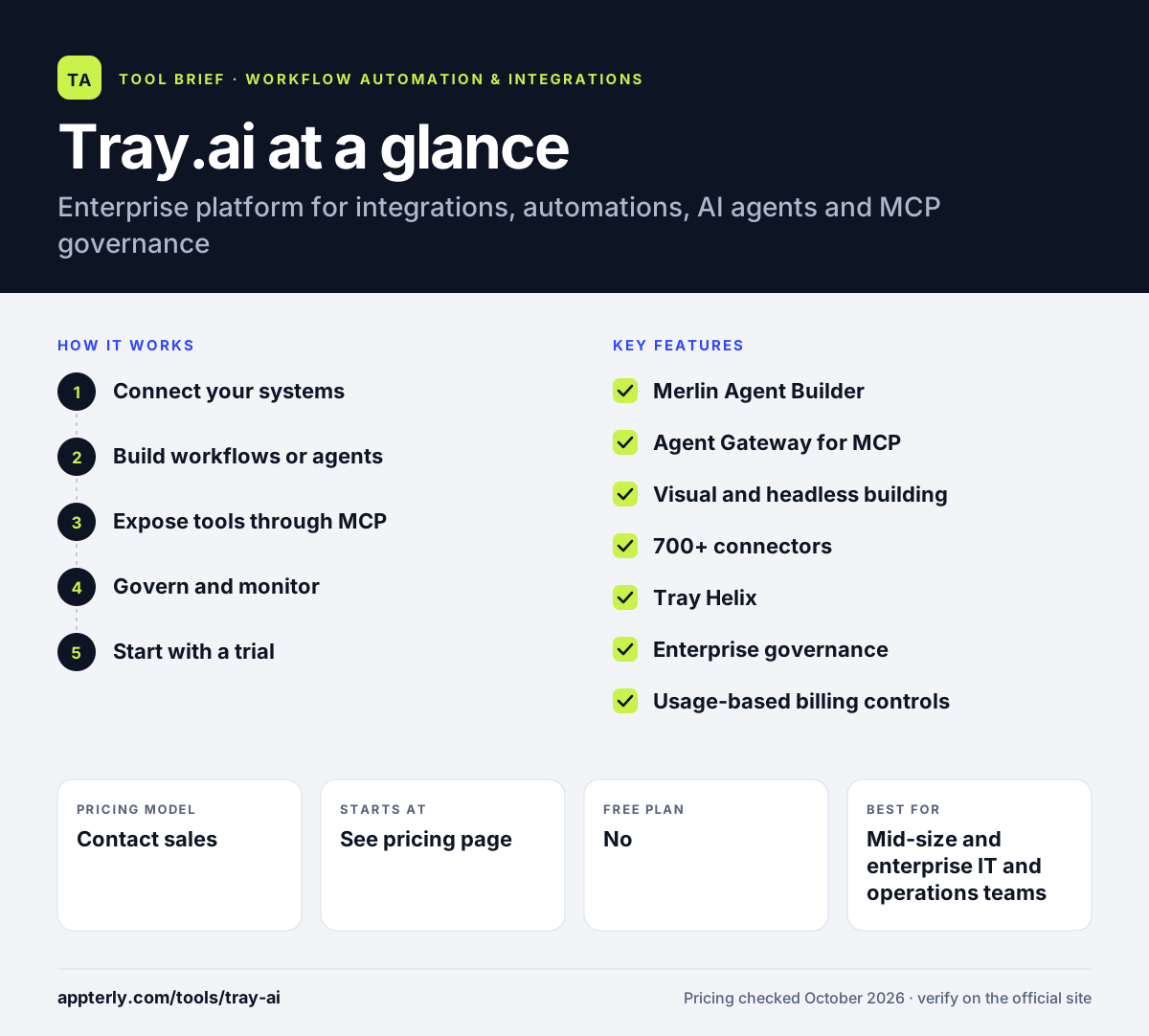
Tray.ai at a glance
How does Tray.ai work?
- Connect your systems
Authenticate the business apps and data sources you need, such as Salesforce, NetSuite, Snowflake or Slack, from the connector library.
- Build workflows or agents
Use the visual builder for automations and integrations, Merlin Agent Builder for AI agents, or headless development from a coding assistant.
- Expose tools through MCP
Publish approved actions as managed MCP servers so AI assistants can use them under controlled access.
- Govern and monitor
Apply role-based access, audit trails, log masking and insights across workflow runs and agent actions.
- Start with a trial
Use the 30-day trial to build a proof of concept with real systems, then size an annual task commitment from measured usage.
Tray.ai key features
Merlin Agent Builder
No-code builder for AI agents, with guardrails and an agent hub for reuse.
Agent Gateway for MCP
Managed MCP servers with governed tool access, auditing and observability.
Visual and headless building
Tray Build offers low-code visual development, while Tray Headless supports code-based work from coding assistants.
700+ connectors
Prebuilt connectors for CRM, ERP, data warehouse, HR and collaboration tools, plus API management.
Tray Helix
A governed runtime for deploying and managing apps built with AI, with security and cost controls.
Enterprise governance
Role-based access control, audit trails, SSO, HIPAA options, regional hosting and log streaming on higher tiers.
Usage-based billing controls
Usage is measured in tasks and compute units, with annual volume commitments, monthly limits and a true-up for overages instead of per-seat fees.
Why use Tray.ai?
- One platform for integrations, automations, AI agents and MCP access.
- Usage-based pricing with no per-user or per-connection fees.
- Strong governance suits regulated or security-conscious companies.
- A 30-day trial with 1 million tasks allows a real proof of concept.
- Supports both low-code builders and developers.
Who is Tray.ai best for?
A good fit for
- Mid-size and enterprise IT and operations teams
- Revenue operations teams integrating CRM, billing and data tools
- Companies rolling out AI agents that need governance
- Organizations with data residency or compliance needs
- Platform teams standardizing integrations across several departments
Less suited to
- Freelancers and very small businesses with simple automations
- Buyers who want public, self-serve pricing
- Teams looking for one-click marketing templates
Tray.ai pricing
| Pricing model | Contact sales |
|---|---|
| Free plan | No |
| Free trial | 30 days |
| Starting price | See the official pricing page |
Tray iPaaS Pro, Team and Enterprise plans are quoted based on expected task volume, with more workspaces, longer insights and added security at higher tiers. Tray Helix Builder Edition is listed from $50 per month.
Prices checked October 2026. Vendors change plans often, so confirm on the official Tray.ai pricing page before you buy.
Tray.ai pros and cons
Pros
- Broad enterprise feature set covering agents, MCP and integrations
- No per-user charges
- Generous trial for testing
- Strong security and governance options
Cons
- No published prices for the core iPaaS plans
- More platform than small marketing teams need
- Fewer connectors than consumer-focused tools like Zapier
Tray.ai integrations and platforms
Works with
Available on
Tray.ai alternatives
See the full shortlist in Best Zapier Alternatives.
Tray.ai FAQ
Is Tray.ai free?
Tray.ai does not have a free plan. It offers a 30-day free trial that includes 1 million tasks, the full connector library and all capabilities, with no card or sales call required. After the trial, Pro, Team and Enterprise plans are quoted based on usage.
What is Tray.ai used for?
Tray.ai is used by larger organizations to integrate business systems, automate cross-department processes and deploy AI agents with governance. Typical uses include syncing CRM and ERP data, automating lead routing and quote-to-cash flows, and giving AI assistants controlled access to company tools through MCP. It also offers business-hours support on every plan, with an optional premium support tier.
Is Tray.ai good for beginners?
Tray.ai has a visual builder and no-code agent tools, but it is designed for technical operations and IT teams. Beginners with simple needs will likely find tools such as Zapier or Make easier to start with and cheaper to run. New users can test it first with the 30-day trial.
Tray.ai vs Workato: what's the difference?
Both are enterprise automation and integration platforms with AI agent and MCP features and sales-led pricing. Tray.ai emphasizes usage-based pricing without per-user fees, a combined low-code and headless approach and its Helix runtime for AI-built apps. Workato emphasizes a very large connector catalog, prebuilt agents called Genies and Workbot for chat apps.
Was Tray.ai previously called Tray.io?
Yes. The company was known as Tray.io before rebranding as Tray.ai, reflecting its shift toward AI agents and AI orchestration. The core integration platform remains, now alongside Merlin Agent Builder, the MCP Agent Gateway and Tray Helix.
Sources
This overview is based on Tray.ai's official website and documentation, checked October 2026.