What is Activepieces?
Activepieces is an open-source workflow automation platform that connects apps, runs automated flows and hosts AI agents in one workspace. It is often described as an alternative to Zapier or Make. Its core and its integrations, called pieces, are released under the MIT license, so teams can read the code, self-host it with Docker or Kubernetes, or use the managed cloud.
Flows are built in a visual editor with branching, retries, subflows and human approval steps, and developers can drop into TypeScript when a step needs custom logic. Activepieces also includes shared tables, a knowledge base for agents and an MCP server that lets AI tools such as Claude and Cursor trigger flows. Pricing is credit-based with a free plan and flat-fee paid tiers.
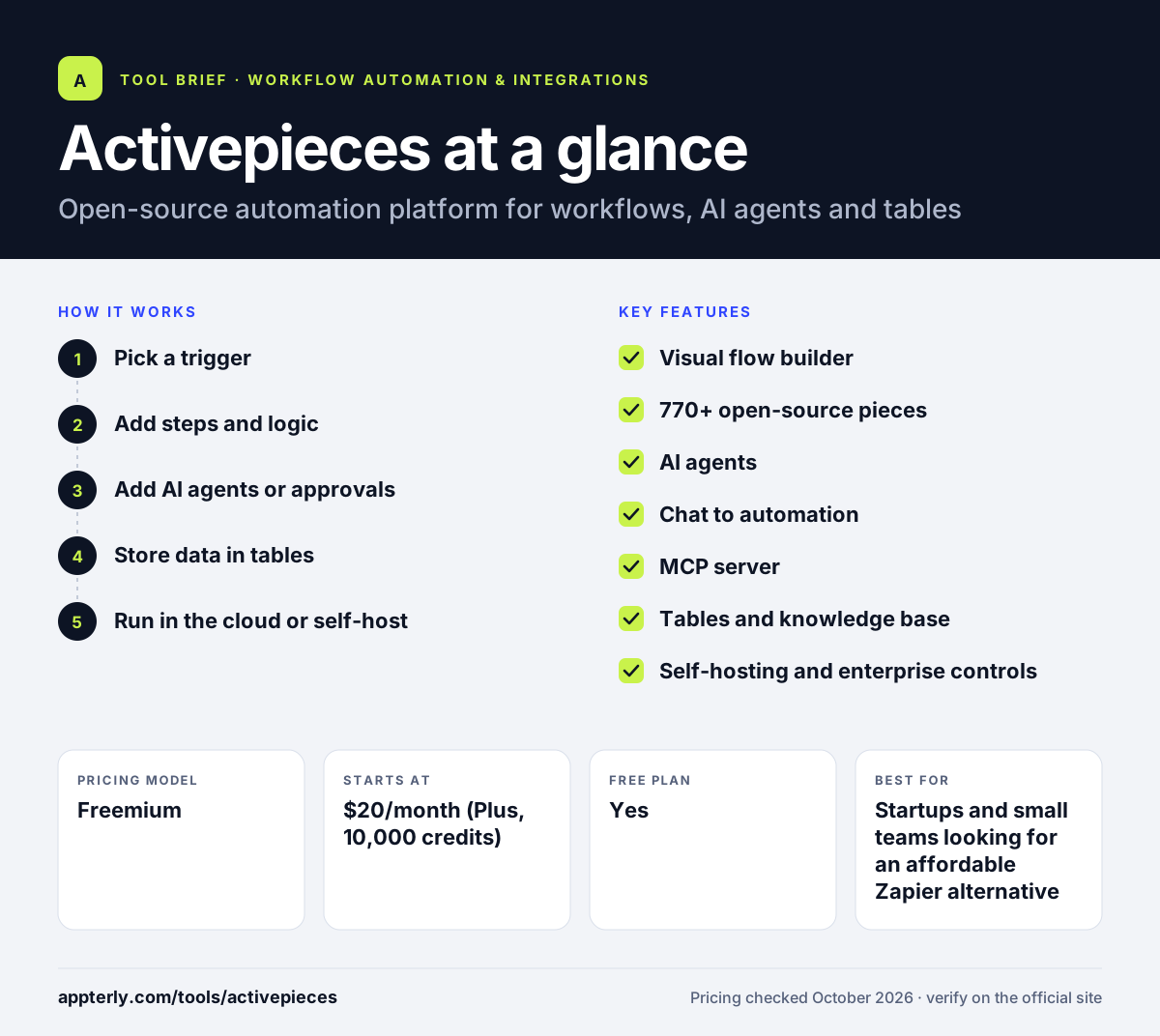
Activepieces at a glance
How does Activepieces work?
- Pick a trigger
Start a flow from an app event, a schedule, a webhook or a chat message, using one of more than 770 pieces.
- Add steps and logic
Chain actions across apps, add branches, loops and retries, or write a TypeScript step for custom logic.
- Add AI agents or approvals
Describe a task for an AI agent that chooses its own tools, and require human approval for sensitive actions.
- Store data in tables
Read and write shared tables so flows and agents can keep state and share information.
- Run in the cloud or self-host
Publish the flow on Activepieces Cloud or on your own servers, and monitor runs and credit usage.
Activepieces key features
Visual flow builder
Branching, retries, waitpoints, subflows, error handling and approvals in a drag-and-drop editor.
770+ open-source pieces
MIT-licensed integrations for apps like Slack, HubSpot and Google Sheets, plus an HTTP piece for any API.
AI agents
Agents take a plain-language job description and pick tools from connected apps or MCP servers.
Chat to automation
Describe a workflow in plain language and Activepieces drafts the flow for you.
MCP server
Exposes your flows to AI tools such as Claude and Cursor so they can run team automations.
Tables and knowledge base
Shared data tables and a searchable knowledge base that flows and agents can use.
Self-hosting and enterprise controls
Deploy on your own infrastructure or air-gapped, with SSO, custom roles, audit logs and secret managers on higher plans.
Why use Activepieces?
- Activepieces is open source under MIT, so you can self-host it and avoid vendor lock-in.
- Flat monthly pricing with generous credits can be cheaper than per-task automation tools.
- AI agents and an MCP server bring AI directly into business workflows.
- Developers can write TypeScript steps when no-code blocks are not enough.
- A free plan with no time limit makes it easy to try real automations.
Who is Activepieces best for?
A good fit for
- Startups and small teams looking for an affordable Zapier alternative
- Technical teams that want to self-host automation
- Companies building AI agent workflows connected to business apps
- SaaS companies that want to embed automation in their product
Less suited to
- Users who need the very largest app catalog available
- Non-technical teams that want fully managed, hands-off support on a free plan
- Organizations that cannot run or maintain self-hosted software but need on-premise deployment
Activepieces pricing
| Pricing model | Freemium |
|---|---|
| Free plan | Yes |
| Free trial | Not confirmed |
| Starting price | $20/month (Plus, 10,000 credits) |
The free plan includes 1,000 credits and up to 5 users. Plus costs $20/month and Team $200/month with 50,000 credits and 25 users, with extra credits at $0.007 each, while Ultimate is custom priced. Annual billing saves about two months.
Prices checked October 2026. Vendors change plans often, so confirm on the official Activepieces pricing page before you buy.
Activepieces pros and cons
Pros
- Open-source core that can be self-hosted
- Free plan and low-cost flat-rate paid plans
- Built-in AI agents, tables and MCP support
- Code steps for developers
Cons
- Smaller integration catalog than the largest competitors
- Advanced governance features require the custom Ultimate plan
- Self-hosting requires technical skills to run and update
Activepieces integrations and platforms
Works with
Available on
Activepieces alternatives
See the full shortlist in Best Zapier Alternatives.
Activepieces FAQ
Is Activepieces free?
Yes. Activepieces has a free plan with 1,000 credits, up to five users and unlimited flows, with no card and no time limit. The open-source Community Edition can also be self-hosted for free. Paid plans start at $20 per month for Plus, which adds 10,000 credits and paid overage.
What is Activepieces used for?
Activepieces is used to automate repetitive work across business apps. Common uses include syncing leads between forms and CRMs, posting alerts to Slack, updating spreadsheets, processing invoices and running AI agents that research or respond to requests. Teams also use it to give AI assistants access to internal workflows through MCP.
Is Activepieces open source?
Yes. The Activepieces core and its pieces are released under the MIT license. You can read the code, fork it and run your own instance with Docker or Kubernetes. Paid plans add features such as access control, audit visibility, agents and vendor support on top of the open-source core.
Activepieces vs Zapier: what's the difference?
Both connect apps and automate workflows. Zapier has a larger app catalog and is a closed, cloud-only service. Activepieces is open source, can be self-hosted and uses flat-rate plans with credits, which can lower costs at higher volumes. Teams that value control or self-hosting often prefer Activepieces.
Does Activepieces integrate with Google Sheets?
Yes. Google Sheets is one of Activepieces' integrations, along with Gmail, Google Drive, Slack, HubSpot, Salesforce, Notion and many others. You can trigger flows when a row is added or write data into a sheet from another app, and an HTTP piece covers APIs without a dedicated piece.
Sources
This overview is based on Activepieces's official website and documentation, checked October 2026.