What is Determ?
Determ is an AI-powered media monitoring and media intelligence platform that tracks what online media and social channels say about your brand in real time. Formerly known as Mediatoolkit, it is built by a team based in Zagreb, Croatia. Users set up topics with keywords, and Determ collects matching mentions, scores sentiment and flags unusual spikes so teams can react quickly.
The platform is aimed at PR, communications and marketing teams that need to monitor brands, competitors and campaigns. Its AI assistant, Synthia, summarizes coverage and surfaces insights, while reports and exports turn data into clippings and PR metrics. Plans include unlimited users and keywords, with pricing based on the number of topics and mentions you track each month. Common use cases include campaign tracking, competitor benchmarking and crisis communication.
Determ at a glance
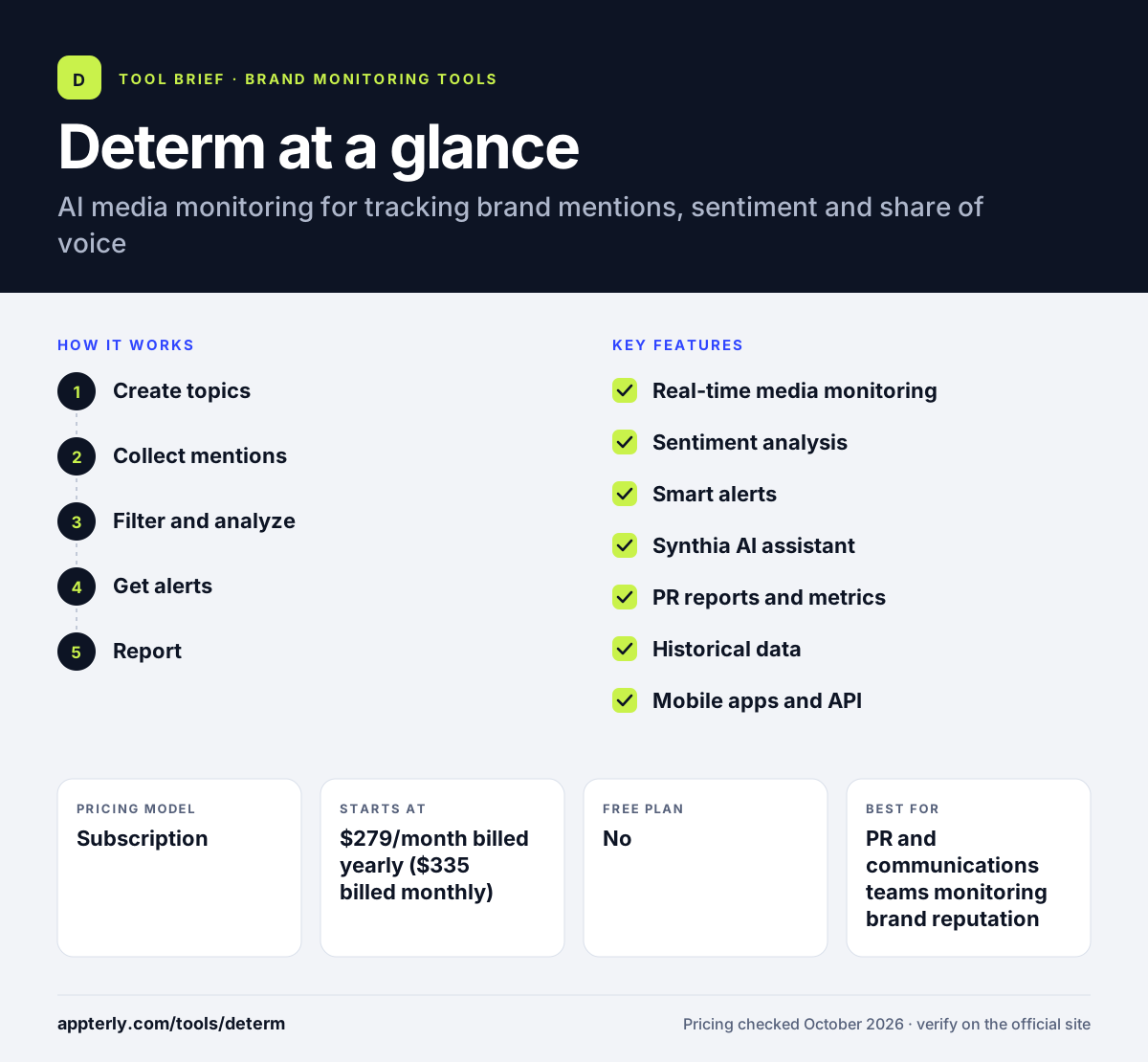
How does Determ work?
- Create topics
Set up a topic for your brand, a competitor or a campaign, and add the keywords Determ should search for. Plans include unlimited keywords, so topics can be as broad or narrow as you need.
- Collect mentions
Determ gathers matching mentions from online media and social sources and updates the feed in real time.
- Filter and analyze
Narrow results by sentiment, source type, location or topic, and read AI summaries of what is being said.
- Get alerts
Receive alerts when mentions spike, sentiment shifts or a potential risk appears. This helps teams respond before a small issue grows.
- Report
Build PR reports and clippings, then export them to Excel, PDF or PowerPoint.
Determ key features
Real-time media monitoring
Tracks mentions across online news and social channels as they are published.
Sentiment analysis
Scores the tone of mentions across languages and sources so you can spot negative trends early.
Smart alerts
AI-driven alerts flag spikes, sentiment changes and emerging risks.
Synthia AI assistant
Summarizes coverage and answers questions about your mentions to speed up analysis.
PR reports and metrics
Automated reports and clippings cover visibility, engagement and share of voice.
Historical data
Archives let you look back at past coverage for comparisons and research.
Mobile apps and API
iOS and Android apps for checking mentions on the go, plus an API and MCP for connecting data to other systems.
Search and signal filtering
Filter mentions by sentiment, source type, geography and topic to cut noise and focus on what matters.
Why use Determ?
- Unlimited users and keywords on every plan make it easy to share across a team.
- Real-time alerts help with crisis communication when coverage turns negative.
- AI summaries save time reading through large volumes of mentions.
- Share-of-voice metrics make competitor comparisons straightforward.
- Exports to common formats simplify reporting to clients and managers.
Who is Determ best for?
A good fit for
- PR and communications teams monitoring brand reputation
- Agencies reporting coverage to multiple clients
- Marketing teams tracking campaigns and competitors
- Organizations that need crisis alerts
Less suited to
- Individuals who only need occasional, free keyword alerts
- Teams that need a journalist database and pitching tools
- Very small budgets, since paid plans start in the hundreds per month
Determ pricing
| Pricing model | Subscription |
|---|---|
| Free plan | No |
| Free trial | 5 days |
| Starting price | $279/month billed yearly ($335 billed monthly) |
Expand covers 5 topics and 5,000 mentions; Command at $467/month billed yearly doubles both. Custom plans are quoted, and a longer 14-day trial is available after a demo.
Prices checked October 2026. Vendors change plans often, so confirm on the official Determ pricing page before you buy.
Determ pros and cons
Pros
- Unlimited users and keywords on all plans
- Useful AI summaries and alerts
- Mobile apps for monitoring on the go
- No credit card needed to start a trial
Cons
- Plans cap the number of topics and monthly mentions
- Short default trial of five days
- Monitoring only, with no outreach or media database
Determ integrations and platforms
Available on
Determ alternatives
See the full shortlist in Best Brand Monitoring Tools.
Determ FAQ
How much does Determ cost?
Determ's Expand plan costs $279 per month billed yearly or $335 billed monthly, and covers 5 topics and 5,000 mentions. Command costs $467 per month billed yearly and covers 10 topics and 10,000 mentions. Custom plans are quoted. All plans include unlimited users, unlimited keywords and every AI feature.
Is Determ the same as Mediatoolkit?
Yes. Determ is the current name of the media monitoring platform previously called Mediatoolkit. The product, built by Determ d.o.o. in Zagreb, Croatia, has grown into an AI-powered media intelligence tool with sentiment analysis, smart alerts, AI summaries and reporting, but it serves the same purpose of tracking brand mentions.
Does Determ have a free trial?
Yes. Determ offers a 5-day free trial on its Expand and Command plans, and no credit card is needed to start. If you book a personalized demo, the company says an extended 14-day trial is available. There is no permanent free plan, so you need a paid subscription after the trial. Trials let you test real topics before committing.
Determ vs Google Alerts: what's the difference?
Google Alerts is a free tool that emails you new search results for a keyword. Determ is a paid monitoring platform that tracks online and social mentions in real time, scores sentiment, flags spikes, summarizes coverage with AI and produces reports. Google Alerts suits basic tracking, while Determ suits teams that need analysis and reporting.
What is Determ used for?
Determ is used for brand and competitor monitoring, campaign tracking, crisis communication, social listening and PR reporting. Teams set up topics with keywords, watch mentions come in, filter them by sentiment and source, and export reports that show visibility, engagement and share of voice over time. Agencies can set up a separate topic for each client.
Sources
This overview is based on Determ's official website and documentation, checked October 2026.