What is BuzzSumo?
BuzzSumo is a content research and media intelligence platform that shows which articles, videos and topics get the most engagement online, and helps PR teams find and pitch journalists. It indexes billions of articles and tracks shares, links and trends across Facebook, X, Reddit and YouTube. Content marketers use it to plan topics, while communications teams use it for outreach, monitoring and coverage reporting.
The platform is organized around a few modules. Content Analyzer and Trending Feeds surface popular and fresh content, Question Analyzer pulls real questions from forums and Q&A sites, and the influencer tools show creators by impact. Monitoring alerts cover brands, competitors and keywords. Higher plans add a media database of about 700,000 journalists, an AI pitching assistant, coverage reports and a YouTube analyzer. BuzzSumo is part of the Cision group. Plans differ mainly by users, alerts and how many years of historical data you can search.
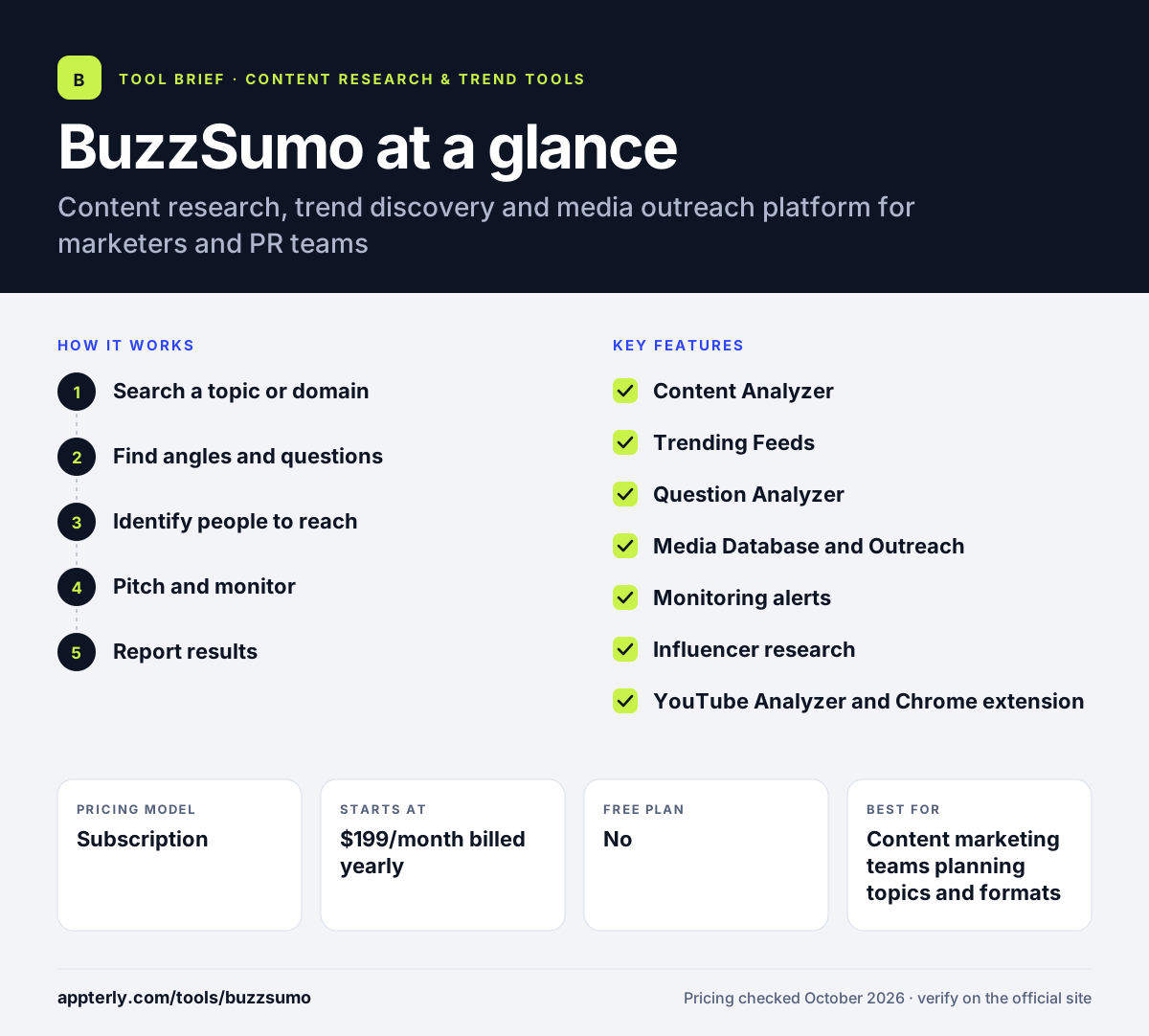
BuzzSumo at a glance
How does BuzzSumo work?
- Search a topic or domain
Enter a keyword or a competitor's site to see the content that earned the most engagement and links in a chosen time range.
- Find angles and questions
Use Trending Feeds and Question Analyzer to spot rising stories and the questions your audience asks.
- Identify people to reach
Browse influencers and the journalist database to find writers and creators who cover your topic.
- Pitch and monitor
Draft outreach with the AI pitching tool, then set alerts to catch brand mentions, competitor coverage and new links.
- Report results
Build coverage reports or export data to show what your content and PR work achieved.
BuzzSumo key features
Content Analyzer
Searches a large article archive and ranks results by social engagement, links and trend data, with up to five years of history on top plans.
Trending Feeds
Shows content gaining traction over the past 24 hours in topics you choose, which helps with timely posts and newsjacking.
Question Analyzer
Collects questions from forums, Reddit, Quora, Amazon and Q&A sites to fuel FAQ content and blog ideas.
Media Database and Outreach
Profiles of roughly 700,000 journalists with an AI pitching tool, included from the PR and Comms plan.
Monitoring alerts
Tracks brand names, competitors, keywords and new backlinks, with optional Slack delivery.
Influencer research
Finds creators on Facebook, X, YouTube and TikTok and shows their reach and engagement.
YouTube Analyzer and Chrome extension
Measures YouTube performance and shows engagement data while you browse, with advanced extension features on the Suite plan.
Unlimited searches and exports
Every plan allows unlimited searches and CSV exports, so research is not capped by query counts.
Why use BuzzSumo?
- It shows what already resonates in your niche, so content planning starts from evidence.
- Content research and journalist outreach live in one tool instead of two.
- Alerts catch brand mentions and competitor coverage soon after they appear.
- Question data gives writers real phrasing to target in headings and FAQs.
- All plans include unlimited searches and exports.
Who is BuzzSumo best for?
A good fit for
- Content marketing teams planning topics and formats
- PR and communications teams pitching journalists
- Agencies reporting on coverage and content performance
- SEO teams looking for link-worthy content ideas
Less suited to
- Solo creators or very small budgets, since plans start near $200 per month
- Teams that need full social listening across every network
- Users who want keyword search volume and rank tracking
BuzzSumo pricing
| Pricing model | Subscription |
|---|---|
| Free plan | No |
| Free trial | Not confirmed |
| Starting price | $199/month billed yearly |
Plans scale from Content Creation to PR and Comms, Suite and Enterprise, adding users, alerts, history, the journalist database and YouTube tools. Enterprise is $999 per month on annual billing only.
Prices checked October 2026. Vendors change plans often, so confirm on the official BuzzSumo pricing page before you buy.
BuzzSumo pros and cons
Pros
- Strong engagement data for finding proven content ideas
- Combines content research, monitoring and journalist outreach
- Unlimited searches and exports on every plan
- Long historical data on higher tiers
Cons
- No free plan and a high entry price for small teams
- Key PR features such as the media database start on the second tier
- Social engagement data depends on what each network makes available
BuzzSumo integrations and platforms
Works with
Available on
BuzzSumo alternatives
See the full shortlist in Best Content Research Tools.
BuzzSumo FAQ
What is BuzzSumo used for?
BuzzSumo is used to research which content performs best on a topic, spot trending stories, find questions people ask online, monitor brand and competitor mentions, and find journalists and influencers for outreach. Content marketers use it to plan articles and formats, while PR teams use its media database, AI pitching tool and coverage reports.
Is BuzzSumo free?
No. BuzzSumo does not list a free plan. Its pricing page offers a free trial button but does not state a trial length. In October 2026, paid plans started at $199 per month billed yearly for the Content Creation plan, rising to $999 per month for Enterprise on annual billing.
How much does BuzzSumo cost?
BuzzSumo has four plans billed yearly: Content Creation at $199 per month, PR and Comms at $299, Suite at $499 and Enterprise at $999. Each step adds users, alerts and historical data, and higher tiers unlock the journalist database, YouTube Analyzer and RSS sync. Nonprofits and education groups can ask about discounts.
BuzzSumo vs Ahrefs: what's the difference?
BuzzSumo focuses on content engagement, trends, journalists and brand monitoring. Ahrefs is an SEO platform centered on keywords, backlinks, site audits and rank tracking. Ahrefs also has a Content Explorer, but BuzzSumo goes deeper into social engagement and PR outreach. Many teams pair the two for research and SEO.
Who owns BuzzSumo?
BuzzSumo launched in 2014 and was acquired by Brandwatch in 2017. In 2021 it became part of Cision, alongside Brandwatch. The company still operates under the BuzzSumo name, and its listed business address is in Brighton, United Kingdom.
Sources
This overview is based on BuzzSumo's official website and documentation, checked October 2026.