What is Brandwatch?
Brandwatch is an enterprise consumer intelligence and social media platform that helps large brands understand online conversations and act on them. Its best-known product, Consumer Intelligence (formerly Consumer Research), searches a very large archive of public posts and news to show what people think about brands, products and topics. The suite also covers social media publishing and engagement, influencer marketing and search intelligence.
Brandwatch is owned by Cision and sells mainly to global companies and agencies. Pricing is custom and set through a sales demo. Teams can buy one product, such as listening, or combine several into a single suite. Generative AI features, branded as Iris, turn large data sets into short written insights, which helps analysts and marketers share findings with people who do not use the tool every day.
Brandwatch at a glance
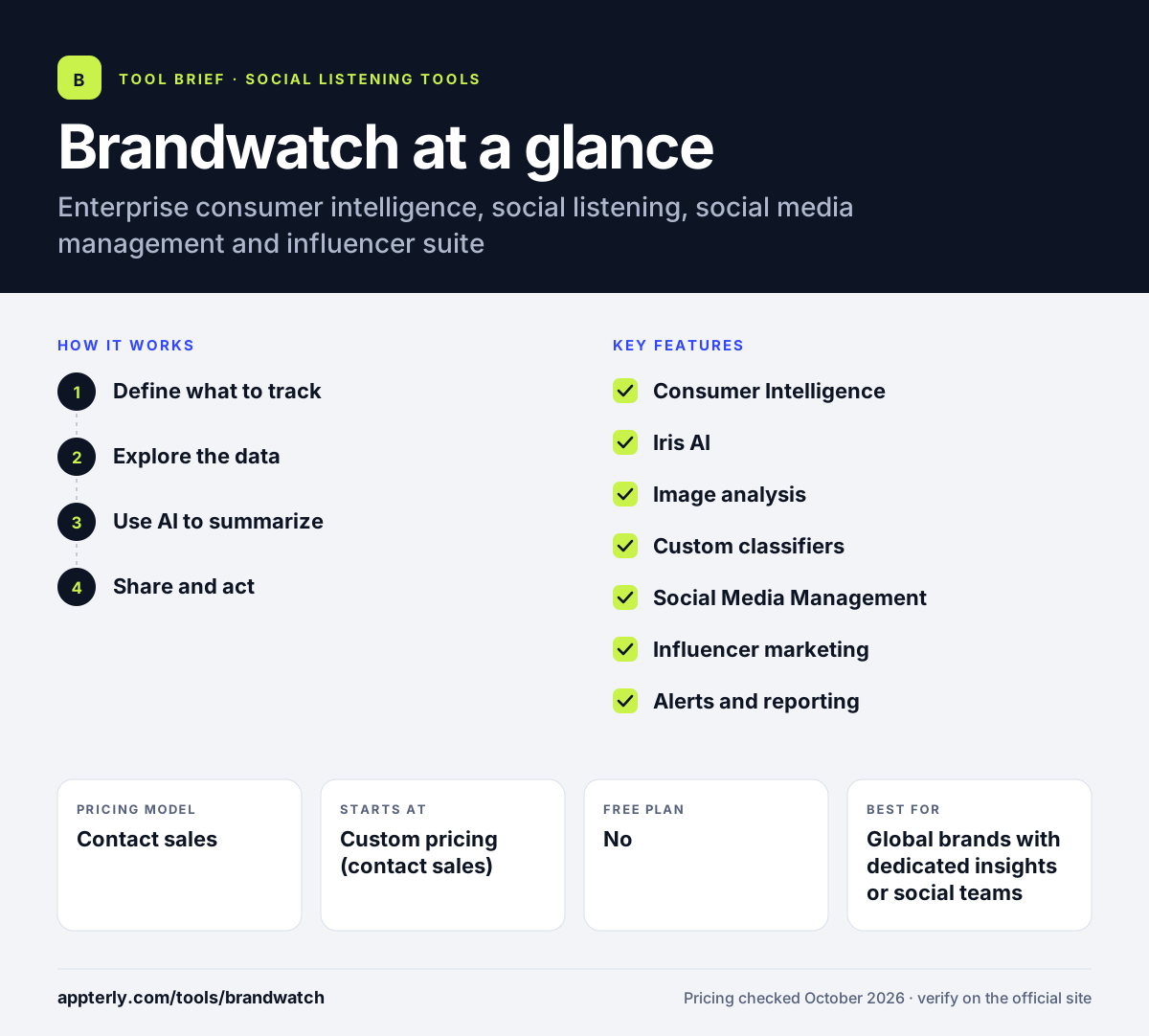
How does Brandwatch work?
- Define what to track
Set up searches for brands, competitors, products or themes. Custom classifiers let you sort conversations into categories that fit your business.
- Explore the data
Brandwatch pulls matching posts from its archive and live sources. You can filter by time, source, location, sentiment and topic, and analyze images as well as text.
- Use AI to summarize
Iris, the built-in AI assistant, condenses large result sets into readable insights so you can see the main drivers of a trend quickly.
- Share and act
Build dashboards, schedule reports and set alerts for stakeholders. Social teams can then respond and publish from the Social Media Management product.
Brandwatch key features
Consumer Intelligence
Search an archive of more than 1.4 trillion posts going back to 2008, with hundreds of millions of new posts added each day.
Iris AI
A generative AI assistant that summarizes data and points out notable patterns in plain language.
Image analysis
Deep learning models detect logos and visual content in images, so you catch brand appearances that text search would miss.
Custom classifiers
Train categories that match your own taxonomy, such as product lines or complaint types, and apply them automatically.
Social Media Management
A shared calendar, publishing for organic and paid posts, a social inbox and competitor benchmarking, based on the former Falcon suite.
Influencer marketing
Find creators in a database of over 30 million profiles, manage relationships and report on campaigns.
Alerts and reporting
Proactive alerts flag spikes, and automated reports keep stakeholders updated without manual exports.
Why use Brandwatch?
- Deep historical data lets you study trends over many years, not just recent weeks.
- One vendor covers listening, publishing and influencer work, which reduces tool sprawl.
- Image recognition finds brand mentions that do not include your name in the text.
- AI summaries help analysts share findings with non-technical teams.
- First-party data can be uploaded and analyzed next to public online data.
Who is Brandwatch best for?
A good fit for
- Global brands with dedicated insights or social teams
- Agencies running research for large clients
- Market researchers studying consumer trends over time
- Enterprises wanting listening and social management from one vendor
Less suited to
- Small businesses that need low-cost, self-serve monitoring
- Teams that want to start without a sales process or demo
- Users who need only simple brand alerts
Brandwatch pricing
| Pricing model | Contact sales |
|---|---|
| Free plan | No |
| Free trial | Not confirmed |
| Starting price | Custom pricing (contact sales) |
Brandwatch does not publish prices. Each product has plans from standard to enterprise, and a quote is given after a demo based on the products and scale you need.
Prices checked October 2026. Vendors change plans often, so confirm on the official Brandwatch pricing page before you buy.
Brandwatch pros and cons
Pros
- Very large historical archive dating back to 2008
- Strong analysis tools, including image recognition and custom classifiers
- Covers listening, social management and influencer work in one suite
Cons
- No public pricing and no self-serve trial
- Depth of features means a learning curve for new users
- Likely more than small teams need or can afford
Brandwatch integrations and platforms
Available on
Brandwatch alternatives
See the full shortlist in Best Social Listening Tools.
Brandwatch FAQ
Is Brandwatch free?
No. Brandwatch does not offer a free plan or a self-serve trial. You request a free demo, and the sales team builds a custom quote based on which products you need, such as Consumer Intelligence, Social Media Management or Influencer Marketing, and the scale of your use. It is priced for enterprise and agency budgets rather than individual users.
What is Brandwatch used for?
Brandwatch is used for social listening and consumer research. Brands track what people say about them and their competitors, study trends over long periods and measure campaign reaction. Its other products handle publishing and engagement on social channels and influencer discovery and campaign management, so some companies use it as their main social platform.
Who owns Brandwatch?
Brandwatch is a Cision company. Over time it has also absorbed other products: Falcon.io became the base of its Social Media Management product, and Paladin, acquired in March 2022, became part of its influencer offering. The listening product formerly known as Consumer Research is now called Consumer Intelligence.
Brandwatch vs Talkwalker: what's the difference?
Both are enterprise social listening platforms with AI features and image recognition. Brandwatch stands out for its long historical archive back to 2008 and for bundling social media management and influencer tools. Talkwalker, now part of Hootsuite and marketed as Lumen by Talkwalker, focuses on listening and media monitoring with tiered plans that connect closely to Hootsuite.
Is Brandwatch good for beginners?
Brandwatch can be used by beginners for basic searches and dashboards, but it is built for analysts and large teams. Getting the most from it, such as custom classifiers and detailed queries, takes training. New users usually rely on onboarding from the vendor. Small teams looking for simple brand alerts may find lighter tools easier.
Sources
This overview is based on Brandwatch's official website and documentation, checked October 2026.