What is Contentful?
Contentful is a composable content platform that lets teams create structured content once and deliver it through APIs to websites, apps and other digital channels. Instead of building pages in a single website theme, editors fill in reusable content types, and developers pull that content into any front end. Updating one component updates it everywhere it appears, across brands, regions and languages.
Contentful sits in the headless CMS category and is aimed at companies running many digital properties. On top of core content management it offers Studio for visually assembling experiences, Personalization for audience-specific content and testing, and AI Actions for automating tasks such as translation and content generation. A free plan suits small projects, while the Lite and Enterprise tiers add users, locales, workflows and higher API limits. Contentful now says it is part of Salesforce.
Contentful at a glance
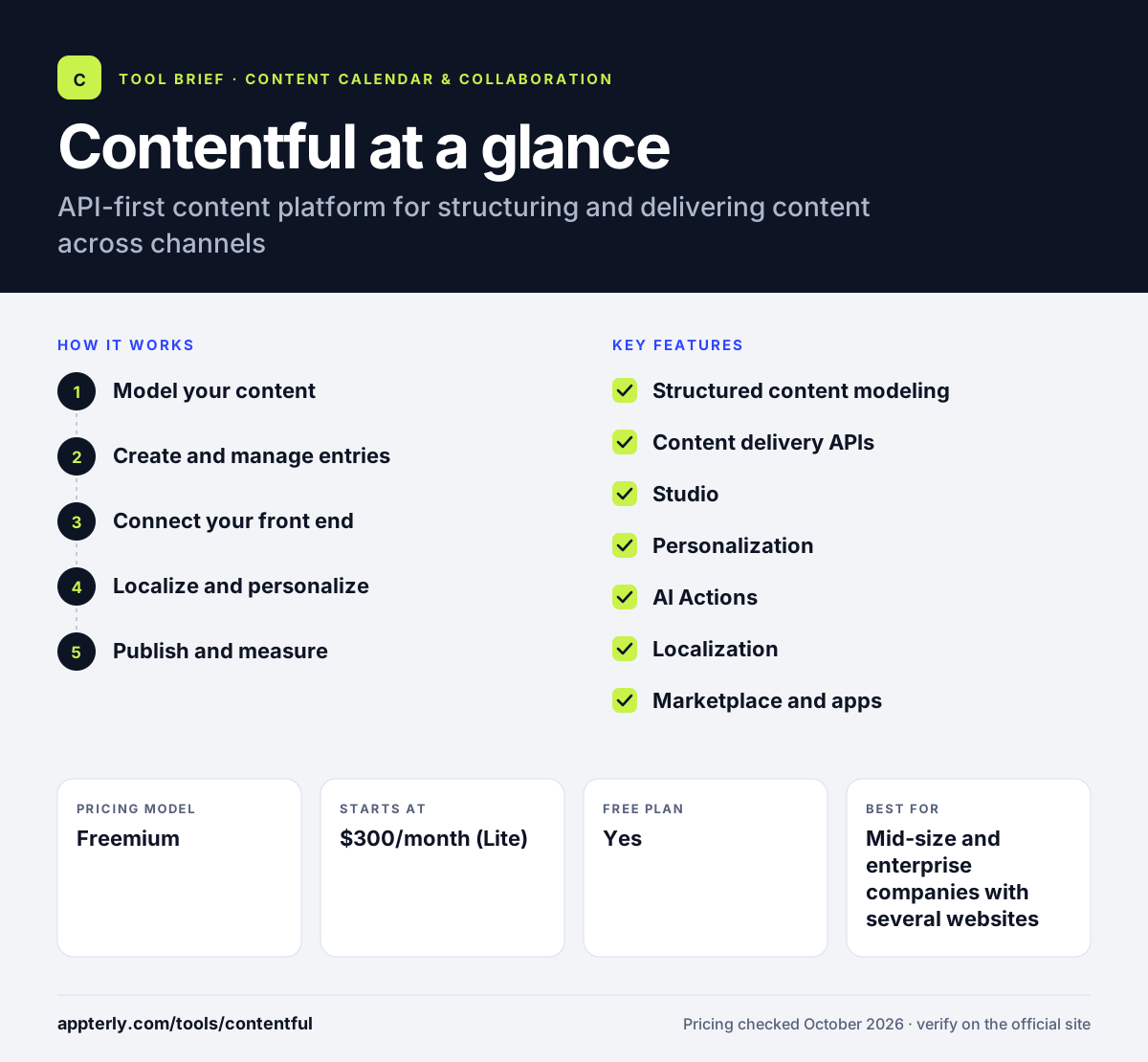
How does Contentful work?
- Model your content
Define content types, such as blog post, product or landing page section, with the fields each one needs.
- Create and manage entries
Editors write and organize content in the web app, add media assets and collaborate with comments and tasks on paid plans.
- Connect your front end
Developers fetch content through Contentful's APIs and render it in a website, mobile app or other channel.
- Localize and personalize
Add locales for each market, use AI-assisted translation, and serve tailored variants with the Personalization add-on.
- Publish and measure
Schedule releases, push updates everywhere at once, and review component-level results with content insights.
Contentful key features
Structured content modeling
Reusable content types and components keep content consistent and easy to reuse across channels.
Content delivery APIs
Flexible APIs let developers use any framework and deliver content quickly through a CDN. Content stays available through APIs even as front ends change.
Studio
A visual tool for assembling pages and experiences from existing components without heavy developer help.
Personalization
An Enterprise add-on for building audience-specific experiences with no-code tools and built-in experimentation.
AI Actions
AI automations handle repeat content jobs like generating drafts and translating within brand guidelines.
Localization
Multiple locales per space, from two on Free to custom counts on Enterprise, support global sites.
Marketplace and apps
Apps and integrations extend the editor and connect Contentful to ecommerce, AI and other tools.
Why use Contentful?
- One content source can feed websites, apps and other channels, which cuts duplicate work.
- Developers are free to choose their own front-end framework.
- Reusable components keep messaging consistent across brands and regions.
- A free plan lets teams build and test a project before paying.
- Enterprise options add uptime guarantees, dedicated support and unlimited spaces.
Who is Contentful best for?
A good fit for
- Mid-size and enterprise companies with several websites or apps
- Development teams building custom front ends
- Global brands managing content in many languages
- Ecommerce teams delivering product content across channels
Less suited to
- Small businesses that want a simple website builder with themes
- Teams without developer support to build and maintain the front end
- Tight budgets, since the first paid plan is $300 per month
Contentful pricing
| Pricing model | Freemium |
|---|---|
| Free plan | Yes |
| Free trial | Not confirmed |
| Starting price | $300/month (Lite) |
Free includes 10 users, 2 locales and 100K API calls per month with hard caps. Lite raises limits and allows paid overages, while Enterprise is custom priced with unlimited API calls, spaces and add-ons like Personalization.
Prices checked October 2026. Vendors change plans often, so confirm on the official Contentful pricing page before you buy.
Contentful pros and cons
Pros
- Strong content modeling and reuse
- Developer-friendly APIs
- Solid localization support
- Usable free plan for small projects
Cons
- Big price jump from Free to Lite
- Requires developers to build the presentation layer
- Advanced features like Personalization are Enterprise add-ons
Contentful integrations and platforms
Works with
Available on
Contentful alternatives
See the full shortlist in Best Content Calendar Tools.
Contentful FAQ
Is Contentful free?
Yes. Contentful has a free plan with up to 10 users, two roles, two locales, one starter space, 100,000 API calls and 50GB of CDN bandwidth per month. Limits are hard caps with no overages. The paid Lite plan starts at $300 per month, and Enterprise pricing is custom.
What is Contentful used for?
Contentful is used to manage structured content and deliver it through APIs to websites, mobile apps and other digital channels. Companies use it to run multiple sites from one content source, localize content for different markets and reuse the same components across brands, often alongside a custom-built front end.
Is Contentful a headless CMS?
Yes. Contentful separates content management from presentation, which is the defining trait of a headless CMS. Editors manage content in Contentful, and developers display it with any framework through APIs. The company now positions itself more broadly as a composable digital experience platform with Studio and Personalization. This model is sometimes called composable architecture.
Contentful vs WordPress: what's the difference?
WordPress is a traditional CMS where content and website themes live together, which makes it quick for simple sites. Contentful is headless, so content is stored separately and delivered by API to any front end. Contentful suits multi-channel and enterprise projects, while WordPress suits standard websites and blogs. Some teams use both, pairing a headless back end with a separate front end.
Is Contentful good for small businesses?
Usually not as a first choice. Contentful's free plan works for small projects, but it needs developers to build the website, and the first paid plan costs $300 per month. Small businesses that want a ready-made site are often better served by a traditional CMS or website builder. Growing companies with in-house developers, however, may find the free plan a good place to prototype.
Sources
This overview is based on Contentful's official website and documentation, checked October 2026.