What is Canto?
Canto is a digital asset management (DAM) platform that gives organizations one central, secure library for photos, videos, documents and other brand content. It focuses on making files easy to find through AI Visual Search and an AI Library Assistant, and easy to share through unlimited portals and style guides. Every plan includes unlimited end users, which makes it practical to open the library to a whole company.
Beyond the core library, Canto offers add-on suites. The Brand Suite adds Approval Hub for proofing, Brand Studio for AI-powered templates and tools for external distribution. The Retail Suite adds a Product Hub, retailer catalogs and Amazon and Shopify connections. Canto's Global Assistant lets users search, fill metadata, run bulk edits and build portals by typing plain requests. The company also provides API access and implementation support.
Canto at a glance
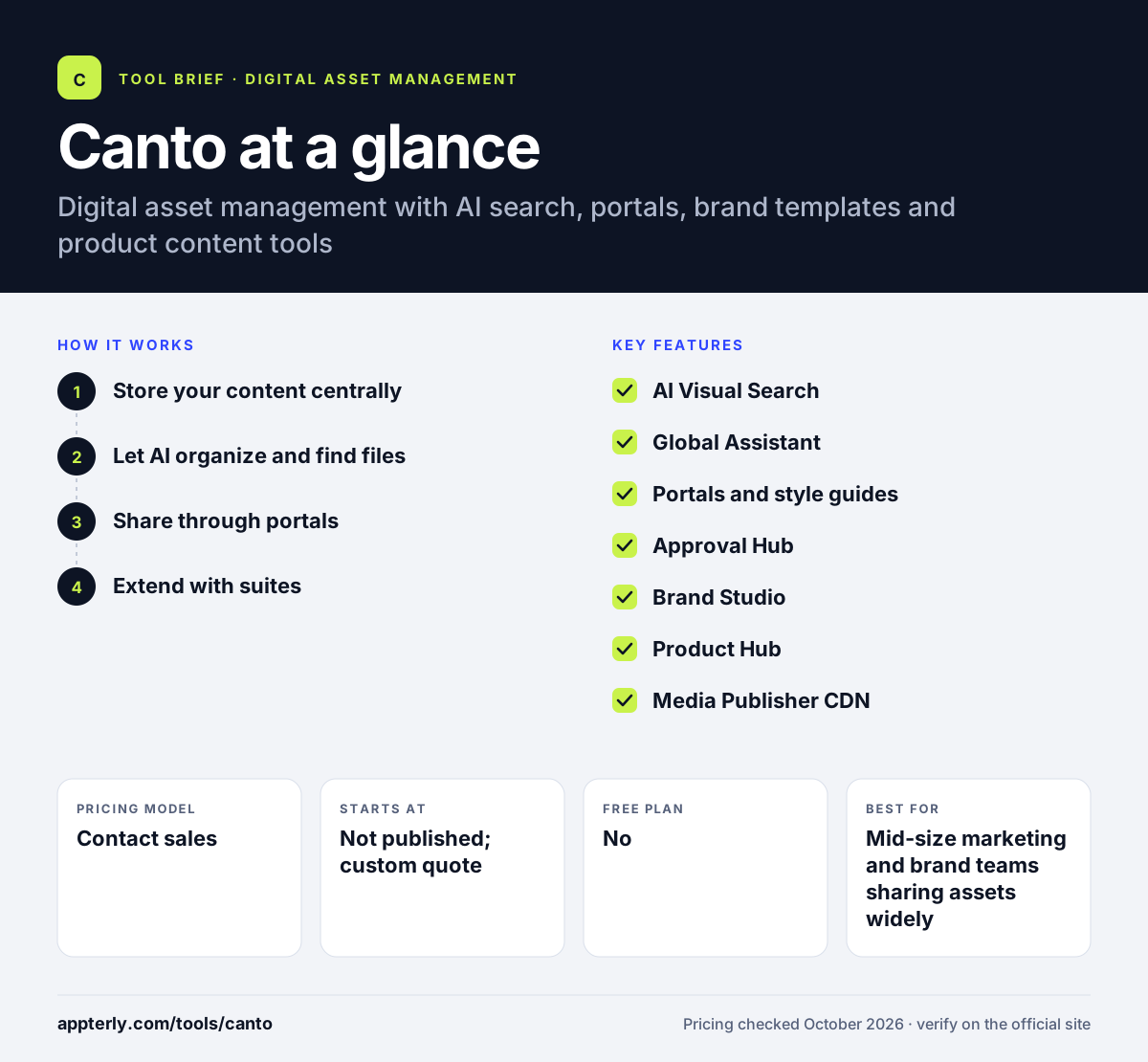
How does Canto work?
- Store your content centrally
Upload assets to the Canto library, or capture them automatically through FTP Direct Capture, and set rights and expiration controls.
- Let AI organize and find files
AI Visual Search and the AI Library Assistant help tag content and find assets by description instead of exact keywords.
- Share through portals
Create branded portals and style guides so partners, agencies and staff can access approved assets on their own.
- Extend with suites
Add the Brand Suite for approvals and templates, or the Retail Suite for product content and storefront integrations.
Canto key features
AI Visual Search
Find images and videos by describing what is in them rather than relying on manual tags.
Global Assistant
An AI assistant that searches, fills in metadata, handles bulk edits and can build portals from plain-language requests.
Portals and style guides
Unlimited branded portals and style guides give external and internal users self-serve access to approved content.
Approval Hub
Proofing and approval tools in the Brand Suite keep reviews and sign-offs in one place.
Brand Studio
AI-powered templates let non-designers create on-brand materials from approved assets.
Product Hub
The Retail Suite links product information with assets and supports Amazon and Shopify publishing.
Media Publisher CDN
DAM Pro adds CDN delivery and video embedding so assets can be published straight to websites.
Rights and expiration controls
Digital rights settings and expiration dates help prevent expired or unlicensed assets from being used.
Why use Canto?
- Unlimited end users on every plan keep costs predictable as access grows.
- AI search reduces time spent looking for the right file.
- Portals let partners help themselves instead of emailing for assets.
- Rights and expiration controls lower the risk of using expired content.
- Broad integrations with Adobe, Microsoft and marketing tools fit existing workflows.
Who is Canto best for?
A good fit for
- Mid-size marketing and brand teams sharing assets widely
- Retailers and manufacturers managing product imagery
- Organizations that want to give many users access without per-seat fees
- Teams working heavily in Adobe Creative Cloud and Microsoft 365
Less suited to
- Freelancers who want a low monthly self-serve plan
- Buyers who need published prices before speaking with sales
- Teams that only need basic cloud file storage
Canto pricing
| Pricing model | Contact sales |
|---|---|
| Free plan | No |
| Free trial | Free trial available (length not stated) |
| Starting price | Not published; custom quote |
Plans run from DAM Essentials to DAM Plus and DAM Pro, with Retail and Brand Suites built on Pro. Pricing scales with team size and storage, and higher tiers add the Global Assistant, SSO, API access, CDN delivery and dedicated success support.
Prices checked October 2026. Vendors change plans often, so confirm on the official Canto pricing page before you buy.
Canto pros and cons
Pros
- Unlimited end users on all plans
- Strong AI search and assistant features
- Large catalog of Adobe, Microsoft and marketing integrations
- Retail-focused suite for product content
Cons
- No published prices
- Key features such as SSO and API access start above the entry tier
- No Android app listed
Canto integrations and platforms
Works with
Available on
Canto alternatives
See the full shortlist in Best Digital Asset Management Software.
Canto FAQ
How much does Canto cost?
Canto does not publish prices. Its pricing page lists DAM Essentials, DAM Plus, DAM Pro and two suites built on Pro, and each one asks you to request pricing. Canto says cost scales with team size and storage, and it prepares a custom quote for each customer. Higher tiers add AI portals, SSO, API access and CDN delivery.
Does Canto have a free trial?
Yes. Canto's pricing page links to a free trial sign-up, though it does not state how long the trial lasts. There is no free plan. Most buyers combine the trial with a demo so they can test AI search, portals and integrations against their own files.
What is Canto used for?
Canto is used to store, organize, find and share brand and marketing assets from one secure library. Teams use its portals to give partners self-serve access, its rights controls to manage licensing, and its add-on suites for approvals, branded templates and product content for retail channels such as Amazon and Shopify. It also helps product teams keep imagery aligned with product data across retail channels.
Canto vs Bynder: what's the difference?
Both are established DAM platforms with AI search and branded portals. Canto includes unlimited end users on every plan and offers a dedicated Retail Suite for product content. Bynder sells a modular enterprise suite with Studio, workflow modules and AI compliance agents. Both price by custom quote.
Does Canto integrate with Adobe Creative Cloud?
Yes. Canto lists integrations with Photoshop, Illustrator, InDesign, Lightroom, Premiere Pro, After Effects and Adobe Workfront. It also connects with Microsoft 365 apps, Slack, Figma, Canva, HubSpot, WordPress and Shopify, and offers Canto Connect desktop apps for Mac and Windows.
Sources
This overview is based on Canto's official website and documentation, checked October 2026.