What is Bynder?
Bynder is an enterprise digital asset management (DAM) platform that helps large brands create, manage and distribute content at scale. At its core is a central library with AI-powered search, duplicate detection, face recognition, OCR and speech-to-text search. Around that core, Bynder sells modules for content creation, review workflows, analytics and content delivery, so companies can build a package that fits how their teams work.
The platform leans heavily on AI. Bynder offers AI agents for brand compliance, metadata enrichment, asset transformation and governance, which check content against brand guidelines and regulations before it goes out. It connects with a wide range of marketing, commerce and product tools, including Salesforce, Shopify, Figma, Canva and Contentful. Bynder is aimed at mid-market and enterprise organizations rather than small businesses or freelancers.
Bynder at a glance
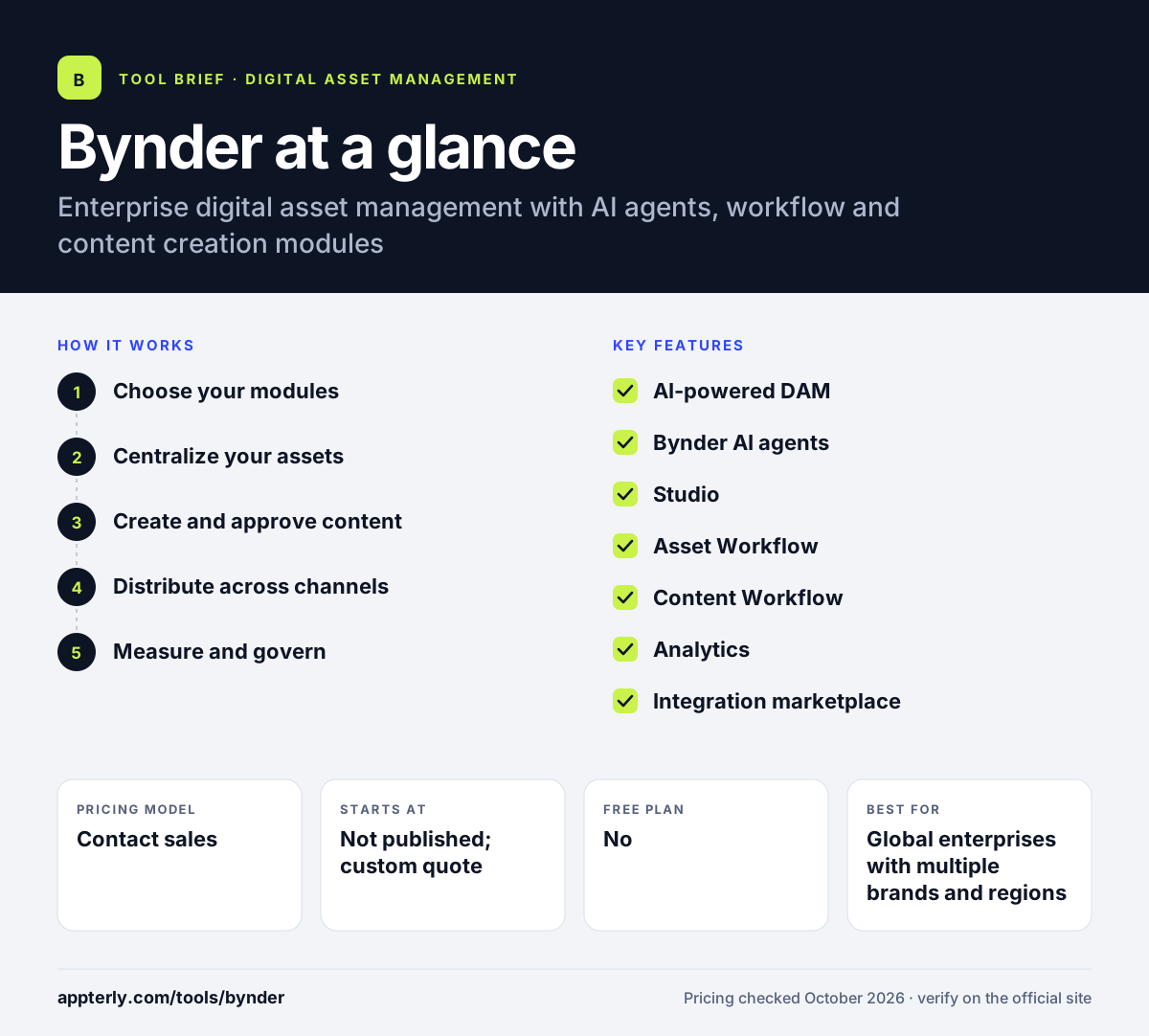
How does Bynder work?
- Choose your modules
Work with Bynder's sales team to build a package around the core DAM, adding modules such as Studio, Asset Workflow, Content Workflow or Analytics.
- Centralize your assets
Migrate files into the DAM, where AI enrichment adds metadata and powers search by visual content, text and speech.
- Create and approve content
Brief, review and approve assets in Asset Workflow, or produce on-brand variations at scale with Studio and brand templates.
- Distribute across channels
Push approved assets to connected systems such as your CMS, ecommerce platform or PIM through the integration marketplace.
- Measure and govern
Use Analytics to see how assets perform and AI agents to keep content compliant with brand and legal rules.
Bynder key features
AI-powered DAM
A central library with AI search, duplicate detection, face recognition, OCR and speech-to-text so files are easy to find.
Bynder AI agents
Agents for brand compliance, enrichment, transformation and governance automate checks and repetitive library tasks.
Studio
Creates on-brand content variations at scale using AI and automation, with print brand templates available as well.
Asset Workflow
Handles briefing, review and approval of creative assets in one place before they enter the library.
Content Workflow
Manages the creation, review and approval of editorial content such as copy and articles.
Analytics
Shows how assets are used and performing so teams can make better content decisions.
Integration marketplace
Connects to tools such as Salesforce, Shopify, Figma, Canva, Contentful, WordPress, Akeneo and Slack.
Content Experiences
CX modules for user communities and omnichannel delivery help publish approved content to audiences and channels.
Why use Bynder?
- It scales to very large libraries and many brands, regions and teams.
- Modular packaging means you pay for the capabilities you actually need.
- AI agents help enforce brand and regulatory rules before content is published.
- A broad integration catalog reduces manual file transfers between systems.
- Security and compliance credentials, including SOC 2 and ISO standards, suit regulated industries.
Who is Bynder best for?
A good fit for
- Global enterprises with multiple brands and regions
- Retail and consumer brands managing product and campaign content
- Marketing operations teams that need governed workflows
- Organizations in regulated industries that need compliance checks
Less suited to
- Small businesses and freelancers with modest budgets
- Teams that want a self-serve sign-up or published prices
- Buyers who need a quick, lightweight setup
Bynder pricing
| Pricing model | Contact sales |
|---|---|
| Free plan | No |
| Free trial | Not confirmed |
| Starting price | Not published; custom quote |
Bynder builds custom packages around its core DAM. Price depends on users, storage, ecosystem usage, the modules you add and the support level you choose.
Prices checked October 2026. Vendors change plans often, so confirm on the official Bynder pricing page before you buy.
Bynder pros and cons
Pros
- Deep AI features for search, enrichment and compliance
- Modular suite covers creation, workflow and distribution
- Large integration marketplace
- Strong security and compliance certifications
Cons
- No public pricing, free plan or free trial
- Setup and migration can be a sizable project
- Likely too much for small teams
Bynder integrations and platforms
Works with
Available on
Bynder alternatives
See the full shortlist in Best Digital Asset Management Software.
Bynder FAQ
How much does Bynder cost?
Bynder does not publish prices. It builds custom packages, and the cost depends on the number of users, storage, how widely the platform is used across your marketing systems, which modules you add and the support level. To get a figure, you need to request a quote or book a demo with Bynder's sales team.
Is Bynder free?
No. Bynder does not offer a free plan, and its pricing page does not mention a free trial. Instead, it offers a free consultation and a product demo. Bynder is built for mid-market and enterprise organizations, so most buyers go through a sales process before getting access. Many buyers start with the DAM and add workflow or Studio modules later.
What is Bynder used for?
Bynder is used to store, organize and distribute brand content such as images, videos and documents from one central library. Larger teams also use it to brief and approve creative work, produce on-brand variations with Studio, manage editorial approvals, track asset performance and check content against brand and legal rules with AI agents.
Bynder vs Brandfolder: what's the difference?
Both are enterprise DAM platforms that rely on AI tagging and controlled sharing. Bynder offers a broader modular suite, including Studio for content creation, separate asset and content workflows, and AI compliance agents. Brandfolder is known for asset analytics and its tie-in with Smartsheet. Both price by quote.
Does Bynder integrate with Shopify?
Yes. Bynder lists Shopify among its integrations, along with other commerce and product tools such as Salsify, Akeneo and inRiver. These connections let teams publish approved product images and videos to their store without downloading and re-uploading files by hand.
Sources
This overview is based on Bynder's official website and documentation, checked October 2026.