What is Acquia DAM?
Acquia DAM is an enterprise digital asset management platform that stores, organizes and distributes images, videos, documents and other brand files from one central library. Built on Widen technology, it uses AI to tag assets, write alt text and find files with natural language search. Rights, expiration dates and usage rules travel with each asset, so teams know what they can use and where.
Acquia DAM is aimed at marketing, creative and ecommerce teams in larger organizations. Portals and microsites share approved assets with partners and regional teams, workflows handle creation, review and release, and Product Catalogs tie specs and attributes to product images. Templates help local teams create on-brand materials, and Video Creator uses AI to edit and translate videos. Pricing is custom and quoted after a demo.
Acquia DAM is usually bought by organizations that manage thousands of assets across many teams, brands or regions. Acquia lists a large integration library with pre-built connectors and marketplace connectors, plus an open REST API. Security, analytics through Insights and publishing with usage tracking round out the platform for teams that need to prove how assets are used.
Acquia DAM at a glance
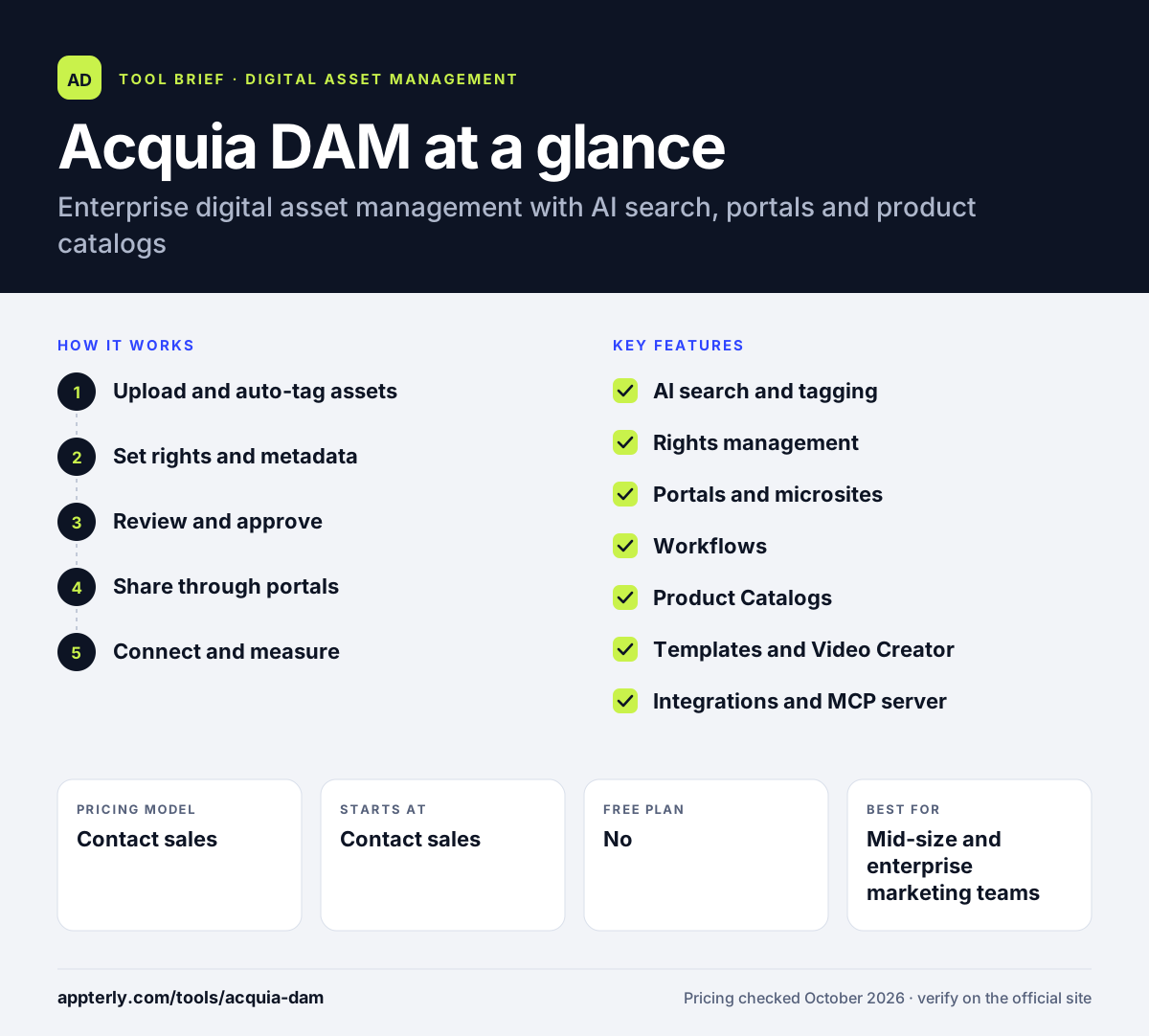
How does Acquia DAM work?
- Upload and auto-tag assets
Add files to the library, where AI applies tags, alt text and duplicate detection at upload.
- Set rights and metadata
Attach usage rights, expiration dates and product data so every asset carries its rules.
- Review and approve
Run assets through workflows that cover creation, feedback and approval before release.
- Share through portals
Publish approved assets to portals and microsites for partners, agencies and regional teams.
- Connect and measure
Push assets to your CMS, ecommerce and design tools through integrations, then track usage with Insights.
Acquia DAM key features
AI search and tagging
Natural language search finds assets by intent, and auto-tagging and alt text reduce manual metadata work.
Rights management
Usage rules and expiration dates stay attached to assets to lower compliance risk.
Portals and microsites
Branded portals auto-fill with the latest approved files for external and internal audiences.
Workflows
Built-in review and approval steps manage the asset lifecycle from request to release.
Product Catalogs
Link product specs, attributes and licensing to the images and files used in ecommerce.
Templates and Video Creator
Templates help teams localize on-brand materials, and Video Creator uses AI to create, edit and translate videos.
Integrations and MCP server
Pre-built connectors, an open REST API and an MCP server link the library to creative, marketing and AI tools.
Why use Acquia DAM?
- A single source of truth reduces lost files and off-brand usage.
- AI tagging and search save time on metadata and finding assets.
- Rights tracking helps avoid using expired or unlicensed content.
- Portals make sharing with partners and agencies simple.
- Integrations with Adobe Creative Cloud, Drupal, Shopify and Salesforce fit common marketing stacks.
Who is Acquia DAM best for?
A good fit for
- Mid-size and enterprise marketing teams
- Brands with many partners, dealers or regional teams
- Ecommerce teams managing product imagery
- Organizations already using Drupal or Acquia products
Less suited to
- Small businesses that only need cloud file storage
- Buyers who want transparent, self-serve pricing
- Teams wanting a free plan to start
Acquia DAM pricing
| Pricing model | Contact sales |
|---|---|
| Free plan | No |
| Free trial | Not confirmed |
| Starting price | Contact sales |
Acquia quotes custom pricing based on organization size, number of users, storage and feature needs. Some features, such as Entries, are sold as add-ons.
Prices checked October 2026. Vendors change plans often, so confirm on the official website before you buy.
Acquia DAM pros and cons
Pros
- Strong AI search and auto-tagging
- Built-in rights and expiration management
- Flexible portals for sharing
- Large integration library
Cons
- No public pricing
- Built for larger teams, so it may be too much for small businesses
- Some capabilities are add-ons
Acquia DAM integrations and platforms
Works with
Available on
Acquia DAM alternatives
See the full shortlist in Best Digital Asset Management Software.
Acquia DAM FAQ
What is Acquia DAM?
Acquia DAM is a digital asset management platform from Acquia that stores and organizes brand files such as images, videos and documents. It uses AI for search, tagging and alt text, tracks usage rights and expiration, and shares approved assets through portals. It is built on Widen technology.
Is Acquia DAM the same as Widen?
Acquia DAM is built on Widen technology, and Acquia still refers to the product as Acquia DAM (Widen). The core library, metadata and portal features come from that foundation, and Acquia has extended it with AI search, Video Creator, an MCP server and connections to other Acquia products such as Drupal.
How much does Acquia DAM cost?
Acquia does not publish prices for Acquia DAM. Pricing is custom and depends on organization size, number of users, storage and the features you need. You can request a demo and quote from Acquia. Some capabilities, such as Entries, are sold as add-ons on top of the base platform. Request a personalized demo to see the platform with your own use cases.
Acquia DAM vs Bynder: what's the difference?
Both are enterprise DAM platforms with AI tagging, portals and brand management. Acquia DAM stands out for rights management, Product Catalogs and close ties to Drupal and other Acquia products. Bynder is a standalone DAM vendor. Buyers usually compare integrations, workflow needs and pricing quotes.
Does Acquia DAM integrate with Adobe Creative Cloud?
Yes. Acquia DAM lists Adobe Creative Cloud among its pre-built integrations, along with Drupal, Shopify, Salesforce and Workfront. It also offers an open REST API and marketplace connectors, so teams can connect it to design, marketing and ecommerce systems. An MCP server can also connect the asset library to the AI assistant your team uses.
Sources
This overview is based on Acquia DAM's official website and documentation, checked October 2026.