What is Salesforce?
Salesforce is a cloud-based customer relationship management (CRM) platform that helps companies track leads, manage deals, support customers and run marketing from one shared customer record. It is sold as a set of connected products, often called clouds. Sales Cloud handles pipeline and forecasting, Service Cloud covers support, and Marketing Cloud and Commerce Cloud extend the same data into campaigns and online stores.
The current product is built around Agentforce, a layer of AI agents that can work alongside sales reps and service staff inside the CRM. Data 360 unifies customer data from different sources, and Slack connects conversations to records. Small businesses can start with the Starter or Pro suites, while larger companies buy individual editions that can be heavily customized with apps from the AppExchange marketplace.
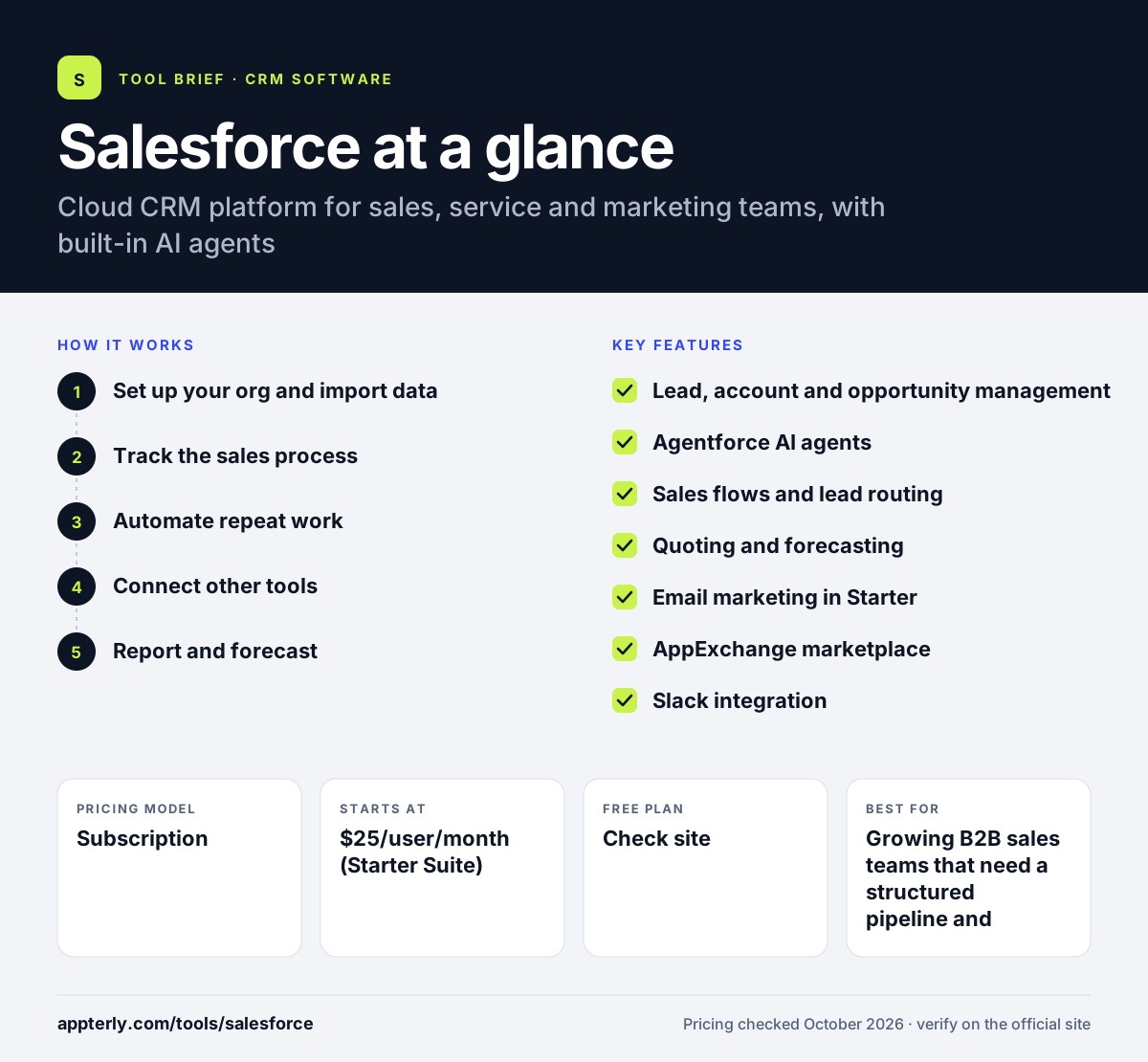
Salesforce at a glance
How does Salesforce work?
- Set up your org and import data
Create your Salesforce account, then import leads, contacts and accounts from spreadsheets or another CRM. Fields and page layouts can be adjusted to match how your team sells.
- Track the sales process
Reps log activities, convert leads into opportunities and move deals through pipeline stages. Lead routing assigns new prospects to the right person automatically.
- Automate repeat work
Build flows that send follow-ups, update records or trigger approvals. Agentforce AI agents can take on tasks such as drafting outreach or answering routine questions.
- Connect other tools
Link email, calendar, Slack and apps from the AppExchange, or use MuleSoft and the APIs for deeper integrations with internal systems.
- Report and forecast
Use dashboards and reports to watch pipeline health, win rates and team performance, and forecast revenue on higher plans.
Salesforce key features
Lead, account and opportunity management
A shared record for every prospect and customer, with activity history, deal stages and ownership in one place.
Agentforce AI agents
AI agents that work inside the CRM to help sellers and service teams with research, outreach and routine customer requests.
Sales flows and lead routing
Built-in automation that assigns leads and moves records through standard sales steps without manual updates.
Quoting and forecasting
Available from the Pro Suite upward, these tools help reps build quotes and give managers a view of expected revenue.
Email marketing in Starter
The Starter Suite includes basic email campaigns with analytics, so small teams can send marketing emails from the same CRM.
AppExchange marketplace
A large catalog of add-on apps and components that extend Salesforce for specific industries and workflows.
Slack integration
Conversations in Slack can be tied to CRM records so teams can discuss deals and cases where they already work.
Trailhead learning
A free online learning platform with guided lessons on using and administering Salesforce.
Why use Salesforce?
- Salesforce keeps sales, service and marketing data on one customer record, so teams stop working from separate spreadsheets.
- It scales from a small team on the Starter Suite to large enterprises with custom objects and complex permissions.
- The AppExchange and APIs make it possible to connect almost any business system.
- Agentforce brings AI agents directly into daily CRM work instead of a separate tool.
- Trailhead and a large partner network make it easier to find training and implementation help.
Who is Salesforce best for?
A good fit for
- Growing B2B sales teams that need a structured pipeline and forecasting
- Midsize and large companies that want one platform for sales, service and marketing
- Organizations with admins or partners who can customize the system
- Small businesses that want to start simple and grow into a larger CRM
Less suited to
- Solo freelancers who only need a simple contact list
- Teams without time or budget for setup, training or a Salesforce admin
- Buyers who want every price listed upfront without talking to sales
Salesforce pricing
| Pricing model | Subscription |
|---|---|
| Free plan | Not confirmed |
| Free trial | 30 days (Starter Suite) |
| Starting price | $25/user/month (Starter Suite) |
Starter can be paid monthly or annually, while Pro Suite costs $100/user/month on an annual contract and adds quoting, forecasting and more automation. Larger editions and add-ons such as Agentforce are priced separately and generally billed annually.
Prices checked October 2026. Vendors change plans often, so confirm on the official Salesforce pricing page before you buy.
Salesforce pros and cons
Pros
- Very deep CRM features that scale to large organizations
- Huge ecosystem of apps, partners and training resources
- AI agents built into the core CRM
- Low entry price for the Starter Suite
Cons
- Costs rise quickly as you add editions, users and add-ons
- Setup and customization often need an admin or consultant
- Many advanced features require annual contracts
Salesforce integrations and platforms
Works with
Available on
Salesforce alternatives
See the full shortlist in Best CRM Software.
Salesforce FAQ
Is Salesforce free?
Salesforce is a paid CRM. It offers a free 30-day trial of the Starter Suite with no credit card required. After the trial, Starter costs $25 per user per month and can be billed monthly or annually. Pro Suite and the larger editions cost more and usually require an annual contract.
What is Salesforce used for?
Salesforce is used to manage customer relationships. Sales teams use it to track leads, deals and forecasts, support teams use Service Cloud to handle cases, and marketers use Marketing Cloud to run campaigns. Because all of these share one customer record, companies get a fuller view of each customer across departments.
Is Salesforce good for small businesses?
Yes, Salesforce offers Starter and Pro suites aimed at small businesses. Starter bundles lead and opportunity management, basic email marketing and sales flows at a lower price. Small teams should still expect a learning curve, because the platform has many settings and options compared with lightweight CRMs.
Salesforce vs HubSpot: what's the difference?
Both are full CRM platforms with sales, service and marketing tools. Salesforce is known for deep customization and enterprise scale, with a large app marketplace. HubSpot is often seen as easier to set up and offers a free CRM tier. Teams with complex processes often lean toward Salesforce, while smaller teams may find HubSpot quicker to adopt.
Does Salesforce have a mobile app?
Yes. Salesforce offers mobile access to the CRM, so reps can view and update records, log activities and check dashboards from a phone or tablet. Because the platform is cloud-based, the same data is available on desktop browsers and mobile devices without separate syncing.
Sources
This overview is based on Salesforce's official website and documentation, checked October 2026.