What is Attio?
Attio is a customer relationship management platform for revenue teams that lets you shape the data model around your business instead of fitting into fixed records. It syncs email and calendar activity, enriches companies and people automatically, and adds AI agents that can research accounts, answer questions about your data and handle follow-up work. Startups, venture firms and fast-growing B2B companies often use it as a modern alternative to older CRMs.
The product is organized around objects, records and lists, so you can track deals, investors, partners or anything else with custom attributes. On top of that sit workflows, outreach sequences, call intelligence and real-time reporting. Attio offers a free plan for up to three seats, and paid plans add more objects, records, reports, emails and permission controls as a team grows.
Attio at a glance
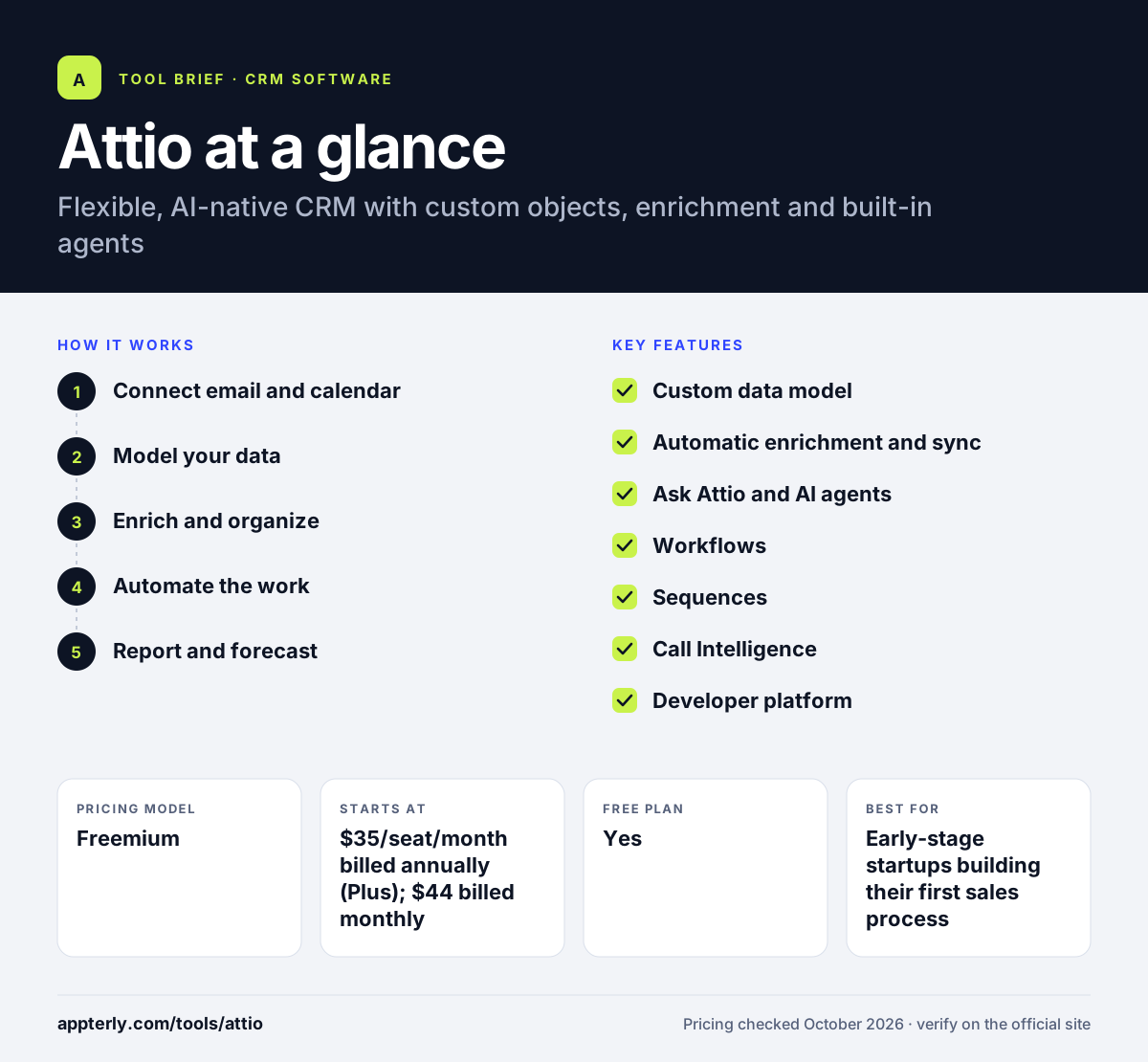
How does Attio work?
- Connect email and calendar
Link Gmail or Outlook so Attio builds contact and company records from your existing communication.
- Model your data
Use standard objects or create custom ones, add attributes and set up lists or pipelines for deals and other processes.
- Enrich and organize
Let automatic enrichment fill in company and people details, then filter and segment records in table or kanban views.
- Automate the work
Build workflows for routing and updates, enroll contacts in sequences and use AI agents for research and follow-up.
- Report and forecast
Track pipeline and team activity with real-time reports and forecasts.
Attio key features
Custom data model
Create custom objects and attributes so the CRM matches how your team actually sells or raises money.
Automatic enrichment and sync
Contacts and companies update in real time from email, calendar and enrichment data.
Ask Attio and AI agents
Query records in plain language, draft content and run custom or web research agents.
Workflows
Visual automations handle conditional routing, record updates and sequence enrollment.
Sequences
Multi-step email outreach runs from inside the CRM on the Pro plan.
Call Intelligence
Records and analyzes meetings so key details land on the right records, available on Pro and above.
Developer platform
An API, SDK and MCP support let teams build integrations and connect AI tools.
Why use Attio?
- You can model unusual processes, such as fundraising or partnerships, without forcing them into a standard deal object.
- Records stay current with less manual data entry thanks to email sync and enrichment.
- AI agents handle research and follow-up tasks that would otherwise eat into selling time.
- The free plan makes it easy for small teams to try the product properly.
- A modern interface and strong API suit technical, data-minded teams.
Who is Attio best for?
A good fit for
- Early-stage startups building their first sales process
- B2B SaaS teams that want a flexible, data-driven CRM
- Venture capital and investment firms tracking deal flow
- Founders who sell directly and want light automation
Less suited to
- Teams that need a built-in phone dialer as a core feature
- Large enterprises that require deep, mature ecosystem add-ons
- Users who want a rigid, preconfigured CRM with no setup decisions
Attio pricing
| Pricing model | Freemium |
|---|---|
| Free plan | Yes |
| Free trial | 14 days (Pro plan) |
| Starting price | $35/seat/month billed annually (Plus); $44 billed monthly |
Free covers up to 3 seats with limits on objects, records and emails. Pro costs $79/seat/month billed annually and adds sequences, call intelligence and advanced permissions, while Enterprise is quoted by sales.
Prices checked October 2026. Vendors change plans often, so confirm on the official Attio pricing page before you buy.
Attio pros and cons
Pros
- Highly flexible objects and attributes
- Generous free plan for small teams
- Strong AI features and developer tooling
- Clean, fast interface
Cons
- Flexibility means more setup decisions up front
- Key features such as sequences and call intelligence sit on the Pro plan
- AI usage is tied to monthly credits that can run out
Attio integrations and platforms
Works with
Available on
Attio alternatives
See the full shortlist in Best CRM Software.
Attio FAQ
Is Attio free?
Yes. Attio has a free plan for individuals and teams of up to three seats. It includes email and calendar sync, automatic enrichment and up to 50,000 records, with limits on objects, reports and emails. Paid plans start at $35 per seat per month billed annually, and a 14-day Pro trial is available.
What is Attio used for?
Attio is used to manage customer relationships, sales pipelines and other relationship-driven processes such as fundraising, hiring or partnerships. Teams sync email and calendars, enrich records automatically, track deals in custom pipelines, automate follow-up with workflows and sequences, and report on revenue in real time.
Attio vs HubSpot: what's the difference?
Attio focuses on a flexible data model, real-time enrichment and AI agents inside a lean CRM. HubSpot is a broader suite that bundles CRM with marketing, service and content tools. Teams that want a customizable, modern CRM often pick Attio, while those wanting an all-in-one marketing and sales platform lean toward HubSpot.
Can I import my data from another CRM into Attio?
Yes. Attio supports imports from Salesforce, HubSpot, Pipedrive and Zoho, as well as Excel and CSV files. After import, you can map fields to standard or custom attributes and let enrichment fill in missing company and contact details.
Does Attio have a mobile app?
Yes. Attio offers mobile apps for iOS and Android in addition to the web app, so you can look up records and log updates on the go. There is also a Gmail extension for working with CRM data from your inbox. Calendar sync also keeps meeting history attached to the right people and companies.
Sources
This overview is based on Attio's official website and documentation, checked October 2026.