What is Plerdy?
Plerdy is a conversion rate optimization and UX analytics platform that combines heatmaps, session replay, funnels, pop-ups and an SEO checker in one account. It is aimed at small businesses, ecommerce stores and marketing agencies that want to understand visitor behavior and act on it without buying several separate tools. Setup works through a single script or a platform connection for Shopify, WordPress, Wix, Drupal or Joomla.
What sets Plerdy apart from pure heatmap tools is its mix of analysis and action. Alongside click, scroll and attention maps, it tracks ecommerce revenue by channel and page block, flags JavaScript and server errors, runs A/B tests on live traffic and shows targeted pop-ups to capture leads. A daily SEO audit with Search Console alerts and an MCP connector for Claude and ChatGPT round out the toolkit.
Plerdy at a glance
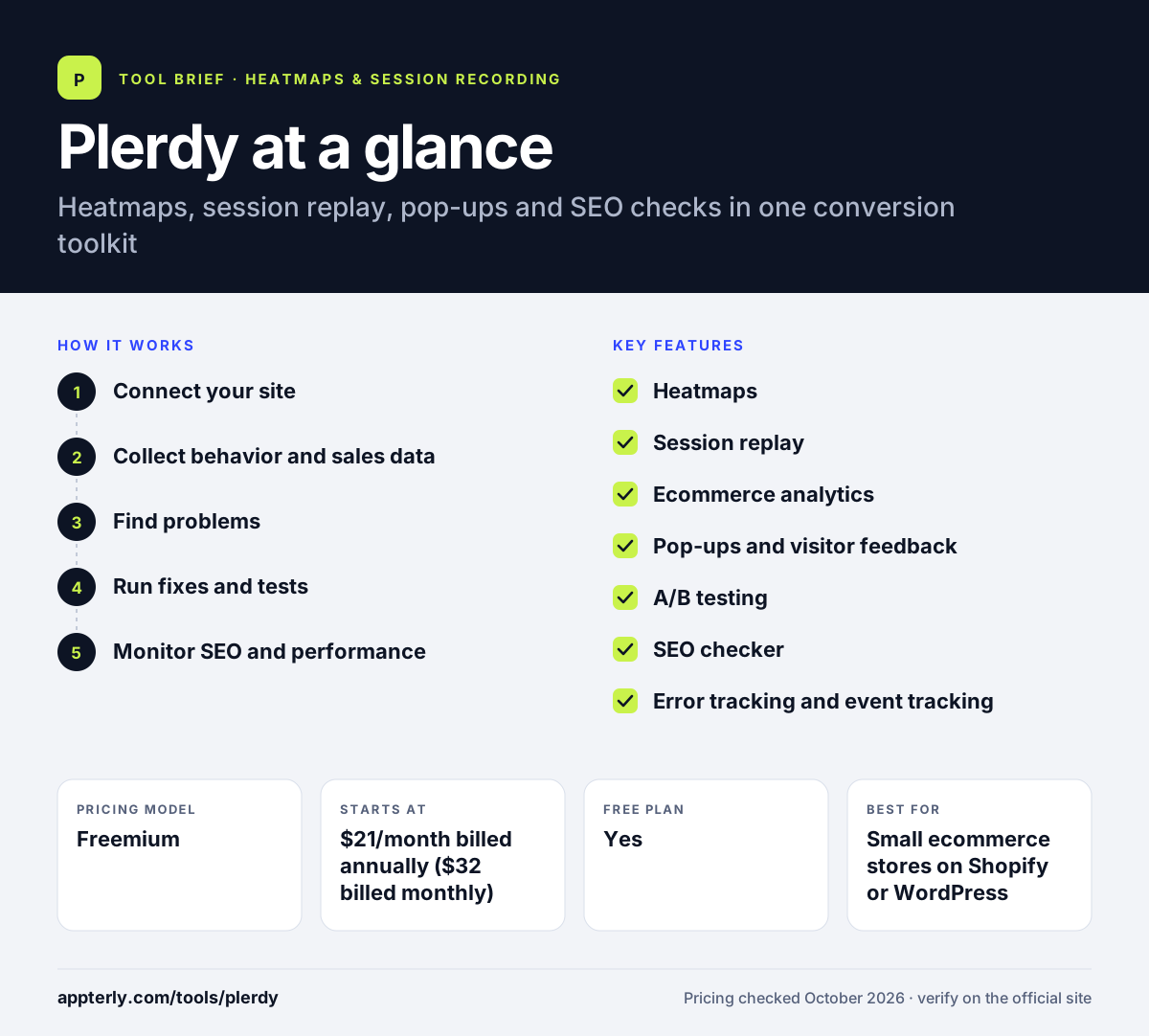
How does Plerdy work?
- Connect your site
Install the Plerdy script or connect through Shopify, WordPress, Wix, Drupal or Joomla.
- Collect behavior and sales data
Plerdy records heatmaps, session replays, events, errors and ecommerce metrics such as revenue and order value.
- Find problems
Use funnels, rage-click detection, error tracking and the traffic value report to see which pages and channels lose sales.
- Run fixes and tests
Launch pop-ups, visitor feedback forms and A/B tests to try improvements on live traffic.
- Monitor SEO and performance
Review daily SEO audits and Search Console alerts, and query your data through the AI connector.
Plerdy key features
Heatmaps
Click, scroll and attention heatmaps for each page, plus a free Chrome extension that predicts attention heatmaps.
Session replay
Recordings of real visits that show where users get stuck, paired with rage-click detection and alerts.
Ecommerce analytics
Revenue, orders and average order value broken down by channel, product and page block.
Pop-ups and visitor feedback
Targeted pop-ups for lead and sales capture, plus feedback forms that ask visitors why they did not buy.
A/B testing
Test page changes on live traffic, with unlimited tests on every plan.
SEO checker
Daily site audits with Google Search Console alerts, plus an optional SERP checker add-on.
Error tracking and event tracking
Flags JavaScript, 404 and server errors, and tracks clicks and goals without code, sending events to GA4.
AI connector (MCP)
Lets Claude or ChatGPT query your Plerdy data on paid plans, with read-only access.
Why use Plerdy?
- One subscription covers heatmaps, replays, pop-ups, A/B testing and SEO checks.
- Ecommerce reporting ties UX problems to lost revenue.
- A permanent free plan and low entry pricing suit small budgets.
- Unlimited A/B testing on every plan encourages regular experimentation.
- Platform connections make setup simple for Shopify, WordPress and Wix sites.
- Error tracking catches JavaScript, 404 and server errors that can quietly break checkout or lead forms.
Who is Plerdy best for?
A good fit for
- Small ecommerce stores on Shopify or WordPress
- Marketing agencies managing several client sites
- Small businesses that want CRO and SEO in one tool
- Marketers who want to test changes quickly
Less suited to
- Large enterprises with complex analytics governance needs
- Teams that only need deep developer debugging data
- Users who prefer a minimal, single-purpose interface over an all-in-one dashboard
Plerdy pricing
| Pricing model | Freemium |
|---|---|
| Free plan | Yes |
| Free trial | 14 days |
| Starting price | $21/month billed annually ($32 billed monthly) |
Plans raise daily limits for heatmaps, pop-ups and ecommerce tracking, plus video sessions, SEO audits, AI requests and data storage. Annual billing saves 35%, and extra capacity is sold as monthly add-ons. Paid tiers are Startup, Scale and Thrive, and only paid plans include the AI connector.
Prices checked October 2026. Vendors change plans often, so confirm on the official Plerdy pricing page before you buy.
Plerdy pros and cons
Pros
- Wide feature set for the price
- Free plan with no time limit
- Combines CRO tools with SEO auditing
- Unlimited A/B testing on all plans
Cons
- Daily limits on heatmaps and pop-ups can feel restrictive on busier sites
- The broad feature set means a steeper learning curve
- Free plan heatmaps are limited to three pages
Plerdy integrations and platforms
Works with
Available on
Plerdy alternatives
See the full shortlist in Best Heatmap Tools.
Plerdy FAQ
Is Plerdy free?
Yes. Plerdy has a free plan that costs nothing forever and needs no credit card. It includes limited heatmaps on three pages, 500 video sessions, SEO audits, pop-ups and unlimited A/B testing, with one month of storage. A 14-day trial with Scale plan limits is also available.
What is Plerdy used for?
Plerdy is used to improve website conversion rates and search performance. Teams study heatmaps and session replays, track ecommerce revenue by page block and channel, detect errors, run A/B tests and show pop-ups. Its SEO checker runs daily audits, so marketers can watch UX and SEO health in one place.
Plerdy vs Hotjar: what's the difference?
Both offer heatmaps, session replay and visitor feedback. Plerdy also includes pop-ups, A/B testing, ecommerce revenue analytics, error tracking and an SEO checker, so it covers more of the conversion workflow in one tool. Hotjar focuses on behavior analytics and user research, such as surveys and interviews.
Does Plerdy integrate with Shopify?
Yes. Plerdy connects to Shopify and is listed on the Shopify App Store. It also connects with WordPress, Wix, Drupal and Joomla. For Shopify stores, Plerdy can track revenue, orders and average order value alongside heatmaps and session recordings of shopper behavior.
Is Plerdy good for beginners?
Plerdy is usable for beginners thanks to platform connections and no-code event tracking, but its wide feature set takes time to learn. Starting with heatmaps and session replay is the easiest path, then adding pop-ups, A/B tests and SEO audits as you get comfortable with the dashboard.
Sources
This overview is based on Plerdy's official website and documentation, checked October 2026.