What is Mutiny?
Mutiny is an AI go-to-market assistant that helps B2B sales and marketing teams create customer-facing work such as deal rooms, proposals, follow-up emails and 1:1 account pages. The company started in 2018 in Y Combinator as a website personalization and A/B testing tool. It now says it no longer offers those products and focuses on AI help for revenue teams instead.
The current Mutiny records and organizes meeting notes, researches attendees before calls, drafts follow-ups in the rep's voice and builds pricing proposals and executive decks. For marketing, it still supports account-based campaigns with AI-generated landing pages and microsites for named accounts. A free plan covers small teams, and paid tiers add credits, members, custom domains and CRM integrations.
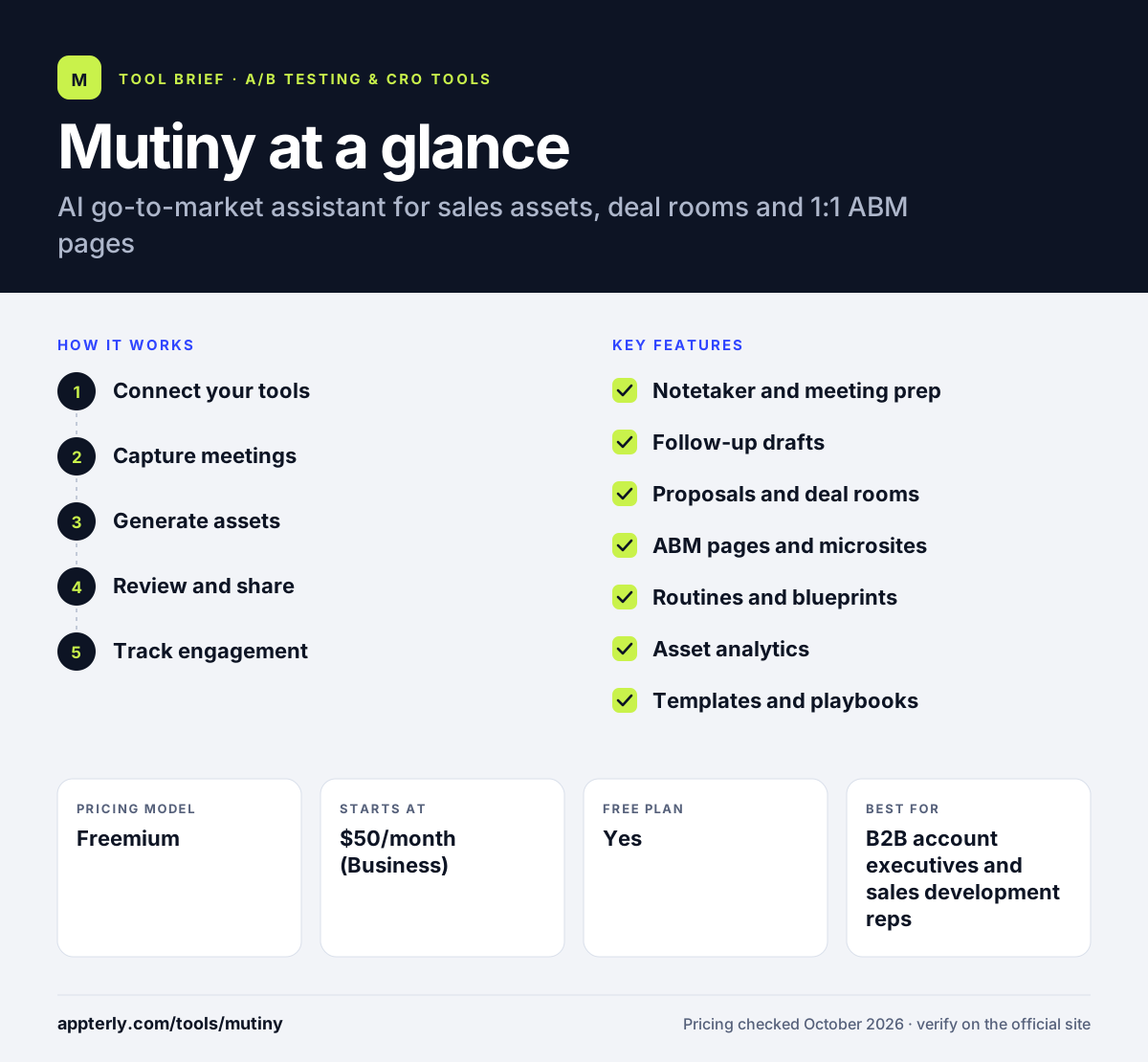
Mutiny at a glance
How does Mutiny work?
- Connect your tools
Link email, calendar and CRM systems such as HubSpot or Salesforce so Mutiny has account context.
- Capture meetings
The notetaker records calls and stores notes and context by account and project.
- Generate assets
Ask the assistant for a follow-up email, deal room, proposal, deck or ABM page using templates and past work. Blueprints give a starting point for each sales stage.
- Review and share
Edit the draft, then send or publish it to the buyer on a Mutiny or custom domain.
- Track engagement
See who viewed a deal room or page, and let routines update the CRM after calls.
Mutiny key features
Notetaker and meeting prep
Records calls, organizes notes by account and prepares briefs on attendees and past conversations before each meeting.
Follow-up drafts
Writes follow-up emails based on the meeting and the rep's past writing style, ready for review.
Proposals and deal rooms
Builds pricing proposals, business cases, executive decks and shared deal rooms from call details.
ABM pages and microsites
Creates personalized landing pages and microsites for named target accounts at scale.
Routines and blueprints
Automations and templates for each sales stage, from prospecting to expansion, with account memory.
Asset analytics
Shows buyer activity on shared assets, with Visitor Intelligence for Outreach and Salesloft on Business.
Templates and playbooks
Templates and pre-loaded GTM playbooks give new users a starting point instead of a blank page.
Why use Mutiny?
- Mutiny cuts the time reps spend writing follow-ups, decks and proposals after calls.
- Account memory keeps context in one place across a long B2B deal cycle.
- Marketing can launch 1:1 ABM pages for target accounts without a web team.
- Engagement tracking shows sellers which buyers are actively reviewing materials.
- A free plan lets small teams try it before buying.
Who is Mutiny best for?
A good fit for
- B2B account executives and sales development reps
- ABM and demand generation marketers targeting named accounts
- Customer success and partner managers who create client materials
- High-growth SaaS revenue teams
Less suited to
- Teams looking for website A/B testing or visitor personalization, which Mutiny no longer offers
- B2C and ecommerce businesses without a sales team
- Companies that need Salesforce integration but cannot afford Enterprise
Mutiny pricing
| Pricing model | Freemium |
|---|---|
| Free plan | Yes |
| Free trial | Not confirmed |
| Starting price | $50/month (Business) |
Free covers up to 5 team members with daily credits. Business adds 50 credits a month, unlimited members and a custom subdomain, and Enterprise starts at $40,000 a year with SSO and Salesforce.
Prices checked October 2026. Vendors change plans often, so confirm on the official Mutiny pricing page before you buy.
Mutiny pros and cons
Pros
- Covers notes, follow-ups and buyer assets in one assistant
- Free plan and a low-cost Business tier
- ABM pages for named accounts built with AI
- Tracks buyer engagement on shared materials
Cons
- No longer offers website A/B testing or personalization
- Salesforce integration is limited to Enterprise
- Credit limits can restrict heavy use on lower tiers
Mutiny integrations and platforms
Works with
Available on
Mutiny alternatives
See the full shortlist in Best A/B Testing Tools.
Mutiny FAQ
Is Mutiny free?
Yes. Mutiny has a free plan for up to five team members with five daily credits per seat, capped at 30 per month. It includes limited templates, routines and projects. The Business plan costs $50 per month, and Enterprise starts at $40,000 per year. Heavier users may need Business, which includes 50 credits a month, or Enterprise for custom credit limits.
What is Mutiny used for?
Mutiny is used by B2B revenue teams to prepare for meetings, take notes, draft follow-ups and build buyer-facing assets such as proposals, decks and deal rooms. Marketers also use it to create personalized ABM landing pages and microsites for target accounts.
Does Mutiny still do A/B testing and website personalization?
No. Mutiny was originally known for B2B website personalization and A/B testing, but the company now states it no longer offers those products. Its current focus is an AI assistant for sales and go-to-market work. Teams that need website testing should look at tools such as VWO, Optimizely or Kameleoon. Mutiny's ABM landing pages and microsites still let marketers personalize content for named accounts.
Mutiny vs Gong: what's the difference?
Gong is mainly a revenue intelligence tool that records and analyzes sales calls and forecasts deals. Mutiny records meetings too, but its focus is producing the work that follows, such as follow-up emails, proposals, deal rooms and ABM pages. Mutiny also lists Gong as a tool it can connect with.
Does Mutiny integrate with Salesforce?
Yes, but the Salesforce integration is listed as an Enterprise feature. Mutiny can also update HubSpot records, draft emails in Gmail and provide Visitor Intelligence analytics for Outreach and Salesloft on the Business plan. Enterprise also adds SSO, custom credit limits and a dedicated growth strategist.
Sources
This overview is based on Mutiny's official website and documentation, checked October 2026.