What is LaunchDarkly?
LaunchDarkly is a feature management platform that lets software teams turn features on or off in production, release them gradually and roll them back without a new deploy. Developers wrap new code in feature flags, then control who sees each feature from a dashboard. The product is grouped into CodeControl, for application releases, and AgentControl, for managing AI agents and prompts in production.
Around those flags, LaunchDarkly adds experimentation, with A/B/n tests, multi-armed bandits and holdouts, plus observability tools such as error monitoring, logs, traces and session replay. Pricing is usage-based rather than per seat. A free Developer plan covers small projects, and the Foundation plan charges per service connection and per client-side monthly active user. Special custom rates are offered for some architectures, such as Kubernetes and serverless. SSO and SAML come with every plan, including the free one.
LaunchDarkly at a glance
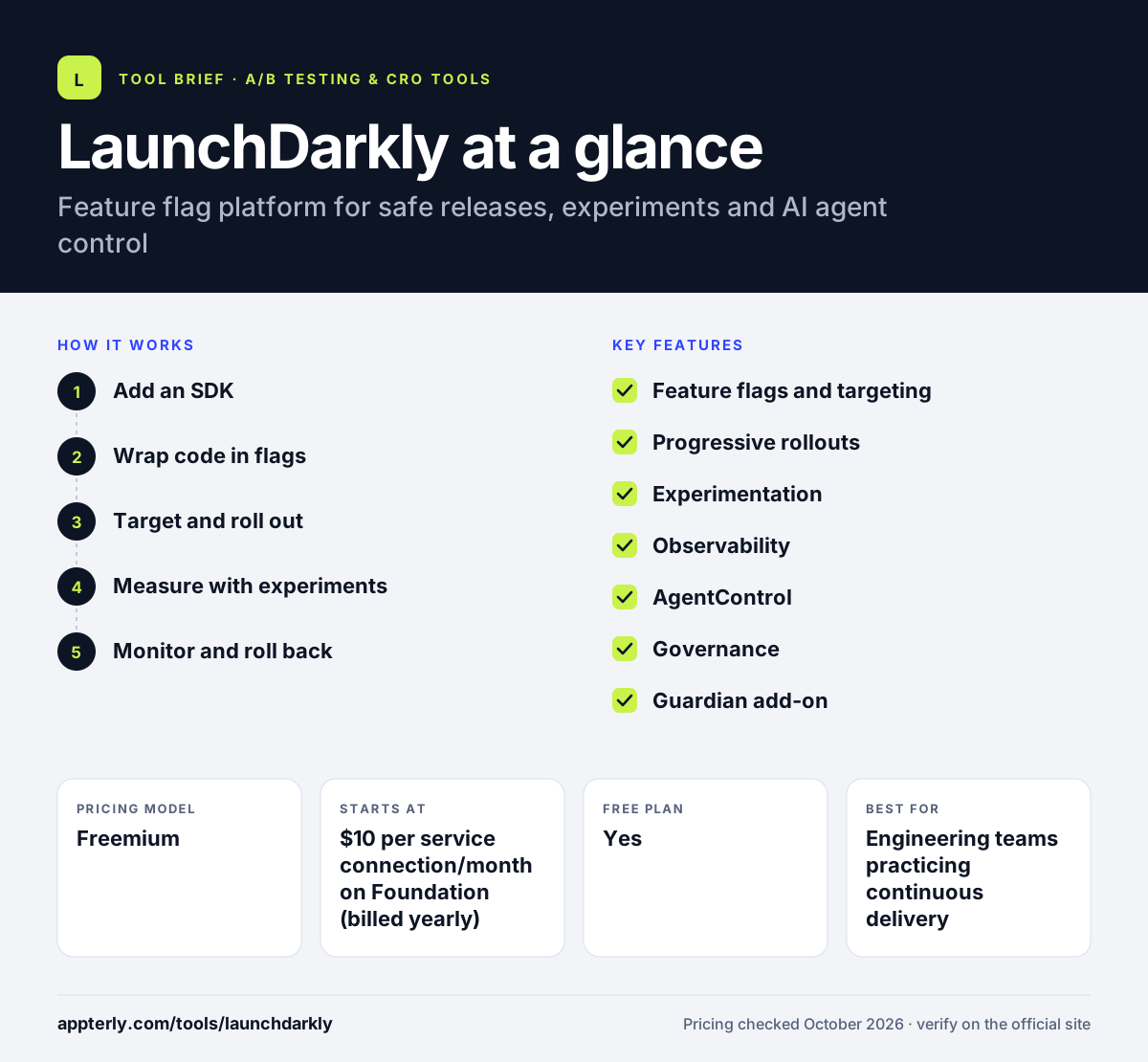
How does LaunchDarkly work?
- Add an SDK
Install a LaunchDarkly SDK in your application and connect it to your project and environments. Projects and environments, such as staging and production, keep flags separate.
- Wrap code in flags
Put new features behind feature flags so they ship to production turned off.
- Target and roll out
Release to internal users, a segment or a small percentage of traffic, then expand step by step.
- Measure with experiments
Attach metrics to a flag to run an A/B/n test and compare variations.
- Monitor and roll back
Watch errors and performance, and switch the flag off or let automated rollback act if something breaks. Enterprise customers can add the Guardian add-on for guardrail metrics and automatic pausing.
LaunchDarkly key features
Feature flags and targeting
Unlimited flags with targeting rules and reusable segments, so you control exactly who sees a feature.
Progressive rollouts
Release features gradually by percentage or audience, with automated rollback when problems appear.
Experimentation
A/B/n tests, multi-armed bandits and holdouts run on the same flags you use for releases.
Observability
Error monitoring, logs, traces and session replay help connect a release to its impact.
AgentControl
Tools for AI agents in production, including evaluations, an LLM playground, traces, approvals and prompt A/B tests.
Governance
Enterprise adds custom roles, approval workflows, release automation and SCIM. SSO is available on every plan.
Guardian add-on
An Enterprise add-on for release monitoring, guardrail metrics and automatic pause or rollback.
Why use LaunchDarkly?
- LaunchDarkly separates deploying code from releasing features, which lowers the risk of each release.
- Bad releases can be turned off in seconds without a rollback deploy.
- Experiments run on the same flags, so product teams can measure impact without a separate testing tool.
- Unlimited seats on every plan mean the whole team can use it without per-user fees.
- AgentControl gives teams building AI features a way to test and govern prompts and agents.
Who is LaunchDarkly best for?
A good fit for
- Engineering teams practicing continuous delivery
- SaaS product teams that run feature experiments
- Companies shipping AI agents or LLM features to production
- Larger organizations that need release approvals and audit controls
Less suited to
- Marketers who want a visual editor for landing page tests
- Very small sites with no developer to install SDKs
- Teams that want simple flat-rate pricing
LaunchDarkly pricing
| Pricing model | Freemium |
|---|---|
| Free plan | Yes |
| Free trial | 14 days |
| Starting price | $10 per service connection/month on Foundation (billed yearly) |
Developer is free with 5 service connections and 1,000 client-side MAU. Foundation adds per-unit charges for service connections, client-side MAU and AI runs, while Enterprise is custom priced.
Prices checked October 2026. Vendors change plans often, so confirm on the official LaunchDarkly pricing page before you buy.
LaunchDarkly pros and cons
Pros
- Mature, flexible feature flag targeting
- Experiments and observability tied to releases
- Free plan with unlimited seats and flags
- SSO included on every plan
Cons
- Usage-based pricing can be hard to forecast
- Needs developers to set up and maintain
- Advanced governance and Guardian require Enterprise
LaunchDarkly integrations and platforms
Available on
LaunchDarkly alternatives
See the full shortlist in Best A/B Testing Tools.
LaunchDarkly FAQ
Is LaunchDarkly free?
Yes, LaunchDarkly has a free Developer plan with no credit card required. It includes unlimited seats and flags, five service connections, 1,000 client-side monthly active users and some observability and AI usage. Paid Foundation usage comes after a 14-day trial, and Enterprise pricing is custom. Foundation is billed per service connection, per 1,000 client-side MAU and per extra 1,000 AI runs.
What is LaunchDarkly used for?
LaunchDarkly is used to manage feature flags, which let teams release, test and roll back features in production without redeploying code. Teams also use it to run A/B experiments on features, monitor release health and control AI agents and prompts once they are live.
Is LaunchDarkly good for beginners?
LaunchDarkly is aimed at developers, so it suits teams comfortable installing SDKs and changing code. The dashboard itself is approachable, and the free plan is a low-risk way to learn feature flags. Non-technical marketers looking for a visual page editor will find it less suitable. Unlimited seats on the free plan also let a whole team learn together.
LaunchDarkly vs Statsig: what's the difference?
Both tools offer feature flags and experimentation. LaunchDarkly is known for release management, targeting and governance, and adds observability and AI agent controls. Statsig bundles experimentation with product analytics and session replay, and its paid tier is a flat monthly fee with event-based overages.
Does LaunchDarkly do A/B testing?
Yes. LaunchDarkly includes experimentation with A/B/n tests, multi-armed bandits and holdouts. Experiments run on feature flags, so the same flag that controls a release can measure its effect on your metrics. The free Developer plan includes 100,000 experimentation MAU per month. Session replay and error data can then show how each variation behaved for real users.
Sources
This overview is based on LaunchDarkly's official website and documentation, checked October 2026.