What is Mixpanel?
Mixpanel is a product analytics platform that tracks what users do inside websites and apps so teams can find drop-off points, measure retention and improve user journeys. It is event-based, meaning each action such as a sign-up or purchase is recorded and analyzed. Mixpanel now combines analytics with session replay, heatmaps, experiments, feature flags and metric trees in one product.
Mixpanel also includes AI features. Mixpanel AI agents watch your product data, surface insights and suggest next steps, and an Experiments Agent helps set up tests. Through Mixpanel MCP, you can query your data from AI tools such as Claude, ChatGPT and Cursor. A generous free plan covers up to 1 million events per month, and paid pricing scales with event volume rather than seats.
Mixpanel at a glance
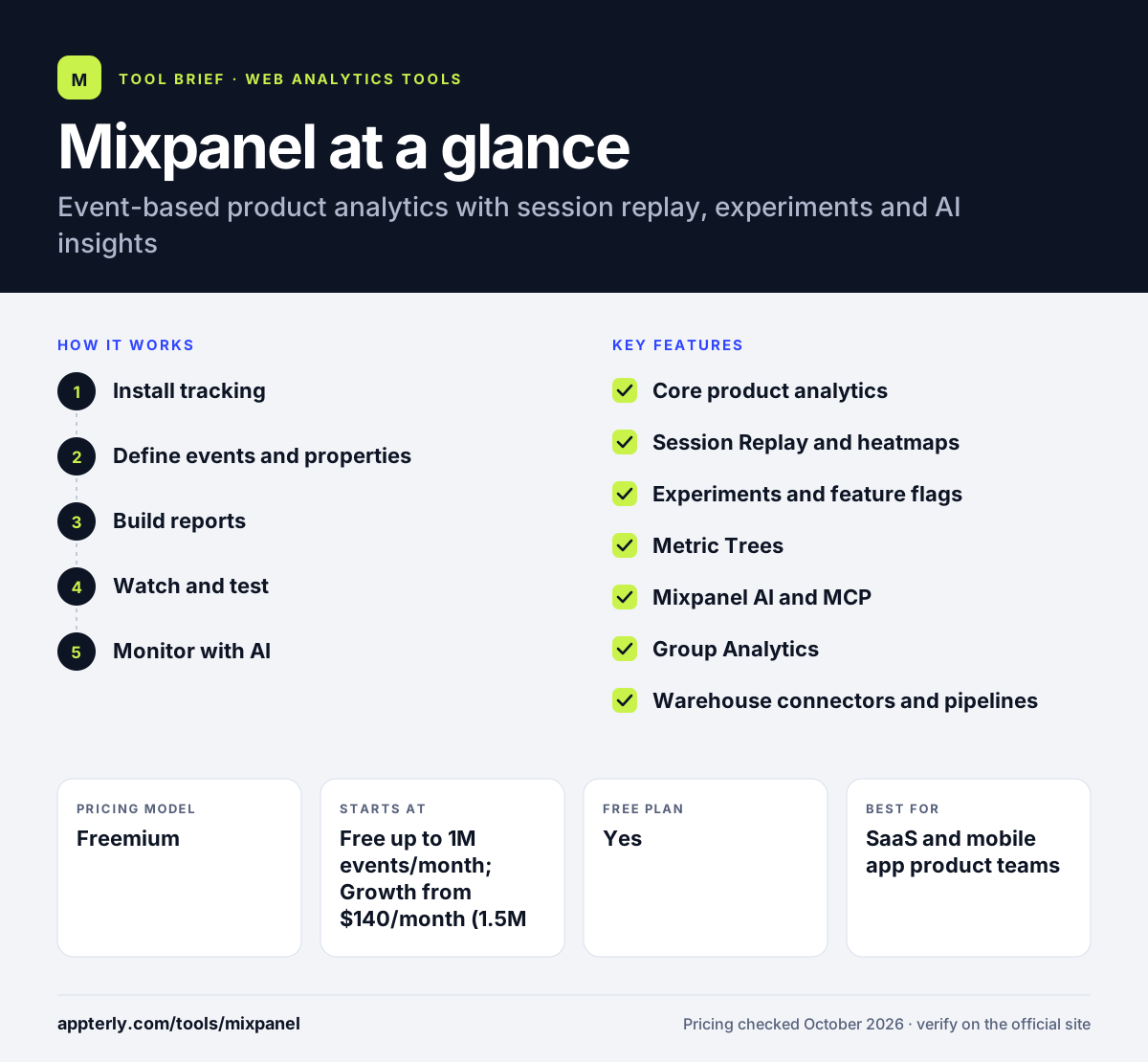
How does Mixpanel work?
- Install tracking
Add Mixpanel's SDK to your web or mobile app, or connect your data warehouse or customer data platform to send events.
- Define events and properties
Track key actions like sign-ups, purchases and feature use, with properties that describe the user and context.
- Build reports
Create Insights, Funnels and Retention reports self-serve to see trends, conversion steps and who keeps coming back.
- Watch and test
Use session replay to see real user struggles, then run experiments and feature flag rollouts to test fixes.
- Monitor with AI
Set alerts and let Mixpanel AI agents flag changes and explain what may be driving them.
Mixpanel key features
Core product analytics
Insights, funnels, retention, flows and campaign reporting help you understand user behavior in real time on all plans.
Session Replay and heatmaps
Watch user sessions and use AI-grouped Magic Playlists to find patterns. The free plan includes 10,000 replays per month.
Experiments and feature flags
Design, run and analyze A/B tests and controlled rollouts alongside your analytics data.
Metric Trees
Map product metrics to company KPIs and revenue in an interactive tree, available as an add-on on paid plans.
Mixpanel AI and MCP
AI agents surface insights and next steps, and the MCP server connects your data to assistants like Claude and ChatGPT.
Group Analytics
An add-on that reports KPIs at the account or company level, useful for B2B SaaS.
Warehouse connectors and pipelines
Sync data from your warehouse and export events and profiles to cloud storage on Growth and Enterprise.
Why use Mixpanel?
- Product teams can answer their own questions without waiting for data analysts.
- The free plan is large enough for many startups to use for real.
- Analytics, replay and experiments in one place reduce tool sprawl.
- Pricing based on events, not seats, lets the whole company use it.
- Warehouse connectors fit modern data stacks.
Who is Mixpanel best for?
A good fit for
- SaaS and mobile app product teams
- Growth teams running experiments on onboarding and activation
- Startups that qualify for the Startup Program
- B2B companies analyzing accounts with Group Analytics
Less suited to
- Content sites that only need pageview and traffic reports
- Teams without the resources to plan and maintain event tracking
- Very high-volume products on a tight budget, since costs rise with events
Mixpanel pricing
| Pricing model | Freemium |
|---|---|
| Free plan | Yes |
| Free trial | Not confirmed |
| Starting price | Free up to 1M events/month; Growth from $140/month (1.5M events, billed monthly) |
Growth keeps the first 1 million events free, then charges by event tier, from $100/month billed yearly at 1.5M events to $1,635/month at 20M. Enterprise is custom priced, and Group Analytics, Metric Trees and Data Pipelines are paid add-ons.
Prices checked October 2026. Vendors change plans often, so confirm on the official Mixpanel pricing page before you buy.
Mixpanel pros and cons
Pros
- Generous free tier with 1M events
- Fast, self-serve funnel and retention analysis
- Replay, experiments and flags built in
- No per-seat pricing
Cons
- Event tracking needs careful planning to stay clean
- Advanced governance and anomaly detection are Enterprise only
- Costs grow quickly at high event volumes
Mixpanel integrations and platforms
Works with
Available on
Mixpanel alternatives
See the full shortlist in Best Google Analytics Alternatives.
Mixpanel FAQ
Is Mixpanel free?
Yes. Mixpanel has a free-forever plan with up to 1 million events per month, 10,000 session replays and core reports like funnels and retention, with no credit card required. The Growth plan also keeps the first million events free and charges only for usage above that. Eligible startups can get a year free through the Startup Program.
What is Mixpanel used for?
Mixpanel is used to understand how people use a digital product. Product and growth teams track events like sign-ups, feature use and purchases, then analyze funnels, retention and user flows. Mixpanel also supports session replay, A/B experiments and feature flags, so teams can see problems and test fixes in the same tool.
Mixpanel vs Google Analytics: what's the difference?
Google Analytics 4 focuses on marketing measurement, such as traffic sources, campaigns and Google Ads performance. Mixpanel focuses on product behavior after sign-up, with deeper funnels, retention, cohorts, experiments and session replay. Many companies use Google Analytics for acquisition and Mixpanel for in-product analysis.
How much does Mixpanel cost?
Mixpanel Growth pricing depends on monthly events. After the first free million, it costs $140 per month billed monthly or $100 per month billed yearly at 1.5 million events, rising to $1,635 per month billed yearly at 20 million. Enterprise plans with governance, HIPAA tools and 24/7 support are custom priced.
Is Mixpanel good for beginners?
Mixpanel's report builders are designed for non-analysts, so beginners can build funnels and retention charts without SQL. The harder part is planning which events to track and naming them consistently. Starting with a few key events and templates on the free plan is a practical way to learn.
Sources
This overview is based on Mixpanel's official website and documentation, checked October 2026.