What is Dub?
Dub is a link attribution platform that creates branded short links and then follows each click through to signups and sales. It started as a modern URL shortener and has grown into a tool that connects link clicks to revenue. Teams use it to share links on their own domains, generate QR codes, and see which channels, campaigns and partners actually produce customers rather than just traffic.
The product has two main parts. Dub Links covers short links, analytics and conversion tracking. Dub Partners adds affiliate and referral program management, including commission rules, partner payouts and an embeddable referral dashboard. Developers get a REST API, webhooks and official SDKs, and the code is published in a public GitHub repository, which appeals to technical teams that want transparency.
Dub at a glance
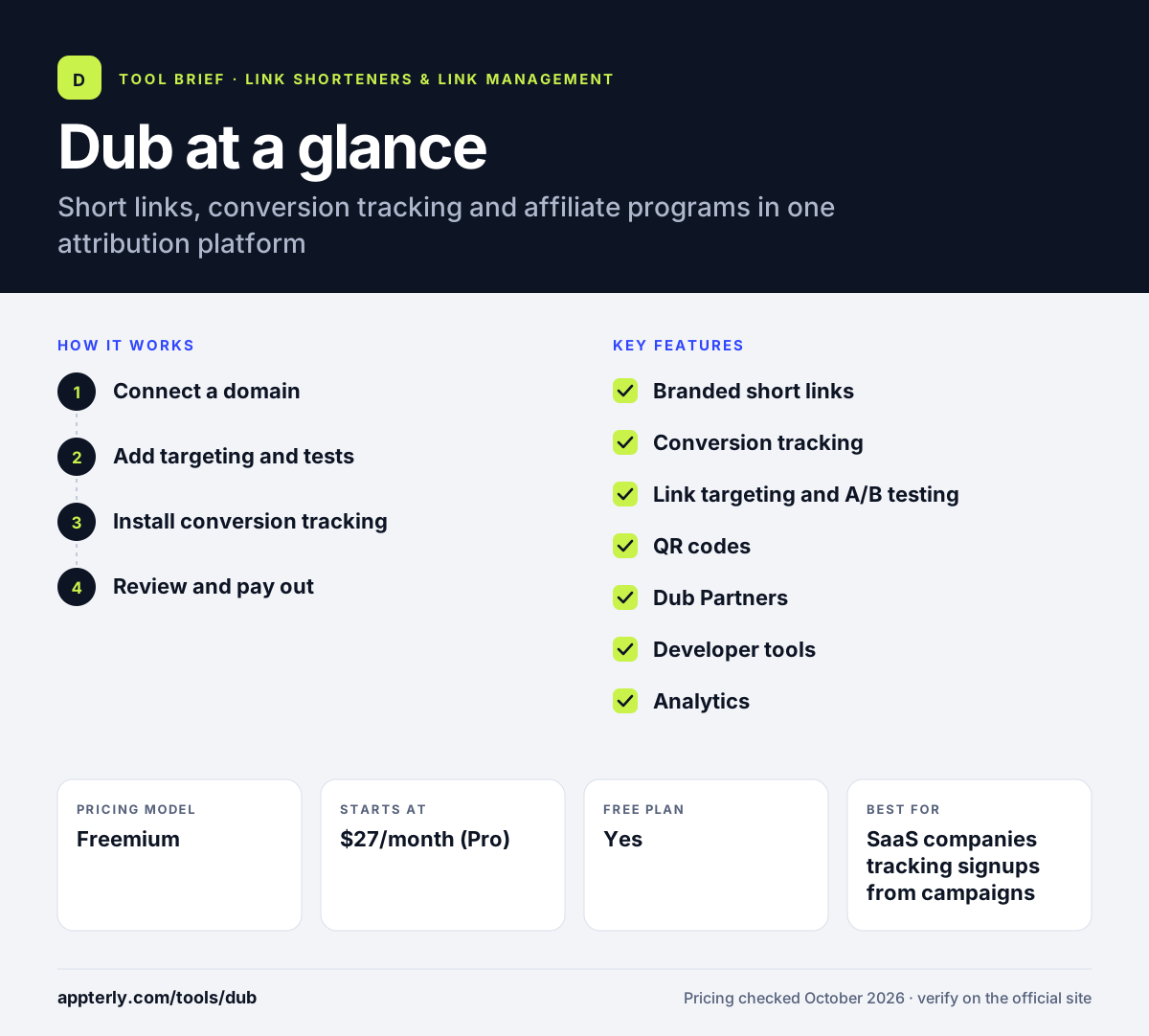
How does Dub work?
- Connect a domain
Add your own branded domain or use a free one, then create short links in the dashboard or through the API. Each link can carry UTM parameters, tags and a folder.
- Add targeting and tests
Set device or country targeting, deep links for mobile apps, or A/B tests that split traffic between destinations. QR codes are generated automatically for every link.
- Install conversion tracking
On paid plans, connect Dub to your app or checkout so leads and sales are attributed back to the link or partner that brought the visitor in.
- Review and pay out
Check real-time analytics for clicks, leads and revenue. If you run a partner program, Dub calculates commissions and handles partner payouts.
Dub key features
Branded short links
Create links on custom domains with tags, folders, UTM templates and role-based access, so teams can manage large link libraries without clutter.
Conversion tracking
Attribute leads and sales to specific links, with customer insights such as lifetime value. This is included from the Business plan upward.
Link targeting and A/B testing
Route visitors by device or geography and split traffic between destination pages to compare results.
QR codes
Every short link gets a QR code, which makes it easy to track offline campaigns alongside digital ones.
Dub Partners
Run affiliate and referral programs with reward rules, bounties, partner groups, an embedded referral dashboard and automated payouts.
Developer tools
A REST API, real-time webhooks, deferred deep linking and SDKs for TypeScript, Go, Python, Ruby and PHP support product-led use cases.
Analytics
Real-time reports on clicks, referrers, locations and devices, with retention that ranges from 30 days on the free plan to several years on higher tiers.
Why use Dub?
- It ties link clicks to actual signups and revenue instead of stopping at click counts.
- Affiliate program management lives in the same tool as your short links, which cuts down on extra software.
- The API and SDKs make it practical to create links inside your own product.
- A free plan lets small teams try branded links and analytics before paying.
- The public code repository gives technical buyers visibility into how the product works.
Who is Dub best for?
A good fit for
- SaaS companies tracking signups from campaigns
- Startups launching affiliate or referral programs
- Developers who need a link API
- Marketing teams using branded domains
Less suited to
- Casual users who only need a few anonymous short links now and then
- Very small budgets that need conversion tracking, since it sits on the $81/month Business plan
- Teams that want a link-in-bio page builder as a core feature
Dub pricing
| Pricing model | Freemium |
|---|---|
| Free plan | Yes |
| Free trial | 14 days on Business and Advanced |
| Starting price | $27/month (Pro) |
The free plan allows 25 new links and 1,000 tracked events per month. Pro, Business ($81/month) and Advanced ($270/month) raise link, event and retention limits, with about 10% off for yearly billing; Enterprise is custom.
Prices checked October 2026. Vendors change plans often, so confirm on the official Dub pricing page before you buy.
Dub pros and cons
Pros
- Combines short links, attribution and partner payouts in one product
- Strong developer tooling with multiple official SDKs
- Generous custom domain limits on paid plans
- Usable free plan for testing
Cons
- Conversion tracking requires a mid-tier plan
- Partner payouts carry a 5% fee on Business and Advanced
- Free plan link and event limits are tight for active campaigns
Dub integrations and platforms
Works with
Available on
Dub alternatives
See the full shortlist in Best URL Shorteners.
Dub FAQ
Is Dub free?
Dub has a free plan with 25 new links per month, 1,000 tracked events, up to three custom domains and 30 days of analytics retention. It also includes QR codes, UTM templates and API access. Paid plans start with Pro at $27 per month, and conversion tracking is included from the Business plan at $81 per month.
What is Dub used for?
Dub is used to create branded short links, track clicks and attribute signups and sales to the links that produced them. Many companies also use its Partners product to run affiliate and referral programs, where Dub tracks referrals, applies commission rules and pays partners from one dashboard.
Dub vs Bitly: what's the difference?
Bitly is a long-established link shortener focused on links, QR codes and click analytics for a broad audience. Dub puts more weight on attribution, tracking leads and sales back to each link, and adds built-in affiliate program management and developer SDKs. Teams that need revenue attribution or partner payouts tend to lean toward Dub.
Is Dub open source?
Dub publishes its codebase in a public GitHub repository under the dubinc organization, so developers can review how it works. The pricing and homepage do not spell out licensing terms, so check the repository's license file before planning to self-host or modify the code for commercial use.
Does Dub have an API?
Yes. Dub offers a REST API for creating and managing links, plus real-time webhooks and deferred deep linking. Official SDKs are available for TypeScript, Go, Python, Ruby and PHP. API access is included on the free plan, and higher tiers raise the request rate limit.
Sources
This overview is based on Dub's official website and documentation, checked October 2026.