What is Clay?
Clay is a go-to-market data platform that lets sales and marketing teams pull contact and company data from more than 200 providers, enrich it in spreadsheet-style tables and turn it into targeted outreach. Instead of buying several data subscriptions, you access many sources through one Clay account and pay with credits. Its best-known idea is waterfall enrichment, which tries one provider after another until it finds an email or phone number.
Clay also uses AI. Claygent agents can visit websites and search the web to answer research questions about each account, such as what software a company uses or whether it is hiring. Signals track job changes, company news and web intent. Results can feed Clay's own sequencer, sync to a CRM, or go to ad audiences on LinkedIn, Meta and Google.
Clay at a glance
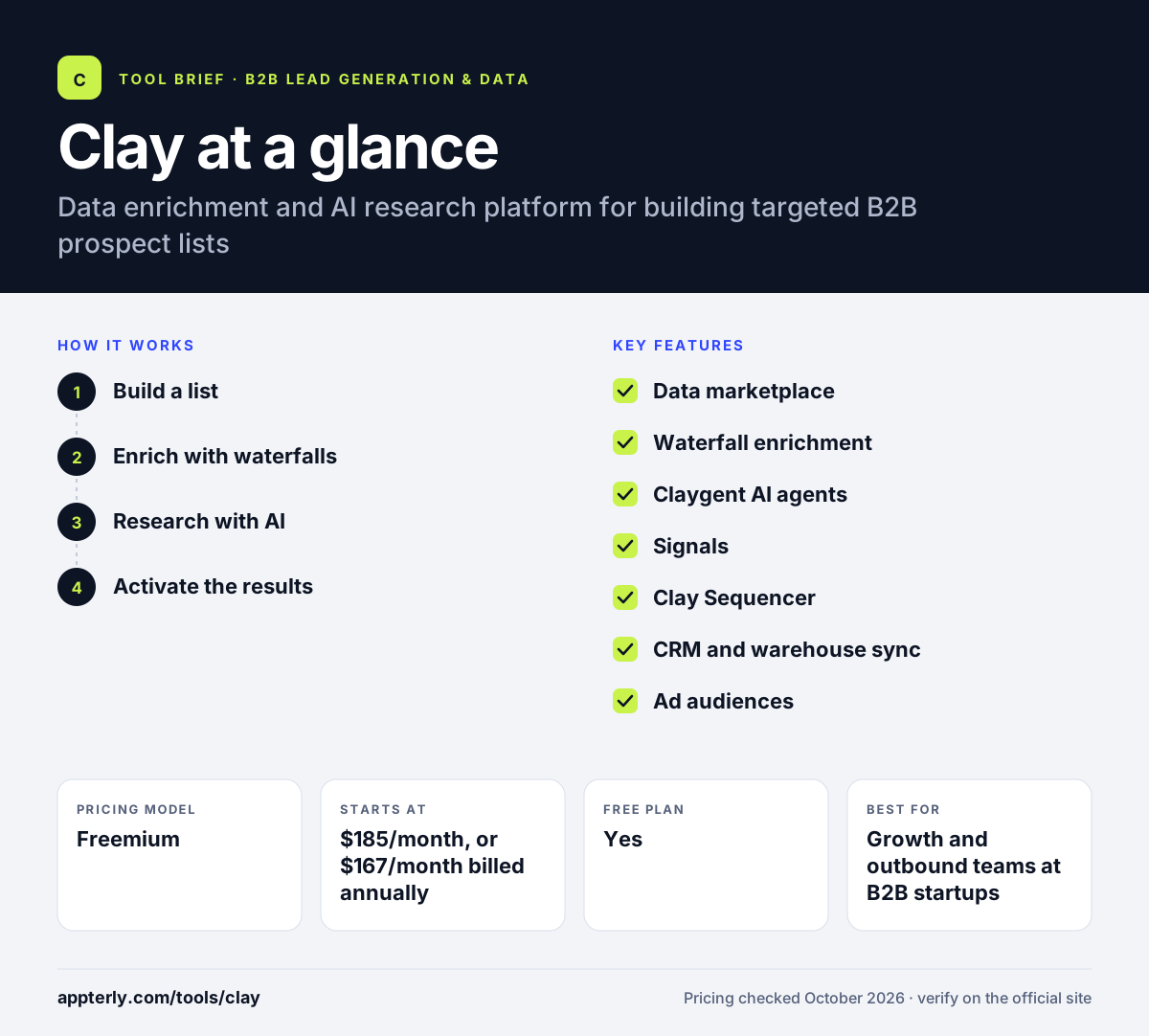
How does Clay work?
- Build a list
Import a CSV, pull records from your CRM, or search Clay's sources for companies and people that match your ideal customer profile.
- Enrich with waterfalls
Add columns that query several data providers in sequence for emails, phones, firmographics or technographics, so coverage is higher than any single source.
- Research with AI
Run Claygent prompts on each row to gather custom details, then use AI to score leads or write personalized first lines.
- Activate the results
Send contacts to Clay Sequencer or tools like Outreach and Instantly, sync to Salesforce or HubSpot, or push audiences to ad platforms.
Clay key features
Data marketplace
Access to 200+ providers such as Apollo, ZoomInfo, Crunchbase and People Data Labs through one contract, or bring your own API keys.
Waterfall enrichment
Chains multiple providers to fill gaps in contact data, and you are not charged when a lookup finds nothing.
Claygent AI agents
AI research agents that browse the web to answer custom questions about companies and people.
Signals
Alerts for job changes, promotions, company news and web intent to time outreach better.
Clay Sequencer
Native email outreach, with integrations for Outreach, Salesloft, Instantly, Lemlist and Smartlead.
CRM and warehouse sync
Auto-enrich Salesforce or HubSpot records and sync with Snowflake or BigQuery on higher plans.
Ad audiences
Push enriched lists to LinkedIn, Meta and Google Ads for account-based campaigns.
Why use Clay?
- Waterfall enrichment usually finds more contact data than relying on one provider.
- AI research can replace hours of manual account digging.
- Unlimited seats on every plan make it easy to share tables across a team.
- Credits roll over, and failed lookups do not cost anything.
- It connects to most popular CRMs, sequencers and data tools.
Who is Clay best for?
A good fit for
- Growth and outbound teams at B2B startups
- RevOps teams cleaning and enriching CRM data
- Lead generation agencies running campaigns for clients
- Technical marketers who like spreadsheet-style automation
Less suited to
- Beginners who want a simple contact lookup tool
- Teams that need CRM sync on a small budget, since it starts at Growth
- Consumer businesses that do not sell to other companies
Clay pricing
| Pricing model | Freemium |
|---|---|
| Free plan | Yes |
| Free trial | 14 days |
| Starting price | $185/month, or $167/month billed annually |
Launch includes 15,000 actions and about 3,000 data credits per month, and Growth costs $495/month for 40,000 actions and 6,000 credits plus CRM sync. Free has 500 actions and 100 credits, and Enterprise is custom.
Prices checked October 2026. Vendors change plans often, so confirm on the official Clay pricing page before you buy.
Clay pros and cons
Pros
- Huge range of data sources in one tool
- Flexible AI research and personalization
- Unlimited seats and a usable free plan
- No charge for enrichment lookups that fail
Cons
- Steep learning curve for people new to tables and formulas
- Credit and action costs can add up on large lists
- CRM integrations and web intent require the Growth plan or higher
Clay integrations and platforms
Works with
Available on
Clay alternatives
See the full shortlist in Best B2B Lead Generation Tools.
Clay FAQ
Is Clay free?
Yes, Clay has a free plan with 500 actions and 100 data credits per month, unlimited seats, Claygent and waterfalls, but tables are capped at 200 rows and it excludes phone enrichment, signals and CRM integrations. Paid plans start at $185 per month, or $167 per month billed annually, and include a 14-day trial.
What is Clay used for?
Clay is used to build and enrich B2B prospect lists. Teams find companies and contacts, fill in emails and phone numbers from many providers, research accounts with AI, score leads and then send them to outreach tools, CRMs or ad platforms for targeted campaigns.
Is Clay good for beginners?
Clay is powerful but has a learning curve. Its table-based interface resembles a spreadsheet with automation, and getting the most out of it means understanding enrichment, prompts and credits. Templates, guides and the free plan help, but simple users may prefer a basic contact lookup tool.
Clay vs Apollo: what's the difference?
Apollo is a single B2B database with built-in prospecting and email sequences. Clay is an enrichment and workflow layer that taps more than 200 providers, including Apollo, and adds AI research. Many teams use Clay to boost coverage and personalization while still sending outreach from another tool.
Does Clay integrate with HubSpot?
Yes. Clay integrates with HubSpot as well as Salesforce, Pipedrive, Dynamics 365 and other CRMs. You can import records, enrich them and write data back automatically. CRM integrations are included on the Growth and Enterprise plans, not on Free or Launch.
Sources
This overview is based on Clay's official website and documentation, checked October 2026.