What is Calendly?
Calendly is a scheduling platform that lets other people book meetings with you through a link that shows only your open times. Freelancers, recruiters, sales reps, customer success managers and whole revenue teams use it to replace email back-and-forth when setting up calls, demos and interviews.
Calendly has grown from a simple booking link into a broader meeting platform. Paid plans add automated reminders, routing forms that qualify leads, round-robin team scheduling, payments and CRM integrations. Newer add-ons include Notetaker, which records meetings and produces summaries, and Callie, a beta AI assistant you copy into an email thread to arrange a time. More than 150 integrations are listed.
Calendly at a glance
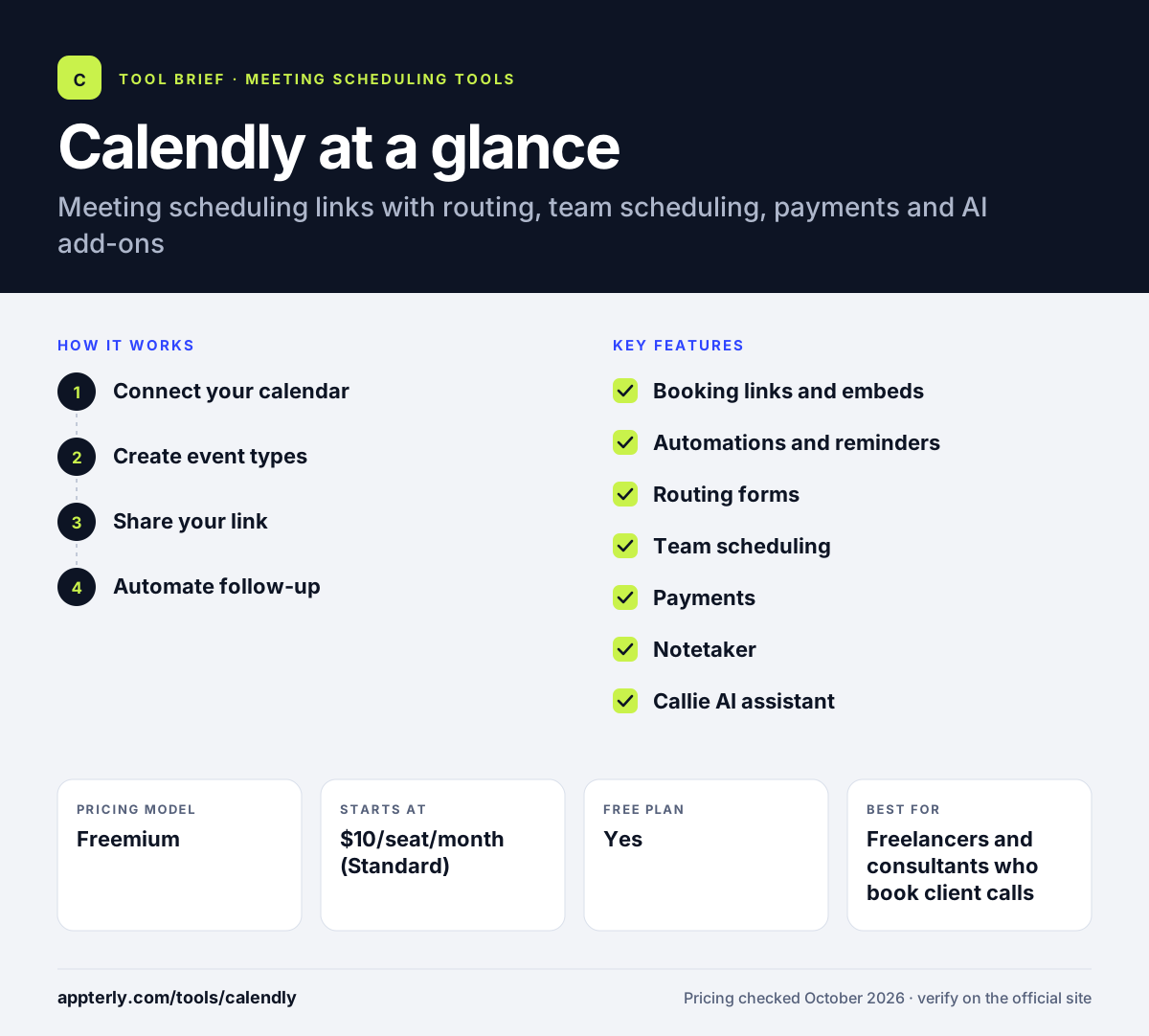
How does Calendly work?
- Connect your calendar
Link Google, Outlook or another calendar so Calendly checks your busy times before offering slots.
- Create event types
Set meeting length, location such as Zoom or Google Meet, buffers and questions for invitees.
- Share your link
Send the link by email, add it to your signature, or embed it on your website so people choose a time.
- Automate follow-up
Calendly adds the meeting to both calendars and sends reminders, and paid plans can trigger workflows and CRM updates.
Calendly key features
Booking links and embeds
Share a customizable booking page or embed it on a website so people can self-schedule.
Automations and reminders
Email and text reminders and follow-up workflows reduce no-shows on paid plans.
Routing forms
Qualify leads with questions and route them to the right rep, with Salesforce lookup routing on Enterprise.
Team scheduling
Round-robin and collective events plus centrally managed event types help teams share meetings fairly.
Payments
Collect payment through Stripe or PayPal at booking, sell meeting packages and send invoices.
Notetaker
An add-on that records meetings and creates transcripts, summaries, next steps and draft follow-up emails.
Callie AI assistant
A beta assistant you add to an email thread to coordinate times without sharing a link.
Browser extension and mobile app
Share availability from Chrome or manage meetings on the go.
Why use Calendly?
- Invitees see only open times in their own time zone, which removes scheduling emails.
- Routing forms help sales teams send qualified leads to the right rep quickly.
- Integrations with Salesforce, HubSpot, Zoom and Microsoft Teams fit common business stacks.
- The free plan is enough for one basic meeting type, so you can start without paying.
- AI add-ons can handle notes and follow-up after the meeting.
Who is Calendly best for?
A good fit for
- Freelancers and consultants who book client calls
- Sales and customer success teams that need routing and round-robin
- Recruiters scheduling interviews at volume
- Companies already using Salesforce or HubSpot
Less suited to
- Users who want several event types for free, since the free plan allows only one
- Service businesses that need intake-heavy client management, memberships or class packages
- Teams that want to self-host their scheduling tool
Calendly pricing
| Pricing model | Freemium |
|---|---|
| Free plan | Yes |
| Free trial | Not confirmed |
| Starting price | $10/seat/month (Standard) |
Free covers one event type and one calendar. Standard ($10/seat/month) adds unlimited event types and automations; Teams ($16/seat/month) adds routing and round-robin. Enterprise starts at $15,000/year for 50+ seats. Annual billing saves up to 20%.
Prices checked October 2026. Vendors change plans often, so confirm on the official Calendly pricing page before you buy.
Calendly pros and cons
Pros
- Simple for invitees, with no account needed to book
- Large integration catalog with more than 150 apps
- Strong routing and team scheduling for revenue teams
- Useful free plan for a single meeting type
Cons
- Free plan is limited to one event type and one calendar
- Routing and round-robin require the Teams plan
- AI features such as Notetaker are sold as add-ons
Calendly integrations and platforms
Works with
Available on
Calendly alternatives
See the full shortlist in Best Scheduling Software.
Calendly FAQ
Is Calendly free?
Yes. Calendly has an always-free plan that includes one event type, one calendar connection, one-on-one scheduling, a customizable booking page and the browser extension. To get unlimited event types, reminders and automations, you need the Standard plan at $10 per seat per month. Teams and Enterprise plans add routing and admin controls. Many users find the free plan enough for a single type of client call.
What is Calendly used for?
Calendly is used to schedule meetings without trading emails. You share a link, invitees pick an open time, and the event lands on both calendars with a video link. Businesses use it for sales demos, client calls, job interviews, onboarding sessions and customer support calls, often with reminders and CRM updates.
Calendly vs Cal.com: which is better?
Calendly is a polished hosted product with a large integration catalog and AI add-ons like Notetaker. Cal.com offers more on its free plan, such as unlimited event types and CRM sync, and it can be self-hosted. Teams that want a familiar tool usually pick Calendly, while developers often prefer Cal.com. Both are strong choices, so the decision usually comes down to budget, hosting needs and existing integrations.
Does Calendly integrate with Salesforce and HubSpot?
Yes. HubSpot connects on the Standard plan, while Salesforce, Marketo and Pardot meeting integrations are part of the Teams plan. Enterprise adds Salesforce lookup routing and Microsoft Dynamics. These connections log meetings in your CRM and let routing forms send leads to the record owner.
Is Calendly good for beginners?
Yes. Calendly is one of the easier scheduling tools to set up. You connect a calendar, create an event type and share the link in a few minutes. Invitees do not need an account. More advanced features, such as routing forms and workflows, take more setup but are optional.
Sources
This overview is based on Calendly's official website and documentation, checked October 2026.