What is BL.INK?
BL.INK is an enterprise link management platform for creating and governing short links and dynamic QR codes. It began as a branded link shortener for businesses and has since become part of Loftware, a labeling and packaging software company, which acquired it in April 2025. Today BL.INK powers the QR code and short link side of Loftware's Connected Packaging offering, and the old bl.ink website redirects there.
BL.INK now centers on products and packaging rather than social media links. Brands use it to put dynamic, GS1 Digital Link-enabled QR codes on packages so the content behind each code can change as product information evolves. Broken-link alerts and backup destinations keep codes working, and enterprise governance controls help large organizations stay consistent and compliant. It connects to supply chain and enterprise systems through APIs, with pricing handled by consultation. Marketers who remember BL.INK as a general branded link shortener should note that the product is now sold mainly to manufacturers and brands in consumer goods, food and beverage, pharmaceuticals, medical devices and retail.
BL.INK at a glance
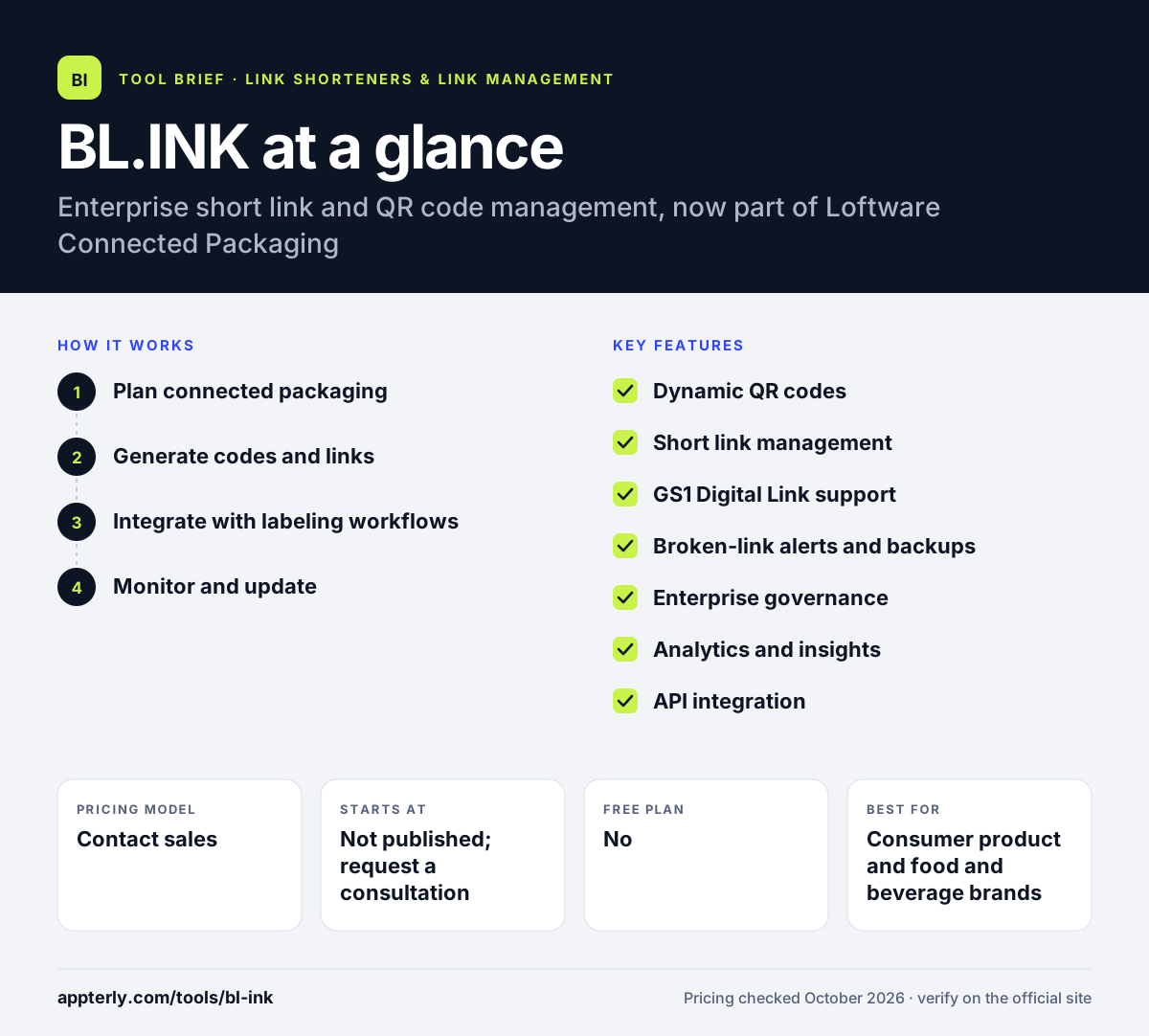
How does BL.INK work?
- Plan connected packaging
Brands work with Loftware to decide which products, labels and packages need QR codes or short links.
- Generate codes and links
BL.INK creates dynamic QR codes and short links, including GS1 Digital Link identifiers tied to product data.
- Integrate with labeling workflows
APIs connect code creation to existing packaging, labeling and enterprise systems so codes print with each label.
- Monitor and update
Teams change destinations as content evolves, while alerts and backup URLs protect against broken links.
BL.INK key features
Dynamic QR codes
Codes whose destinations can be changed after printing, so packaging stays useful over a product's life.
Short link management
Creates and manages short links from a central, governed platform.
GS1 Digital Link support
Produces identifiers that follow the GS1 Digital Link standard for retail and supply chain compliance.
Broken-link alerts and backups
Detects failing destinations and redirects visitors to fallback pages.
Enterprise governance
Controls for brand integrity and compliance when many teams create codes at scale.
Analytics and insights
Reports on engagement with connected packaging, as part of Loftware's platform.
API integration
Connects with existing workflows and enterprise systems through APIs.
Why use BL.INK?
- Dynamic codes let packaging content change without reprinting labels.
- GS1 Digital Link support helps brands prepare for retail QR code requirements.
- Pairing with Loftware's labeling tools brings codes into the same workflow as product labels.
- Governance and broken-link protection reduce risk across large product catalogs.
- Enterprise focus suits regulated sectors such as pharmaceuticals and medical devices.
Who is BL.INK best for?
A good fit for
- Consumer product and food and beverage brands
- Pharmaceutical and medical device manufacturers
- Retail and ecommerce companies adopting GS1 QR codes
- Enterprises already using Loftware labeling software
Less suited to
- Freelancers and small teams wanting a quick, self-serve link shortener for campaigns, emails and social posts
- Social media marketers needing link-in-bio pages
- Anyone wanting published prices or a free plan
BL.INK pricing
| Pricing model | Contact sales |
|---|---|
| Free plan | No |
| Free trial | Not confirmed |
| Starting price | Not published; request a consultation |
Since the Loftware acquisition, BL.INK is sold as part of Connected Packaging, and pricing is set through a consultation with Loftware's team.
Prices checked October 2026. Vendors change plans often, so confirm on the official website before you buy.
BL.INK pros and cons
Pros
- Strong fit for packaging and GS1 Digital Link use cases
- Dynamic codes with broken-link protection
- Backed by an established labeling software company
Cons
- No longer a standalone self-serve link shortener
- No public pricing
- Little use for typical social or campaign link tracking
BL.INK integrations and platforms
Available on
BL.INK alternatives
See the full shortlist in Best URL Shorteners.
BL.INK FAQ
What happened to BL.INK?
Loftware, a labeling and packaging software company, acquired BL.INK in April 2025. The bl.ink website now redirects to Loftware's Connected Packaging page, where BL.INK provides QR code and short link management. The product continues, but it is now positioned for enterprise packaging and supply chain use.
What is BL.INK used for?
BL.INK is used to create and manage short links and dynamic QR codes at enterprise scale. Under Loftware it focuses on connected packaging, where brands print GS1 Digital Link QR codes on products and update the linked content over time without changing the printed label.
How much does BL.INK cost?
BL.INK pricing is not published. Since it became part of Loftware, it is sold through Connected Packaging, and you request a consultation to get a quote. There is no listed free plan or self-serve trial, so it is aimed at mid-size and large companies.
BL.INK vs Bitly: what's the difference?
Bitly is a self-serve link shortener and QR code tool with a free plan and published prices, used widely by marketers and creators. BL.INK, now part of Loftware, targets enterprises that put QR codes on product packaging, with GS1 Digital Link support, governance and labeling system integration.
Does BL.INK support GS1 Digital Link?
Yes. BL.INK creates GS1 Digital Link-enabled QR codes and identifiers, which let a single code on a package serve both retail scanning and consumer content. This helps brands meet the move toward QR codes in retail while keeping product information easy to update.
Sources
This overview is based on BL.INK's official website and documentation, checked October 2026.