How we make this list: we compare vendor pricing pages, product documentation and plan limits, and print the month we checked each price. We don’t accept payment for rankings.
QUICK ANSWER
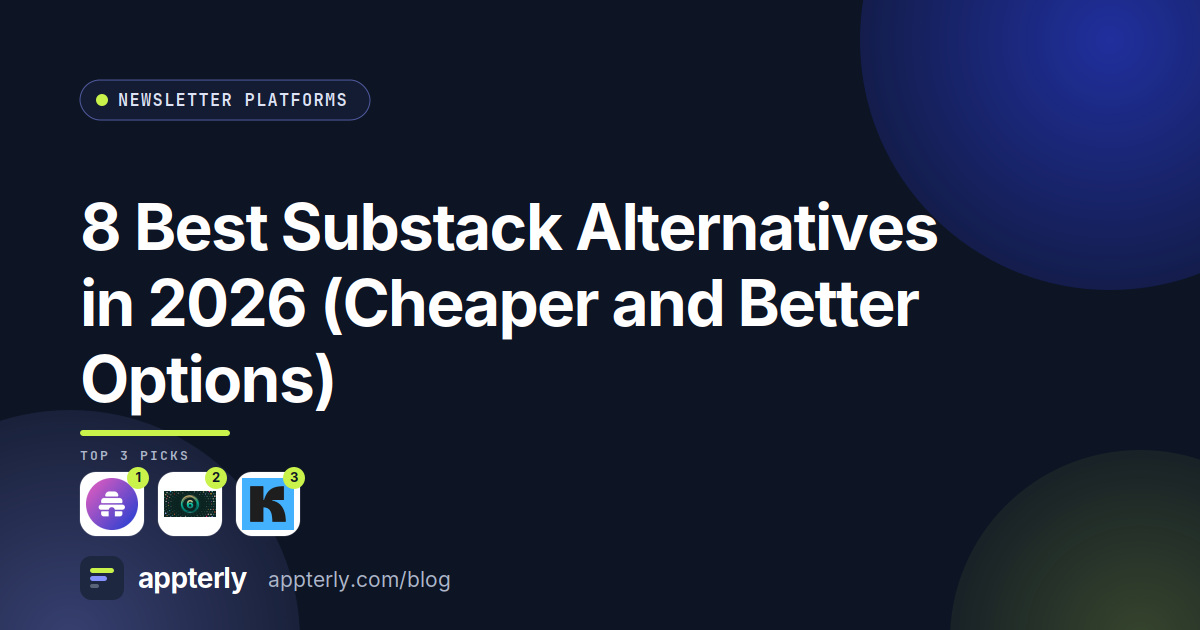
beehiiv is the best Substack alternative for most writers in 2026, because it charges no revenue share, covers 2,500 subscribers free and starts at $49 a month on annual billing. Ghost suits a full website with paid memberships, Kit suits creators who want a free plan up to 10,000 subscribers, and EmailOctopus suits plain newsletters at $9 a month.
Key takeaways
beehiiv takes the top spot: it charges no revenue share, covers 2,500 subscribers free and starts at $49 a month on annual billing (Nov 2026).
6 of the 8 tools here have a free plan, and the cheapest paid start is $9 a month: Buttondown Basic and EmailOctopus Pro billed yearly.
Substack keeps 10% of every paid subscription, so a writer earning $2,000 a month pays $200 to Substack before card fees.
Ghost, beehiiv and Sendy charge no revenue share at all, so your paid income stays yours minus Stripe card fees.
Kit gives away the biggest free plan: 10,000 subscribers with unlimited sends, while Substack free takes a cut the moment you charge.
Substack alternatives make sense once the revenue share, not the tool, becomes the problem. Substack is free to start and takes 10% of your paid subscription revenue, plus card processing fees (Nov 2026). That cut is small while you earn little, but a writer earning $2,000 a month pays $200 to Substack before any other cost. The design is also limited, and the marketing automation and segmentation tools are thin next to a real email platform.
This list groups the 8 best Substack alternatives by the reason people leave: a revenue share that grows with your income, a free plan that runs out too fast, and missing design and marketing tools. Each pick carries a clear switch-if line. Start with our best newsletter platforms for paid subscriptions guide if you want the wider paid-newsletter picture.
Starting price$59/month (Lite, up to 1,000 subscribers; …
Free planYes
Free trialFree trial on Lite and Pro (length not stated)
PlatformsWeb, API
Switch if: Switch if Substack's 10% cut is eating your paid income.
beehiiv fixes the exact problem that pushes most writers off Substack: the 10% revenue share. beehiiv charges no platform fee on paid subscriptions, so you keep your full income minus Stripe card fees. The free plan covers up to 2,500 subscribers, Lite costs $49 a month on annual billing, or $59 month to month (Nov 2026). You also get a website, paid newsletter tools, referral programs and an ad network.
The catch is the price jump. Paid plans start at $49 a month, which is steep for a small list, and removing beehiiv branding requires the Pro plan. Pick beehiiv when your paid income is growing and Substack's 10% cut hurts, and pick Kit when your list is still small and free is the priority.
Switch if: Switch if you want a full website with paid memberships and 0% platform fees.
Ghost is the pick when you want a full website with paid memberships, not just a newsletter. Ghost charges 0% platform fees, so you keep your full subscription income minus Stripe card fees. Starter costs $18 a month on annual billing and covers 1,000 members and one staff user without paid subscriptions, while Publisher costs $29 a month on annual billing and adds paid memberships, custom themes and integrations. Self-hosting Ghost is free if you run your own server,
The catch is the entry tier. Paid subscriptions are not available on the cheapest plan, so you must pay $29 a month before you can charge readers. Email automation is basic compared with marketing platforms, and self-hosting requires technical skills. Pick Ghost when you want a website, a blog and paid memberships under one roof, and pick beehiiv when you want a hosted newsletter with no revenue share and no server work.
Starting price$39/month for up to 1,000 subscribers (Cre…
Free planYes
Free trial14 days
PlatformsWeb, API
Switch if: Switch if you want to grow to 10,000 subscribers free before you pay.
Kit, formerly ConvertKit, is the pick when your list is still growing and free is the priority. Its free Newsletter plan covers up to 10,000 subscribers with unlimited sends, landing pages and forms, which is the most generous free tier on this list by a wide margin. Creators can also sell digital products, paid newsletters and subscriptions from the same account, and the Recommendations network helps one newsletter grow.
The catch is the paid price. Creator costs $39 a month for up to 1,000 subscribers, or $33 a month on annual billing (Nov 2026), and the free plan holds back sequences and automations. Pick Kit when you are a creator growing toward paid products and want the biggest free plan, and pick beehiiv when your paid income is already real and the 10% Substack cut is the problem.
Switch if: Switch if you want the cheapest way to send a plain newsletter to a growing list.
EmailOctopus is the pick when you send plain newsletters and want the lowest cost per subscriber. The free Starter plan allows up to 2,500 subscribers and 10,000 emails a month, and Pro costs $9 a month on annual billing, or $10 month to month (Nov 2026). The price scales with list size, and the tool stays simple: write, send, track, repeat.
The catch is the narrow scope. EmailOctopus is email only, with no SMS channel, and the free plan includes EmailOctopus branding with limited report history. Pick EmailOctopus when your newsletter is plain text and your budget is tight, and pick MailerLite when you need automation and a website builder too.
Free trial14 days of premium features, no card required
PlatformsWeb, API
Switch if: Switch if you want automation, landing pages and a website builder with your newsletter.
MailerLite is the pick when your newsletter needs marketing tools that Substack does not have. The Comfort plan starts at $12 a month for 500 subscribers (Nov 2026), and every paid plan includes the full feature set, so you pay for list size rather than for locked features. You also get landing pages, a simple website builder, paid newsletter subscriptions and digital product sales in the same account, plus automation that Substack cannot match.
The catch is the free plan, which MailerLite cut to 250 subscribers and 2,500 emails a month in June 2026. That is still workable for a new list, but you will outgrow it quickly, and the paid price then rises at each subscriber tier. Pick MailerLite when you want automation, landing pages and a website builder with your newsletter, and pick Kit when a bigger free plan matters more.
Starting price$25/month (Lite, up to 1,000 subscribers; …
Free planYes
Free trial14 days
PlatformsWeb, API
Switch if: Switch if you want magazine-style design and a flat price that never takes a cut.
Flodesk is the pick when your newsletter must look like a magazine, not a plain email. The Lite plan costs $25 a month, or $19 a month on annual billing for up to 1,000 subscribers (Nov 2026), with unlimited sends and designer templates. Prices rise with active subscriber count, Pro adds unlimited workflows and advanced analytics, and Everything adds checkouts, sales pages, funnels and abandoned cart emails. The flat price does not jump with every new subscriber the way Substack's 10% cut does.
The catch is the free plan, which builds forms, landing pages and link-in-bio pages but does not send email. Automation is also less advanced than marketing automation platforms, and checkout is limited to certain countries. Paid subscriptions need the Everything plan. Pick Flodesk when design is the priority and you want a flat price, and pick MailerLite when automation matters more than looks.
Starting price$9/month (Basic, up to 1,000 subscribers; …
Free planYes
Free trialNot confirmed
PlatformsWeb, API
Switch if: Switch if you want the simplest newsletter tool with one clear price.
Buttondown is the pick when you want the simplest possible newsletter tool. The first 100 subscribers are free, and paid pricing scales with active subscribers from $9 a month for 1,000 subscribers, or $90 a year (Nov 2026). All features are included at every level: tagging and segmentation, paid subscriptions, comments and surveys, analytics and RSS-to-email. Automations are an add-on at $20 a month extra.
The catch is the add-ons. Costs can add up as you stack several add-ons, and there are fewer design templates than visual email builders. Buttondown is also not built for ecommerce or multichannel marketing. Pick Buttondown when you write in markdown, want one simple price and do not need fancy templates, and pick Flodesk when design is the priority.
Switch if: Switch if you want to pay once and never see a monthly newsletter bill again.
Sendy is the pick when you never want to see a monthly bill again. The license costs $69 per domain, paid once, and Amazon SES sending costs about $1.60 per 10,000 emails (Nov 2026). A writer with a large list can send 100,000 emails for a few dollars a month in SES fees, which no hosted tool can match.
The catch is the work. Sendy requires hosting, setup and Amazon SES configuration, and the interface and automation are simpler than modern hosted tools. Support and maintenance depend on you and your host. Pick Sendy when you are technical, your list is large and you want the lowest possible sending cost, and pick EmailOctopus when you want a hosted tool at a similar price.
We compared vendor pricing pages, documentation and plan limits, and checked every price in Nov 2026.
Criterion
Weight
What we looked at
Revenue share and price as you grow
30%
Substack's main fault is the 10% revenue share, so we priced each tool at 1,000 and 10,000 subscribers and checked whether it takes a cut.
Free plan size
25%
Substack free costs nothing but takes 10% once you charge, so we compared free subscriber caps and send limits directly against that bar.
Paid subscriptions and monetization
25%
A Substack replacement must sell paid subscriptions, so we checked Stripe support, paid tiers and who keeps the income.
Design and automation
20%
Substack's design and automation are thin, so we weighed templates, customization, segmentation and automation depth.
What is the cheapest Substack alternative?
beehiiv is the cheapest Substack alternative for most writers, because its free plan covers 2,500 subscribers and its Lite plan starts at $49 a month on annual billing (Nov 2026). EmailOctopus Pro matches a low price at $9 a month on annual billing, and Buttondown starts at $9 a month for 1,000 subscribers. beehiiv prices by subscriber count, EmailOctopus by list size, and Buttondown by a simple per-subscriber rate. See our best newsletter platforms for creators guide for more.
What is the best free Substack alternative?
Yes. Kit is the strongest Substack alternative free option, with a free plan covering up to 10,000 subscribers with unlimited sends (Nov 2026). beehiiv is the best free pick for a paid newsletter, free for 2,500 subscribers with no revenue share, and EmailOctopus is the best free pick for plain newsletters, free for 2,500 subscribers and 10,000 emails a month. Both beat Substack free, which takes 10% of your paid income the moment you charge readers.
Why do people leave Substack?
People leave Substack for three reasons: the 10% revenue share, limited design control and weak marketing tools. Substack is free to start but keeps 10% of every paid subscription, so a writer earning $1,000 a month pays $100 to Substack. beehiiv, Ghost and Sendy charge no revenue share at all, Flodesk gives you magazine-style design control, and Kit and MailerLite add the automation and segmentation that Substack lacks.
Can I move my paid subscribers off Substack?
Yes, and most of the tools here offer free migration help. beehiiv, Ghost and Kit all import your Substack archive, subscribers and paid members, and most keep your paid subscriptions running through Stripe. Export your subscriber list first, and keep your Substack publication active for a month to check paid members still get their posts. Switching costs a weekend of setup, not your audience.
Frequently asked questions
What is the best Substack alternative in 2026?
beehiiv is the best Substack alternative for most writers in 2026, because it charges no revenue share, covers 2,500 subscribers free and starts at $49 a month. Ghost is the best pick for a full website with paid memberships, Kit is the best pick for a free plan up to 10,000 subscribers, and EmailOctopus is the best cheap pick at $9 a month.
Is there a free Substack alternative?
Yes. Kit stays free for up to 10,000 subscribers with unlimited sends, and beehiiv stays free for up to 2,500 subscribers with no revenue share (Nov 2026). EmailOctopus is also free for 2,500 subscribers and 10,000 emails a month. All three beat Substack free, which takes 10% of your paid subscription income.
What is the cheapest Substack alternative?
beehiiv is the cheapest Substack alternative at scale, because its free plan covers 2,500 subscribers and its Lite plan starts at $49 a month on annual billing (Nov 2026). EmailOctopus Pro costs $9 a month on annual billing, and Buttondown starts at $9 a month for 1,000 subscribers. Sendy costs $69 once, plus Amazon SES sending at about $1.60 per 10,000 emails.
Does Ghost take a cut of paid subscriptions?
No. Ghost charges 0% platform fees on paid memberships, so you keep your full subscription income minus Stripe card fees (Nov 2026). Substack keeps 10% of every paid subscription. Ghost Starter costs $18 a month on annual billing, but paid subscriptions need the Publisher plan at $29 a month, and self-hosting Ghost is free.
Can I move my paid subscribers from Substack to beehiiv?
Yes. beehiiv, Ghost and Kit all import your Substack archive, subscribers and paid members, and most keep your paid subscriptions running through Stripe. Export your subscriber list first, and keep your Substack publication active for a month to check paid members still get their posts. Switching costs a weekend of setup, not your audience.
Is Sendy really a one-time payment?
Sendy is the best pick for a writer who wants to pay once and never see a monthly bill. The license costs $69 per domain, and Amazon SES sending costs about $1.60 per 10,000 emails (Nov 2026). The catch is that you must host Sendy yourself and configure Amazon SES, so it suits a technical writer, not a beginner who wants a hosted tool.
Is Flodesk or MailerLite better for a newsletter?
Yes, in different ways. Flodesk is best for design, with magazine-style templates and a flat price that does not rise with list size. MailerLite is best for marketing tools, with automation, landing pages and a website builder included. Flodesk Lite starts at $19 a month on annual billing and MailerLite Comfort at $12 (Nov 2026). Pick Flodesk for looks and MailerLite for automation.
Final verdict
Pick beehiiv if Substack's 10% cut is eating your paid income.
Pick Ghost if you want a full website with paid memberships and 0% fees.
Pick Kit if you are a creator who wants to stay free up to 10,000 subscribers.
Pick EmailOctopus if you send plain newsletters and want the lowest cost per subscriber.
Pick MailerLite if you want automation and a website builder with your newsletter.
Pick Flodesk if design is the priority and you want a flat price.
Pick Buttondown if you want the simplest newsletter tool with one clear price.
Pick Sendy if you are technical and want to pay once, never monthly.
Looking for the best newsletter platforms? We compared 10 options on pricing, free plans, key features and trade-offs so you can pick the right one fast.
Our 2026 shortlist of the 8 best newsletter platforms for creators, with real starting prices, free plan details, pros, cons and a clear pick for each use case.