How we make this list: we compare vendor pricing pages, product documentation and plan limits, and print the month we checked each price. We don’t accept payment for rankings.
QUICK ANSWER
Keyword Tool.io is the best keyword research tool for Amazon in 2026 because its Amazon tab pulls autocomplete phrases straight from Amazon search, with volume data on paid plans. Keywords Everywhere is the cheapest way to see Amazon volume at $7 a month. Ahrefs gives the deepest data, but from $129 a month on Lite.
Key takeaways
6 of 8 shortlisted tools have a free plan, and the lowest listed paid start is $7 a month (Keywords Everywhere) (Nov 2026).
Keyword Tool.io ranks first for Amazon because its Amazon tab pulls autocomplete phrases straight from Amazon search.
Keywords Everywhere shows Amazon volume, CPC and competition inside your browser for $84 a year.
Ahrefs and Semrush give the widest keyword data, but their entry prices start at $29 and $139.95 a month.
Google Keyword Planner is free, but it shows volume ranges, not exact counts, and needs a Google Ads account.
The best keyword research tools for Amazon show you the exact words buyers type into the Amazon search box, not just Google queries. That matters because Amazon search behaves differently: buyers search with purchase intent, using product words, sizes and use cases, and a listing that matches their phrasing wins the sale.
This guide ranks 8 keyword tools for Amazon on Amazon search data and listing keyword tools, with prices checked in Nov 2026. It sits under our best keyword research tools pillar, which compares the full category. If you want the cheapest end first, our best cheap keyword research tools guide covers the lowest-cost picks, and the best free keyword research tools guide goes deeper on the free plans here.
Starting price$69/month billed annually ($89 month to mo…
Free planYes
Free trialNot confirmed
PlatformsWeb, API
Keyword Tool.io earns the top spot for Amazon because it has a tab built for the marketplace. Pick Amazon as the source, type a product word, and it returns hundreds of autocomplete phrases that real buyers type, from size and color variants to use-case phrases. That raw phrase volume is what a listing needs: one product word can fill a title, five bullets and the backend search terms.
The catch is the price of the data behind the phrases. The free version shows ideas without volume, so you cannot tell a 100-search phrase from a 10,000-search one. Volume, CPC and competition need Pro Basic at $69 a month billed annually ($89 month to month), which is steep for a seller with one product.
What we like
Amazon tab returns hundreds of autocomplete phrases per product word.
Also covers Google, YouTube, Bing, eBay and Instagram from the same box.
No account needed for basic phrase lists.
Watch out for
Volume data needs Pro Basic at $69 a month billed annually.
No difficulty score on the free version, so phrases need a second check.
No rank tracking, so pair it with another tool to follow listings.
PlatformsChrome extension, Firefox extension, Edge extension, API
Keywords Everywhere is a browser extension that puts volume, CPC and competition right on the pages you already visit, including Amazon. Browse a product page or search Amazon, and the numbers sit next to the results instead of inside a separate dashboard. At $7 a month billed annually for Bronze with 100,000 credits, it is the cheapest paid route to Amazon volume in this list.
The catch is the credit system and the thin free tier. One credit buys the data for one keyword, and credits expire after a year, so heavy research burns through Bronze faster than the headline suggests. The free extension features cover prompts and on-page data, but volume and CPC need paid credits.
What we like
Cheapest paid start in this list at $7 a month billed annually.
Volume shows directly on Amazon, Google and YouTube pages.
One credit buys volume, CPC, competition and a 12-month trend.
Watch out for
Credits expire after 12 months, so unused credits are lost.
No keyword database to browse; it only enriches pages you visit.
No rank tracking or competitor analysis at any price.
Ahrefs brings the deepest data to Amazon research through Keywords Explorer, which covers Amazon alongside Google, YouTube and Bing. You get exact volume, clicks data and a difficulty score, plus the full suite behind it: Site Explorer for competitor stores, Content Explorer for proven topics, and Rank Tracker to follow your pages. For a seller who also runs a site or blog, that breadth is hard to match.
The catch is the price and the credit system. Full Keywords Explorer starts at $129 a month on Lite, since Starter at $29 a month is thin on credits and history. Starter gives 200 report credits a month, and each report you open spends one, so a seller who researches daily will hit the ceiling fast.
What we like
Amazon volume, clicks and difficulty in Keywords Explorer.
Competitor research and rank tracking in the same account.
Free plan covers sites you own through Webmaster Tools.
Semrush is the biggest keyword database in this list, and its strength for Amazon sellers is context: research a product phrase in Keyword Magic Tool, check what the top Google pages cover, then shape the listing and the blog posts that support it. Pro at $139.95 a month ($117.33 billed annually) adds position tracking for 500 keywords, site audits and backlink data, so a team running a store and a site gets one workflow.
The catch is the price for a small seller. At $139.95 a month, Pro costs twenty times Keywords Everywhere Bronze, and the Amazon angle is indirect: Semrush gives you topic and competitor data, not a dedicated Amazon volume feed. The limited free plan allows about 10 reports a day, which is enough to test but not to run a store on.
What we like
Largest keyword database in this list.
Topic research, tracking, audit and backlinks in one login.
Free plan allows about 10 reports a day.
Watch out for
Pro at $139.95 a month is the priciest entry here.
No dedicated Amazon volume feed; the angle is topic research.
AnswerThePublic turns one seed word into a visual map of the questions people ask, and it now pulls from Amazon, Google, YouTube, Bing and TikTok. That is exactly how listing copy starts: a question map shows the what, why and versus angles buyers already search for, and each branch can shape a bullet point or a product description. The free plan gives 3 searches a day, which is enough to plan a few listings.
The catch is the price jump and the missing volume on the free tier. Starter costs $20 a month ($13.33 billed annually) and removes the daily limit, but search volume and CSV export sit further up the ladder. A seller who needs volume for every phrase will still need Keyword Tool.io or Keywords Everywhere next to it.
What we like
Question maps from Amazon, Google, YouTube, Bing and TikTok.
Free plan gives 3 searches a day with no card.
Each question branch maps to a bullet or description line.
Watch out for
Free plan shows no search volume or CPC data.
Starter at $20 a month is up from older $9 and $10 prices.
CSV export and listening alerts need higher tiers.
Google Keyword Planner is the only tool here that costs nothing and shows data straight from Google. It needs a Google Ads account with setup and billing finished, but you pay only if you run ads. For an Amazon seller it is useful for checking which phrases carry real search demand on Google, since many buyers start on Google before they buy on Amazon.
The catch is that the numbers are ranges, not exact counts, unless the account spends on ads. Planner also shows no difficulty score, no autocomplete phrases and no listing competition, so it answers whether people search, not whether your listing can rank. Treat it as a free sanity check, not a research tool.
What we like
Free, with volume data straight from Google.
Shows demand buyers express on Google before Amazon.
No daily search cap on the free account.
Watch out for
Shows volume ranges, not exact counts, without ad spend.
KeySearch packs keyword research, difficulty scores, rank tracking and a site audit into one $24-a-month Starter plan ($20 billed annually). That makes it the best all-rounder for a seller who also blogs: research a product phrase, check its difficulty against the live results, then track the ranking page in the same account. Starter allows 200 keyword searches a day and 80 tracked keywords.
The catch is the ceiling on the entry plan and the missing AI tier. Foresight, the AI recommendation tool, is not on Starter, and the 80 tracked keywords run out fast once you track listings and blog posts together. There is no free plan either, only a 7-day trial, so you pay from the first week.
What we like
Research, difficulty, tracking and audit in one plan.
Starter allows 200 keyword searches a day at $24 a month.
Annual billing drops Starter to $20 a month.
Watch out for
No free plan, only a 7-day trial.
Foresight AI is not included on Starter.
80 tracked keywords is tight once you track listings and posts.
Starting price$58/month (Basic), or $46/month billed ann…
Free planNo
Free trial7 days for $1
PlatformsWeb, API
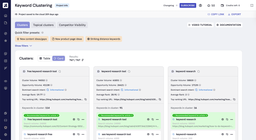
Keyword Insights takes a messy list of Amazon keyword ideas and groups it by live search-result overlap, so phrases Google treats as one topic land in one cluster. Each cluster can become a listing group or a blog post that supports the listing, and the tool turns clusters into content briefs with headings and questions. That planning step is what most sellers skip, and it is the reason listings compete with each other instead of covering distinct phrases.
The catch is the price and the credit burn. Basic costs $58 a month ($46 billed annually) for 10,000 credits, and clustering costs 1 credit per keyword while a brief costs 100, so a big list eats credits fast. There is no free plan, only a $1 trial for 7 days with 5,000 credits.
What we like
Clusters keywords by live result overlap, not guesswork.
Turns clusters into briefs with headings and questions.
$1 trial gives 5,000 credits for 7 days.
Watch out for
No free plan, only a $1 trial for 7 days.
Briefs cost 100 credits each, so big lists burn fast.
Needs a keyword list first; it does not discover ideas.
Sources used: vendor pricing pages, docs, changelogs. Prices and limits were checked against each vendor's own pricing page in Nov 2026.
Criterion
Weight
What we looked at
Amazon search data
40%
We ranked tools on whether they show real Amazon search data and listing phrases, not Google volume relabeled for Amazon.
Listing phrase volume
35%
We favored tools that turn one product word into hundreds of listing phrases, since a listing needs titles, bullets and backend terms.
Price for a small seller
25%
We priced each tool at its entry tier, since most sellers pay out of pocket and need the cheapest workable option.
What are the best keyword research tools for Amazon?
Keyword Tool.io is the best keyword research tool for Amazon for most sellers because its Amazon tab pulls autocomplete phrases straight from Amazon search, and paid plans add volume data from $69 a month billed annually. Keywords Everywhere is the cheapest way to see Amazon volume in your browser at $7 a month, and Ahrefs gives the widest data for sellers who also run a site. Google Keyword Planner is free but shows ranges, not exact counts.
How much do keyword research tools for Amazon cost?
Keyword research tools for Amazon cost $7 to $139.95 a month at the entry tier in Nov 2026. Keywords Everywhere starts at $7 a month billed annually, AnswerThePublic starts at $20 a month, KeySearch starts at $24 a month, Ahrefs Starter starts at $29 a month, Keyword Insights starts at $58 a month, Keyword Tool starts at $69 a month billed annually, and Semrush Pro starts at $139.95 a month. Google Keyword Planner costs nothing.
Is there a free keyword research tool for Amazon?
Yes, free keyword research tools for Amazon exist, and 6 of the 8 tools in this list have a free plan. Google Keyword Planner is free with a Google Ads account, AnswerThePublic gives 3 free searches a day, Keyword Tool shows ideas without volume for free, and Keywords Everywhere gives free extension features. Ahrefs and Semrush both offer limited free accounts. Free tiers hide exact volume, so a paid plan pays off once listings drive real revenue.
Which Amazon keyword tool is easiest for a new seller?
Keyword Tool and Keywords Everywhere are the easiest Amazon keyword tools for a new seller. Keyword Tool needs no account for basic ideas: pick the Amazon tab, type a product word, and copy the phrase list into your listing. Keywords Everywhere adds volume to the Amazon pages you already browse, so there is nothing new to learn. Ahrefs and Semrush take longer because they are full SEO suites.
How should I compare the best keyword research tools for Amazon?
Run a best keyword research tools for Amazon comparison on the same product word in every tool, not on the headline price. Note how many listing phrases each tool returns, whether it shows Amazon volume or Google volume, and what the entry plan costs per month. Then check whether it shows difficulty, since a high-volume phrase crowded with big brands is worth less than a smaller phrase you can win.
Frequently asked questions
What is the best keyword research tool for Amazon in 2026?
Keyword Tool.io is the best keyword research tool for Amazon in 2026 for most sellers. Its Amazon tab pulls autocomplete phrases straight from Amazon search, and paid plans add volume data from $69 a month billed annually. Keywords Everywhere is the best budget pick at $7 a month, and Ahrefs is the best pick for sellers who also run a site.
What are the top keyword research tools for Amazon 2026?
The top keyword research tools for Amazon 2026 are Keyword Tool.io, Keywords Everywhere and Ahrefs, based on Amazon search data, listing phrase volume and price. Keyword Tool.io leads on Amazon-specific ideas, Keywords Everywhere leads on price at $7 a month, and Ahrefs leads on data depth. All three were priced in Nov 2026.
Can I research Amazon keywords for free?
Yes, you can research Amazon keywords for free. Google Keyword Planner is free with a Google Ads account, AnswerThePublic gives 3 free searches a day, and Keyword Tool.io shows ideas without volume at no cost. Keywords Everywhere also gives free extension features. Free tiers hide exact volume, so expect idea lists or ranges only.
Does Google Keyword Planner work for Amazon?
Yes, Google Keyword Planner works for Amazon planning, with limits. It is free with a Google Ads account and shows volume ranges for phrases buyers also type into Google. It does not show Amazon search counts, listing competition or autocomplete phrases, so pair it with Keyword Tool.io or Keywords Everywhere for Amazon-specific ideas.
Is Keyword Tool or Ahrefs better for Amazon?
Keyword Tool.io is better for pure Amazon listing phrases because its Amazon tab returns hundreds of autocomplete phrases per product word. Ahrefs is better if you also run a site and want competitor data, backlinks and rank tracking in the same account. Keyword Tool.io starts at $69 a month billed annually, while full data in Ahrefs starts at $129 a month on Lite.
What is the cheapest Amazon keyword tool?
Keywords Everywhere is the cheapest Amazon keyword tool in this list at $7 a month billed annually for Bronze with 100,000 credits. One credit buys volume, CPC, competition and a 12-month trend for one keyword. The extension installs free, but volume data needs paid credits.
How many keywords should I put in an Amazon listing?
Use every phrase that fits the listing honestly: the title holds the main phrase, the bullet points hold the close variants, and the backend search terms hold the rest. Do not repeat a phrase across fields, since Amazon reads them together. A phrase that does not describe the product hurts conversion, even if its volume looks high.
Final verdict
Pick Keyword Tool.io if you want the most Amazon listing phrases from one product word.
Pick Keywords Everywhere if you want Amazon volume in your browser for $7 a month.
Pick Ahrefs if you also run a site and want competitor data in one account.
Pick Semrush if you research Amazon listings next to Google rankings.
Pick AnswerThePublic if you write listings around the questions buyers ask.
Pick Google Keyword Planner if you want free first-party volume data before you spend.
Pick KeySearch if you want one budget tool for research and rank tracking.
Pick Keyword Insights if you turn a long keyword list into planned listing groups.
Looking for the best keyword research tools? We compared 10 options on pricing, free plans, key features and trade-offs so you can pick the right one fast.
Our 2026 shortlist of the 7 best free keyword research tools, with real starting prices, free plan details, pros, cons and a clear pick for each use case.
Our 2026 shortlist of the 8 best cheap keyword research tools, with real starting prices, free plan details, pros, cons and a clear pick for each use case.