What is KeySearch?
KeySearch is a keyword research and SEO platform that helps bloggers, publishers and small businesses find keywords they have a realistic chance of ranking for. You enter a seed term and it returns related ideas with search volume, cost-per-click and a difficulty score, along with a live look at the pages already ranking. The aim is to spot gaps where smaller sites can compete without the budget of a large SEO suite.
Beyond keyword research, the toolkit bundles competitor analysis, backlink checks, YouTube research, a site auditor, rank tracking and an AI content assistant. The company says it has operated since 2015. KeySearch sits at the lower end of the SEO software price range, which makes it a common pick for solo site owners and freelancers who need the core tools without paying for enterprise features.
KeySearch at a glance
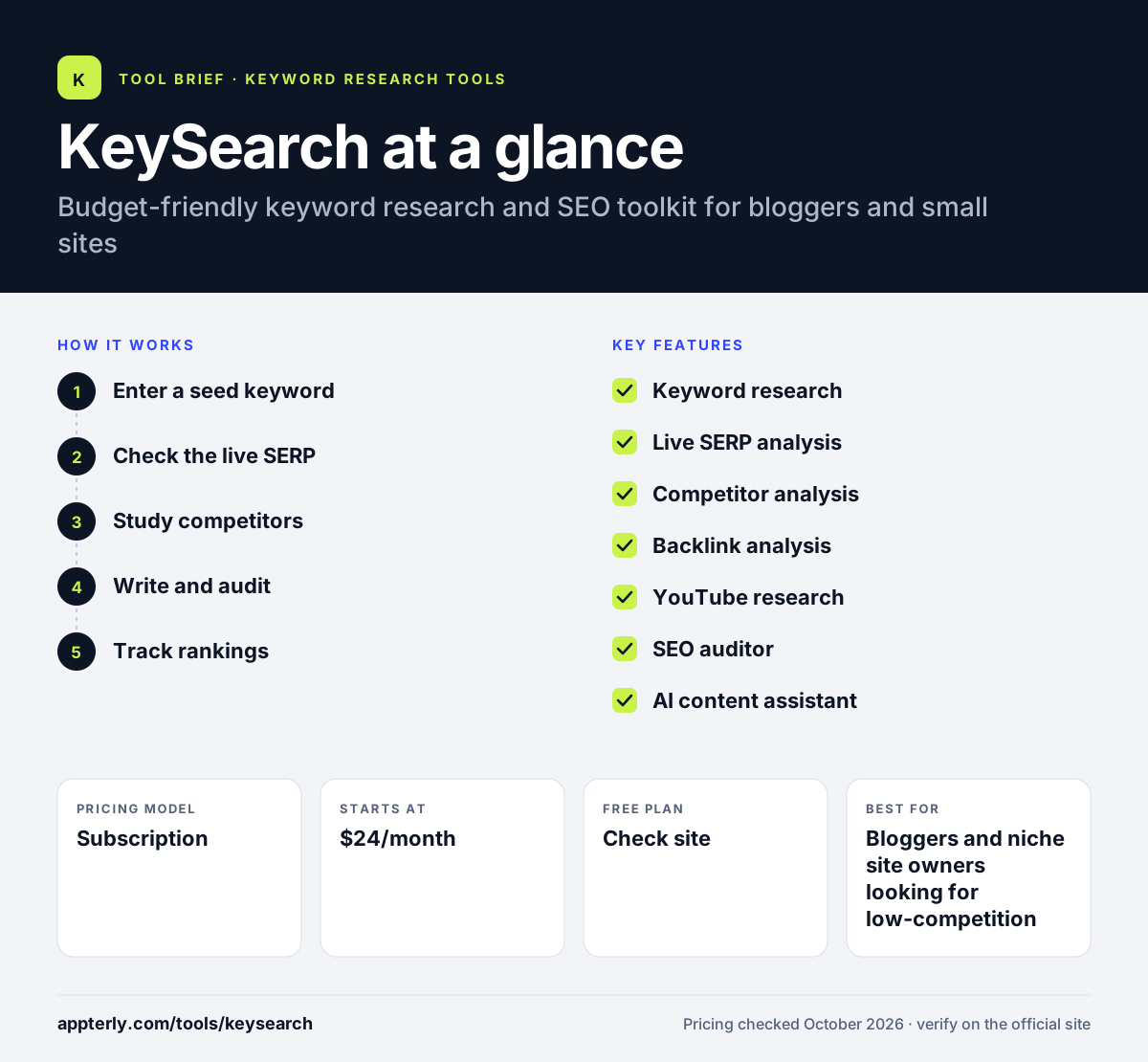
How does KeySearch work?
- Enter a seed keyword
Type a topic and choose a country to get a list of related and long-tail keyword ideas with volume, CPC and difficulty.
- Check the live SERP
Open the results for a keyword to see who ranks, their authority and backlink signals, and whether weaker pages appear on page one.
- Study competitors
Plug in a competitor domain or URL to see the keywords it ranks for and the links pointing to it.
- Write and audit
Use the AI content assistant to draft and optimize a page, then run the SEO auditor to catch technical issues.
- Track rankings
Add your target keywords to the rank tracker and watch how positions move over time.
KeySearch key features
Keyword research
Generates keyword ideas with search volume, CPC and a color-coded difficulty score for each term.
Live SERP analysis
Pulls current search results so you can judge competition from real ranking pages rather than a single number.
Competitor analysis
Shows the organic keywords a domain or page ranks for, helping you find topics to target.
Backlink analysis
Lists backlinks for a site or URL so you can assess link strength and find outreach ideas.
YouTube research
Finds video keyword ideas and checks how strong the competing videos are.
SEO auditor
Crawls your pages to surface on-page and technical problems, with monthly audit page limits by plan.
AI content assistant
Helps draft and optimize content using monthly AI credits included in each plan.
Rank tracking
Monitors positions for a set number of keywords, with Foresight trend data on the Pro plan.
Why use KeySearch?
- It covers keyword research, backlinks, audits and rank tracking in one subscription at a lower price than large SEO suites.
- Difficulty scores are backed by live SERP data, which helps you check whether a keyword is truly winnable.
- YouTube research is included, so video creators can plan content in the same tool.
- A 7-day free trial lets you test the workflow before paying.
- There are no long-term contracts, so you can cancel or change plans as needs shift.
Who is KeySearch best for?
A good fit for
- Bloggers and niche site owners looking for low-competition keywords
- Freelance writers and SEO consultants on a tight budget
- Small businesses doing their own SEO
- YouTube creators who want keyword ideas for videos
Less suited to
- Large agencies that need very high data limits, white-label reporting or deep API access
- Teams that need paid search, social or broad market research tools in the same platform
KeySearch pricing
| Pricing model | Subscription |
|---|---|
| Free plan | Not confirmed |
| Free trial | 7 days |
| Starting price | $24/month |
Starter allows 200 keyword searches per day and 80 tracked keywords. Pro costs $48/month, raises the limits and adds Foresight. Annual billing gives two months free.
Prices checked October 2026. Vendors change plans often, so confirm on the official KeySearch pricing page before you buy.
KeySearch pros and cons
Pros
- Low entry price for a full keyword and SEO toolkit
- Live SERP view makes difficulty scores easier to trust
- Includes YouTube research and an AI content assistant
- Simple two-plan structure with a free trial
Cons
- Daily search and tracking limits can feel tight for heavy users
- Smaller data sets and fewer integrations than large enterprise SEO platforms
KeySearch integrations and platforms
Available on
KeySearch alternatives
See the full shortlist in Best Keyword Research Tools.
KeySearch FAQ
Is KeySearch free?
KeySearch is a paid tool, but it offers a 7-day free trial that you can cancel at any time. After the trial, the Starter plan costs $24 per month and the Pro plan costs $48 per month. Paying annually gives you two months free. The site also offers some free SEO tools and keyword lists separately from the main app.
What is KeySearch used for?
KeySearch is used to find keywords a website can realistically rank for. Bloggers and small businesses use it to research keyword ideas, check search volume and difficulty, review live search results, analyze competitors and backlinks, research YouTube topics, audit their site and track keyword rankings over time.
Is KeySearch good for beginners?
Yes. KeySearch is often chosen by beginners because the interface is simple, difficulty scores are color coded, and the price is low compared with larger SEO suites. New users can start with a seed keyword and quickly see which ideas look winnable. The site also publishes tutorials and an SEO crash course to help newcomers learn.
KeySearch vs KWFinder: what's the difference?
Both KeySearch and KWFinder focus on finding easy-to-rank keywords for smaller sites. KWFinder is part of the Mangools suite, which splits SERP checks, rank tracking and backlinks into separate apps under one plan. KeySearch keeps everything in one dashboard and adds YouTube research and an AI content assistant at a lower starting price.
Does KeySearch track keyword rankings?
Yes. Both KeySearch plans include a rank tracker. The Starter plan covers 80 tracked keywords per month and the Pro plan covers 200. You can follow how your pages move in search results and compare that against the keywords you researched, all from the same account.
Sources
This overview is based on KeySearch's official website and documentation, checked October 2026.