How we make this list: we compare vendor pricing pages, product documentation and plan limits, and print the month we checked each price. We don’t accept payment for rankings.
QUICK ANSWER
ChatGPT is the best AI writing tool for small business in 2026 because one $20-a-month Plus plan covers copy, email, planning and research, with a free plan to start. Gemini ranks second as the cheapest paid option at $4.99 a month, and Claude is the best pick for careful client-facing writing. Rytr is the cheapest route to unlimited short copy.
Key takeaways
6 of 8 tools in this list have a free plan, and the lowest paid start is $4.99 a month (Google AI Plus) (Nov 2026).
ChatGPT ranks first for small business because one tool covers copy, email, planning and research.
Gemini is the cheapest paid start at $4.99 a month, and it suits businesses already on Google Workspace.
Jasper and Copy.ai are the team picks, but they cost $59 a seat and $24 a month for five seats.
Rytr Lite at $9 a month is the cheapest unlimited short-copy plan, and Grammarly keeps client emails clean.
The best AI writing tools for small business do several jobs at once: website copy, emails, social posts, product descriptions and the occasional plan or report. A small business cannot afford five subscriptions, so price at small-business scale, setup time and included support matter more than enterprise features. These are the 8 best AI writing tools for small business in 2026, ranked on value, speed and fit.
It sits under our best AI writing tools pillar, which compares the full category. If you only want free options, our guide to the best free AI writing tools ranks the seven genuine free plans.
PlatformsWeb, iOS, Android, Windows, macOS, Chrome extension, API
ChatGPT is the best small-business AI writer because it does the most jobs for one price. It drafts website copy, emails, social posts, product descriptions and business plans, and the free plan covers unlimited everyday text chats, so a business can start without paying. Custom GPTs can store your services, prices and brand rules, which keeps the output closer to your business on every new task.
The catch is the meter on everything around the chat. Free users get 3 file uploads a day, limited image generation, limited voice and limited deep research, and OpenAI does not publish exact caps for most of them. Plus at $20 a month raises those limits but does not remove them, and there is no annual discount.
What we like
Free plan covers unlimited everyday text chats (Nov 2026).
Plus at $20 a month adds stronger reasoning and higher limits.
Custom GPTs and a wide app list cover many daily jobs.
Watch out for
Free plan caps file uploads at 3 a day and limits image and voice use.
Output still needs fact-checking and editing before you publish it.
No native SEO metrics such as search volume or rankings.
Gemini is the small-business pick for Google users. It drafts inside Gmail and Docs on paid plans, generates images for a post or a listing without a second tool, and Google AI Plus at $4.99 a month is the cheapest paid step in this list. The free plan covers drafting too, with image generation and Deep Research included, which suits a business that already pays for Google storage.
The catch is the unpublished meter. Google says Plus doubles free usage and Pro quadruples it, but it does not publish the base number, so you cannot plan around a fixed message count. The free plan now runs on the lighter Flash-Lite model, and the strongest models need Pro at $19.99 a month.
What we like
Google AI Plus at $4.99 a month is the cheapest paid start in this list (Nov 2026).
Free plan includes image generation and Deep Research.
Paid plans add Gemini inside Gmail, Docs and other Google apps.
Watch out for
Exact usage limits are not published for each plan.
Best value only if you already live in Google's ecosystem.
Free plan moved to the lighter Flash-Lite model in Oct 2026.
PlatformsWeb, iOS, Android, Windows, macOS, Chrome extension, API
Claude is the small-business pick when the writing goes to clients. It writes proposals, quotes, emails and website pages in a natural tone, holds context across a long document, and edits cleanly when you ask it to tighten a paragraph. Projects keep one client's briefs, drafts and notes together, so a proposal stays consistent from first line to last.
The catch is the usage meter. Free usage resets on a rolling five-hour window, and even Pro carries a weekly cap, so a heavy day can stop mid-session. There is no native image generation, and the most capable models sit behind paid plans. Max starts at $100 a month for people who write with Claude all day.
What we like
Strong long-form prose that holds voice across long documents (Nov 2026).
Pro costs $17 a month billed annually, or $20 month to month.
Projects plus Docs and Slides creation suit document-heavy work.
Watch out for
Usage limits reset on a rolling five-hour window and can interrupt heavy sessions.
No native image generation for marketing visuals.
Claude Code and the most capable models need a paid plan.
Jasper suits a small business that publishes a lot and cannot let the brand voice slip. Two Brand Voices on Pro and five Knowledge assets keep the website, emails and social posts sounding like the same company, and the Canvas workspace lets a small team draft together. The price is the issue: Pro costs $59 per seat a month billed annually, so it only pays off when several people write every day.
The catch is the price and the seat model. Pro costs $59 per seat a month billed annually, or $69 month to month, and each seat is billed separately, so a five-person team pays $295 a month on annual billing. There is no free plan, only a 7-day trial, and the Business plan locks you into 12 months.
What we like
Brand Voices and Knowledge assets keep output on-brand (Nov 2026).
Ready-made agents cover common marketing workflows.
Canvas workspace suits teams that draft and edit together.
Watch out for
No free plan, and Pro costs $59 per seat a month billed annually.
Advanced features such as Grid and custom agents need the Business plan.
Copy.ai fits a small business that sells as well as writes. Chat at $24 a month billed annually covers five seats with unlimited words and access to models from OpenAI, Anthropic and Google, so the whole team can draft copy and sales emails in one place. Workflows on higher tiers connect that copy to prospecting and CRM data, which suits a sales-led business.
The catch is the gap between Chat and the real product. Chat at $24 a month billed annually is a fair deal for five seats, but the workflow engine Copy.ai now builds around starts at $1,000 a month billed annually. The old free plan was sunset, and the trial length is not stated on the pricing page.
What we like
Chat covers 5 seats with unlimited words for $24 a month billed annually (Nov 2026).
Workflows tie copy to prospecting, enrichment and CRM data.
One chat gives access to models from OpenAI, Anthropic and Google.
Watch out for
No free plan; the old free tier was sunset in 2026.
Workflow plans jump to $1,000 a month billed annually.
Rytr is the budget small-business pick. The free plan gives 10,000 characters a month with no credit card, and Lite at $9 a month removes the character cap, which makes it the cheapest unlimited short-copy plan in this list. It writes emails, captions, product blurbs and ad lines fast in 30+ languages, though it is not built for long pages or reports.
The catch is length. Ten thousand free characters a month is roughly one short post, and even Lite with unlimited characters stays a short-form tool. Long articles need heavy editing and stitching, and the newer Engage features around follow-ups will not matter if you only want a writer.
What we like
Free plan gives 10,000 characters a month with no credit card (Nov 2026).
Lite at $9 a month removes the character cap entirely.
40+ use cases and 30+ languages cover short copy fast.
Watch out for
Best suited to short-form copy, not long articles.
The shift toward relationship tools may not matter to pure writers.
Grammarly is the small-business editor in this list. The free plan checks spelling, grammar and punctuation, detects tone and includes 100 AI prompts a month, so client emails and quotes go out clean. Pro at $12 a member a month billed annually adds rewrites, tone adjustment, style guides and 2,000 prompts, which suits a team that needs one writing standard.
The catch is the billing gap. Pro costs $12 a member a month billed annually, or $144 a year up front, but $30 a month if you pay month to month, so a year costs $360 that way. The free plan covers the core grammar checks well, and Pro mainly buys rewrites, tone control and a much larger prompt allowance.
What we like
Free plan checks grammar, spelling and tone with 100 AI prompts a month (Nov 2026).
Pro at $12 a month billed annually adds rewrites and 2,000 prompts.
Works across browsers, desktop and mobile apps.
Watch out for
Monthly billing for Pro costs $30 a month, far above the annual rate.
Advanced rewrites and plagiarism checks need a paid plan.
Suggestions can feel generic for creative or technical writing.
QuillBot is the small-business pick for refreshing old copy. Its paraphraser rewrites stale website pages and ad lines in nine modes on Premium, the summarizer condenses long documents into briefs, and the citation generator helps with sourced pieces. Premium at $8.33 a month billed annually is one of the cheapest paid plans here, and the free plan handles 125 words at a time.
The catch is the 125-word ceiling. One long paragraph per pass is fine for a sentence or two, but reworking a full article means dozens of passes, and the free humanizer is capped at 125 words across six uses a day. Premium at $8.33 a month billed annually removes the cap and adds the plagiarism checker at 25,000 words a month.
What we like
Free plan paraphrases 125 words at a time in two modes (Nov 2026).
Premium at $8.33 a month billed annually opens nine modes.
Built-in humanizer, summarizer, citation generator and plagiarism checker.
Watch out for
Free plan caps paraphrasing at 125 words per pass.
Few team or brand voice controls next to marketing platforms.
Paraphrased output still needs review for accuracy.
Sources used: vendor pricing pages, vendor product pages and vendor help pages, checked Nov 2026.
Criterion
Weight
What we looked at
Price at small-business scale
35%
Small businesses pay per seat, so we weighed entry price, free-plan value and how the bill grows with each team member.
Breadth of jobs covered
30%
We favored tools that cover copy, email, social and planning in one subscription over single-purpose tools.
Setup time
20%
We weighed how fast a business can start, since a tool that needs a week of setup costs more than its price.
Support and integrations
15%
We checked Google and Word integrations, browser extensions and whether help is included on the entry plan.
What are the best AI writing tools for small business in 2026?
The best AI writing tools for small business in 2026 are ChatGPT, Gemini and Claude. ChatGPT leads because one tool covers copy, email, planning and research, Gemini is the cheapest paid start at $4.99 a month, and Claude is the best pick for careful client-facing writing. Rytr is the cheapest route to unlimited short copy at $9 a month.
How much do AI writing tools for small business cost?
Small-business tools in this list start at $4.99 a month for Google AI Plus, $8.33 a month billed annually for QuillBot Premium, and $9 a month for Rytr Lite. ChatGPT Plus and Claude Pro both cost $20 a month, Grammarly Pro is $12 a member a month billed annually, and Copy.ai Chat is $24 a month for five seats. Jasper Pro is $59 per seat a month billed annually.
Is there a free AI writing tool for small business?
Yes, six of the eight tools in this list have a free plan: ChatGPT, Gemini, Claude, Rytr, Grammarly and QuillBot. ChatGPT is the strongest free pick because its free plan covers unlimited everyday text chats. Jasper and Copy.ai have no free plan, only trials, so start with a free tool and pay once the limits pinch.
Which AI writing tool is best for a one-person business?
ChatGPT is the best AI writing tool for a one-person business because one plan covers copy, email, planning and research, and the free plan handles a surprising amount of daily work. Gemini is the cheapest paid step at $4.99 a month, and Rytr Lite at $9 a month suits a business that only needs short copy. Avoid per-seat tools like Jasper until you have a team.
Can AI writing tools write my website copy?
Yes, ChatGPT, Claude and Jasper all draft website copy, and Claude writes the most natural pages. Give the tool your services, audience and tone, then edit the draft with real facts about your business, since AI can invent claims that sound right. A human edit is what keeps the copy honest and specific to your business.
Frequently asked questions
What is the best AI writing tool for small business?
ChatGPT is the best AI writing tool for small business because one $20-a-month Plus plan covers copy, email, planning and research, with a free plan to start. Gemini ranks second as the cheapest paid option at $4.99 a month, and Claude is the best pick for careful client-facing writing. Rytr is the cheapest route to unlimited short copy.
Is ChatGPT good for small business?
Yes, ChatGPT is good for small business because it drafts website copy, emails, social posts, product descriptions and plans in one place. The free plan covers unlimited everyday text chats, and Plus costs $20 a month. Custom GPTs can store your services, prices and brand rules, which keeps output consistent across jobs.
What is the cheapest AI writing tool for small business?
Google AI Plus is the cheapest paid entry at $4.99 a month, with double the free usage and 400 GB of storage. QuillBot Premium is $8.33 a month billed annually, and Rytr Lite is $9 a month, or $7.50 a month billed annually. The cheapest way to start is free: ChatGPT, Claude and Gemini all have free plans.
Is Jasper worth it for a small business?
Jasper is worth it only for a small business that publishes a lot and needs every piece to match a strict brand voice. Pro costs $59 per seat a month billed annually, or $69 month to month, with no free plan. Most small businesses get more value from ChatGPT at $20 a month or Copy.ai Chat at $24 a month for five seats.
Can AI writing tools help with customer emails?
Yes, ChatGPT, Claude and Gemini all draft customer emails, and Grammarly checks tone and grammar before you send. Claude writes the most natural client emails, while ChatGPT is fastest for replies and templates. Always check prices, dates and promises in the draft yourself, since AI can invent details that cost you a customer.
Which AI tool is best for product descriptions?
ChatGPT and Jasper are the best picks for product descriptions in this list. ChatGPT is fastest for a small catalog, and Jasper suits a business that needs every description to match one brand voice. For a large catalog, our guide to the best AI writing tools for ecommerce product descriptions covers the bulk and catalog tools in more depth.
Do I need a paid AI writing tool for my business?
Not at first. ChatGPT, Claude and Gemini all have free plans that cover real daily work, and Rytr, Grammarly and QuillBot add free editing and short copy. Pay once the free limits pinch: Gemini at $4.99 a month is the cheapest step, and ChatGPT Plus at $20 a month suits most small businesses that write every day.
Final verdict
Pick ChatGPT if you want one tool for copy, email and planning.
Pick Gemini if your business runs on Google apps and you want the cheapest paid start.
Pick Claude if your writing goes to clients and must read naturally.
Pick Jasper if your team publishes a lot and needs one brand voice.
Pick Copy.ai if your team also sells and needs five seats for $24 a month.
Pick Rytr if your budget is tight and you mainly need short copy.
Pick Grammarly if you want clean emails and documents across the team.
Pick QuillBot if you refresh website and ad copy on a small budget.
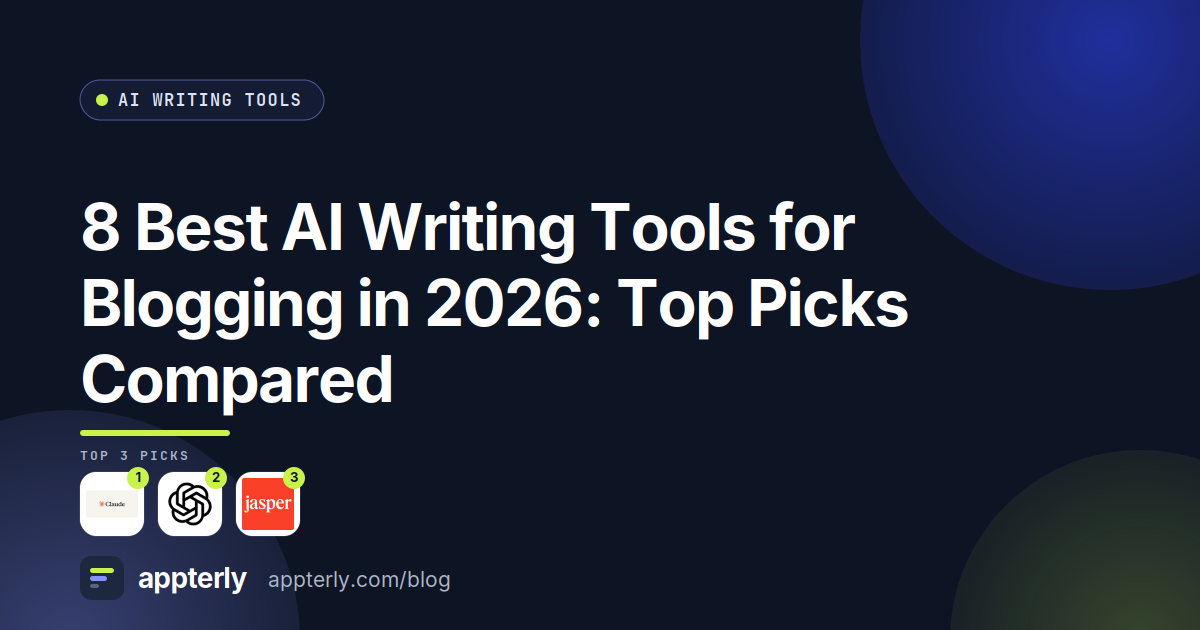
Our 2026 shortlist of the 8 best AI writing tools for blogging, with real starting prices, free plan details, pros, cons and a clear pick for each use case.