What is Wicked Reports?
Wicked Reports is a marketing attribution platform that connects ad clicks to the orders and customers they actually produced. It pulls first-party data from your store, CRM and ad accounts, then shows which channels, campaigns and creatives brought in new buyers versus repeat customers. The goal is to give media buyers a clearer view of return on ad spend than the numbers reported inside each ad platform.
The product is aimed at brands and agencies spending serious money on paid traffic. Beyond reporting, it can send verified new-customer conversion events back to Meta and Google Ads so their algorithms optimize toward real buyers. Its weekly decision framework labels each channel as one to scale, hold steady or cut, and it tracks lifetime value through cohort reports.
Wicked Reports at a glance
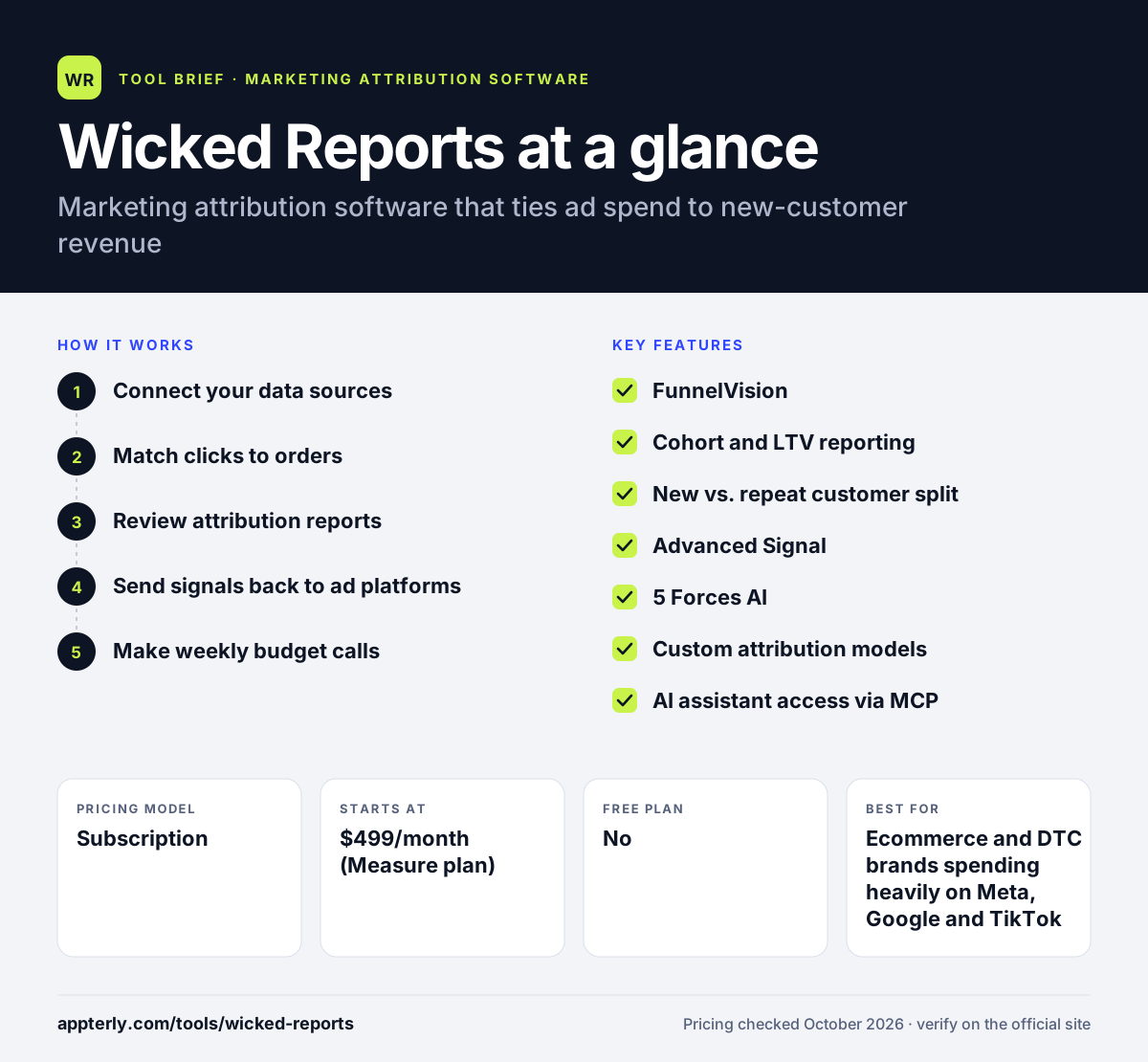
How does Wicked Reports work?
- Connect your data sources
Link your ecommerce cart or CRM, such as Shopify, WooCommerce or Klaviyo, plus ad accounts like Meta, Google Ads and TikTok. Custom systems can connect through the API, Zapier or webhooks.
- Match clicks to orders
Wicked Reports tracks first-party click data and ties each order back to the touchpoints that came before it. It separates new customers from returning ones.
- Review attribution reports
Use FunnelVision views and cohort and LTV reports to compare channels, campaigns and creatives across different attribution windows, including long lookback periods.
- Send signals back to ad platforms
On higher plans, Advanced Signal passes verified new-customer events to Meta through its Conversions API, and a Google Ads Conversion API option is also listed.
- Make weekly budget calls
Decide which channels to scale, hold or cut, and log each decision so you can track its dollar impact over time.
Wicked Reports key features
FunnelVision
Pre-built report views that show how channels perform at different stages of the funnel, from first click to final purchase.
Cohort and LTV reporting
Tracks how customers acquired from each channel keep buying over time, so you can judge ads on lifetime value instead of the first order only.
New vs. repeat customer split
Separates first-time buyers from returning customers, which helps you see whether ads are truly acquiring new people.
Advanced Signal
Sends verified new-customer conversion data to Meta via the Conversions API to improve ad optimization. It is an add-on on lower plans.
5 Forces AI
An AI analysis layer included on the Maximize plan and above, and available as a paid add-on on Measure and Scale.
Custom attribution models
Lets you set up custom conversions and attribution models, with lifetime lookback and lookforward windows on every plan.
AI assistant access via MCP
An MCP server lets AI assistants such as ChatGPT or Claude query your Wicked Reports data in plain language.
Amazon revenue integration
The Maximize plan adds Amazon revenue so brands selling on and off Amazon can see a fuller picture of ad impact.
Why use Wicked Reports?
- You get attribution based on your own first-party order data instead of relying only on each ad platform's self-reported conversions.
- Splitting new and repeat buyers shows whether ad spend is growing the customer base or just retargeting existing customers.
- Cohort and LTV reports help justify channels that look weak on first purchase but bring in high-value customers later.
- Feeding verified new-customer events back to Meta can help its algorithm find more real buyers.
- A weekly scale, hold or cut routine turns attribution data into clear budget decisions.
Who is Wicked Reports best for?
A good fit for
- Ecommerce and DTC brands spending heavily on Meta, Google and TikTok ads
- Subscription brands that need to track customer lifetime value
- Digital agencies and media buyers managing large paid budgets
- Brands selling on both their own store and Amazon
Less suited to
- Small stores or solo sellers with modest ad budgets, since plans start at $499 per month
- Teams that only need basic dashboards rather than order-level attribution
- Businesses with mostly offline sales and little paid digital advertising
Wicked Reports pricing
| Pricing model | Subscription |
|---|---|
| Free plan | No |
| Free trial | Not confirmed |
| Starting price | $499/month (Measure plan) |
Plans are Measure ($499/mo), Scale ($699/mo), Maximize ($999/mo) and Enterprise (from $4,999). Plans are tied to your trailing 12-month gross revenue, and higher tiers add API integrations, 5 Forces AI, Advanced Signal, custom conversions and Amazon revenue.
Prices checked October 2026. Vendors change plans often, so confirm on the official Wicked Reports pricing page before you buy.
Wicked Reports pros and cons
Pros
- Uses first-party click and order data rather than platform-reported conversions alone
- Strong focus on new-customer acquisition and lifetime value
- Can push verified conversion signals back to Meta and Google Ads
- Connects with major carts, CRMs and ad networks, plus API and webhooks for custom setups
Cons
- High entry price makes it hard to justify for small advertisers
- Key features like 5 Forces AI and Advanced Signal cost extra on the two lower plans
- No free trial is listed on the pricing page
Wicked Reports integrations and platforms
Works with
Available on
Wicked Reports alternatives
See the full shortlist in Best Marketing Attribution Tools.
Wicked Reports FAQ
What is Wicked Reports used for?
Wicked Reports is used to measure which paid marketing channels, campaigns and ads actually bring in customers and revenue. It connects your store or CRM with your ad accounts, ties orders back to clicks, and separates new buyers from repeat ones. Brands and agencies use it to decide where to increase, hold or cut ad budgets based on first-party data.
How much does Wicked Reports cost?
As of October 2026, Wicked Reports lists four plans: Measure at $499 per month, Scale at $699 per month, Maximize at $999 per month, and Enterprise starting at $4,999. Pricing is linked to your gross revenue over the last 12 months. The 5 Forces AI and Advanced Signal add-ons cost $199 per month each on the Measure and Scale plans.
Does Wicked Reports integrate with Shopify?
Yes. Wicked Reports lists Shopify among its ecommerce integrations, along with WooCommerce, BigCommerce and Amazon. It also connects to Klaviyo, Stripe and the major ad platforms, including Meta, Google Ads, TikTok, Pinterest, Snapchat and Microsoft Ads. Systems without a native connector can be linked through the API, Zapier or webhooks.
Wicked Reports vs Triple Whale: what's the difference?
Both tools offer ecommerce attribution, but they lean in different directions. Triple Whale is built mainly around Shopify brands and bundles attribution with broad store analytics dashboards. Wicked Reports focuses on first-party click attribution, new versus repeat customer analysis and lifetime value cohorts, and it supports several carts and CRMs. Wicked Reports also positions itself toward agencies and larger ad budgets.
Is Wicked Reports good for beginners?
Wicked Reports suits marketers who already run paid ads at meaningful scale and understand concepts like attribution windows and customer lifetime value. A beginner can follow its pre-built views, but the price and depth are geared toward experienced media buyers and agencies. Smaller advertisers may get more value from built-in ad platform reporting or a lighter attribution tool first.
Sources
This overview is based on Wicked Reports's official website and documentation, checked October 2026.