What is Attribution App?
Attribution App is multi-touch marketing attribution software that shows which ads, channels and campaigns lead to signups, deals and revenue for B2B, SaaS and ecommerce companies. It connects website visits, ad costs and CRM or payment data, then assigns credit across touchpoints using models such as first touch, linear and time decay. The product is sold under the name Attribution and is often called Attribution App after its domain.
A key difference is that Attribution ties ad cost to individual user journeys. That lets teams calculate customer acquisition cost, ROAS, payback period and LTV to CAC by channel or campaign, and trace every number back to the underlying visits. It also offers media mix modeling and incrementality testing, and pricing is based on tracked users rather than ad spend.
Attribution App at a glance
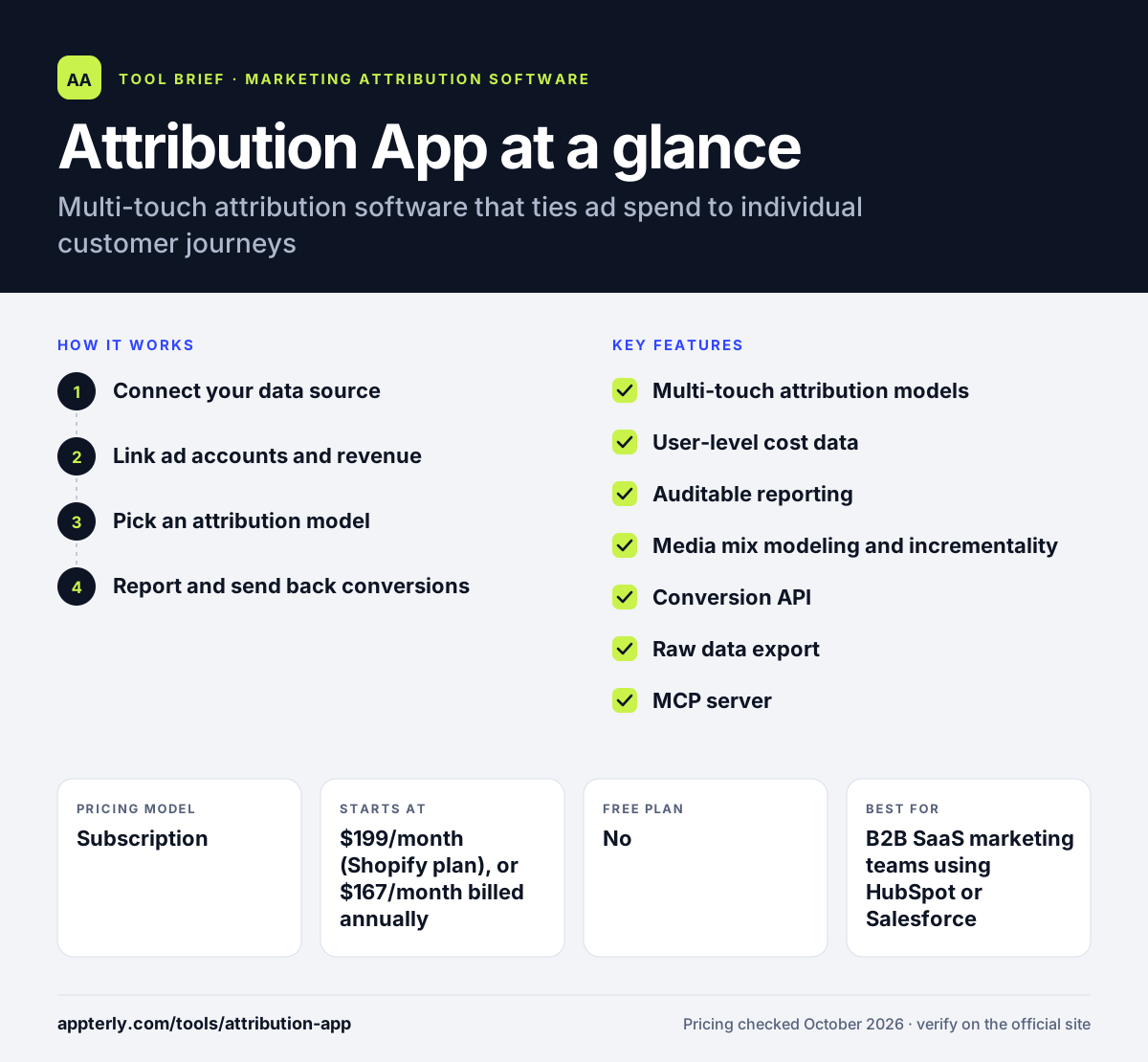
How does Attribution App work?
- Connect your data source
You connect a primary source such as HubSpot, Salesforce, Segment or Shopify, or add the website tracking script, so visits and conversions flow in.
- Link ad accounts and revenue
Ad platforms like Google, Meta and LinkedIn send cost data, and tools such as Stripe or your CRM supply revenue and deal outcomes.
- Pick an attribution model
Choose from five models and several modes, such as excluding direct traffic or cutting off at a trial event, to match your sales cycle.
- Report and send back conversions
Review CAC, ROAS and LTV reports by channel, then send attribution-weighted conversions back to ad platforms to improve their optimization.
Attribution App key features
Multi-touch attribution models
First touch, last touch, linear, time decay and position-based models, each with modes for excluding direct visits or stopping at a cutoff event.
User-level cost data
Ad spend is allocated to individual user journeys, which makes per-user CAC, ROAS and payback calculations possible.
Auditable reporting
Any metric can be traced back to the visits, touchpoints and cost allocations behind it, which helps when finance asks questions.
Media mix modeling and incrementality
Alongside multi-touch attribution, teams can run geo holdout and synthetic control tests to measure true lift.
Conversion API
Sends attribution-weighted conversions back to Google, Meta, LinkedIn and Microsoft so their bidding algorithms learn from real outcomes.
Raw data export
A paid add-on exports visit-level and user-level data to warehouses such as Snowflake, BigQuery and S3.
MCP server
Lets AI assistants such as Claude, ChatGPT and Cursor query your marketing data in plain language.
Why use Attribution App?
- It shows true acquisition cost per customer instead of platform-reported conversions.
- Every feature is included on every plan, so there is no feature gating.
- Pricing is based on tracked users, not on ad spend or revenue.
- Trial-based and product-led companies can attribute credit up to a specific event such as trial start.
- Reports are auditable down to the touchpoint level.
Who is Attribution App best for?
A good fit for
- B2B SaaS marketing teams using HubSpot or Salesforce
- Shopify stores that want multi-touch attribution at a lower price
- Product-led and trial-based software companies
- Agencies reporting on paid media for several clients
Less suited to
- Very small sites with little ad spend, since plans start at around $167 per month
- Teams that want a free plan to test long-term
- Companies that need raw data export but do not want to pay for an add-on
Attribution App pricing
| Pricing model | Subscription |
|---|---|
| Free plan | No |
| Free trial | 14 days |
| Starting price | $199/month (Shopify plan), or $167/month billed annually |
The Pro plan costs $399/month or $335/month billed annually; both Pro and Shopify include up to 10,000 monthly tracked users, with $10 per extra 1,000. Custom plans are quoted for higher traffic, and onboarding and data export are optional extras.
Prices checked October 2026. Vendors change plans often, so confirm on the official Attribution App pricing page before you buy.
Attribution App pros and cons
Pros
- Ties ad cost to individual users for real CAC and LTV figures
- All features available on every plan
- Transparent, published pricing with a free trial
- Wide range of CRM, ad, payment and warehouse integrations
Cons
- Data export and API access cost extra
- Paid onboarding can add $2,500 to $5,000 upfront
- No permanent free plan
Attribution App integrations and platforms
Works with
Available on
Attribution App alternatives
See the full shortlist in Best Marketing Attribution Tools.
Attribution App FAQ
Is Attribution App free?
No. Attribution App does not have a free plan, but it offers a 14-day free trial on its Pro and Shopify plans. After the trial, the Shopify plan costs $199 per month and Pro costs $399 per month, with roughly 16% off when billed annually. Larger sites get a custom quote.
What is Attribution App used for?
Attribution App is used to find out which marketing channels and campaigns actually produce customers and revenue. It combines website visits, ad spend and CRM or payment data, then assigns credit across touchpoints. Teams use the results to calculate CAC, ROAS and payback by channel and to move budget toward what works.
How does Attribution App charge?
Attribution App charges by monthly tracked users, which are unique known and anonymous visitors tracked in a month. Pro and Shopify plans include up to 10,000 of them, and each additional 1,000 costs $10. Pricing does not depend on ad spend or revenue, and every feature is included on every plan. Optional paid onboarding is available if you want help setting up.
Attribution App vs Dreamdata: what's the difference?
Both tools offer B2B multi-touch attribution. Attribution App focuses on tying ad cost to individual users for CAC and LTV analysis, publishes its prices and also serves Shopify stores. Dreamdata centers on account-based B2B journeys and audience activation, offers a free starter plan and quotes its advanced plan after a demo.
Does Attribution App integrate with Shopify?
Yes. Attribution App has a dedicated Shopify plan priced at $199 per month that uses Shopify as the primary data source. It also integrates with BigCommerce, HubSpot, Salesforce, Segment, Stripe and major ad platforms including Google, Meta, LinkedIn and TikTok.
Sources
This overview is based on Attribution App's official website and documentation, checked October 2026.