What is Triple Whale?
Triple Whale is an ecommerce analytics and attribution platform that brings store, ad, email and customer data into one place so online brands can see what drives growth. It combines a first-party pixel for attribution with dashboards, marketing mix modeling and an AI layer called Moby. It is used by founders, marketers and analysts at direct-to-consumer brands, especially on Shopify.
Triple Whale has moved beyond dashboards toward AI agents that can run scheduled analysis and take actions such as adjusting ad budgets or pausing campaigns. Its Compass view combines attribution, MMM and incrementality in one place. A free plan is available, and paid tiers scale with the store's revenue, with custom pricing for larger brands. The company lists its address in Columbus, Ohio.
Triple Whale at a glance
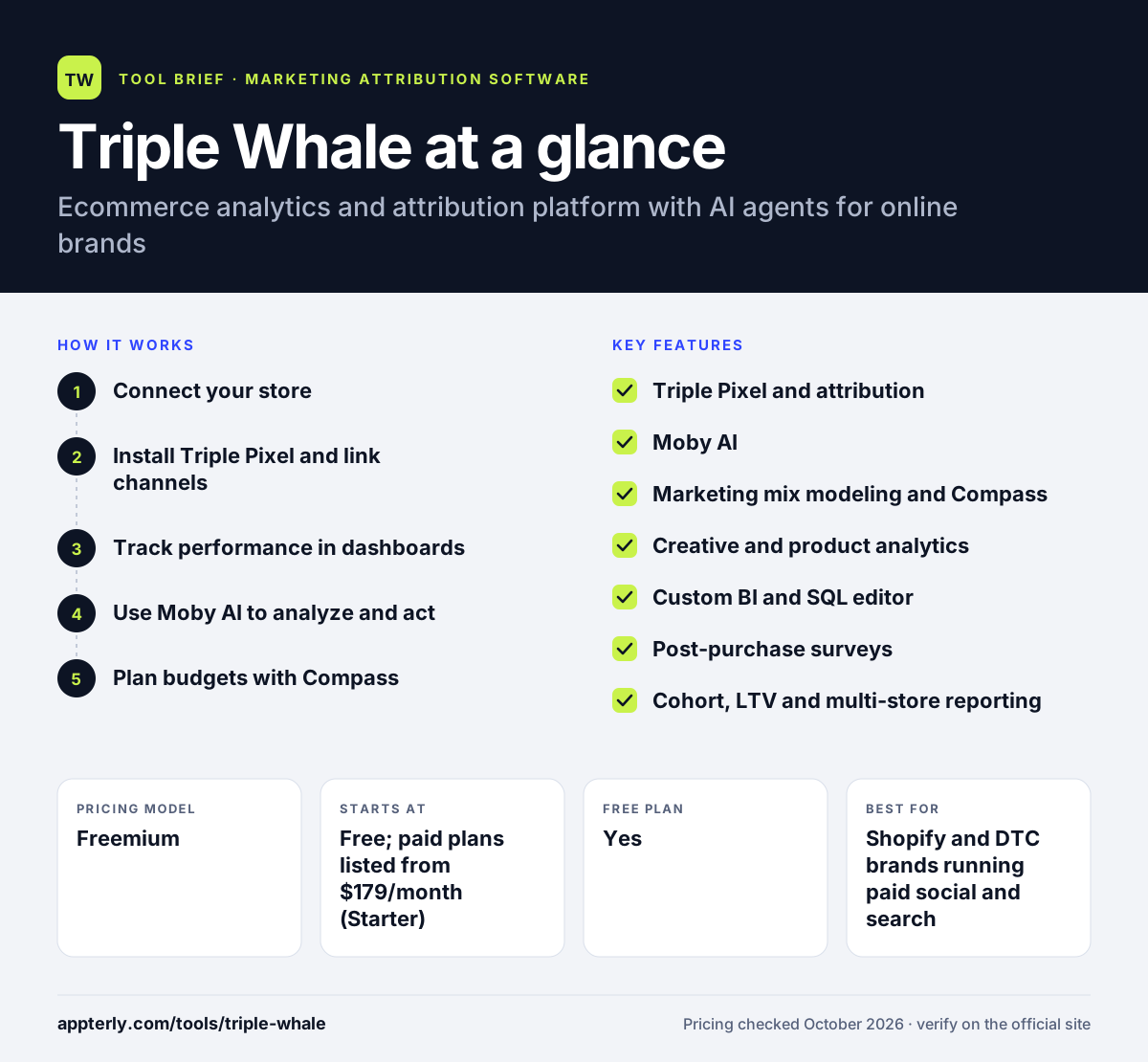
How does Triple Whale work?
- Connect your store
You connect your ecommerce platform, such as Shopify, BigCommerce or WooCommerce, so orders, products and customers sync in.
- Install Triple Pixel and link channels
Add the Triple Pixel for first-party tracking and connect ad accounts, Klaviyo and other tools.
- Track performance in dashboards
Dashboards show revenue, ad spend, ROAS, profit and attribution by channel and campaign.
- Use Moby AI to analyze and act
Ask questions in chat or Slack, schedule recurring analysis and let AI agents carry out tasks in ad accounts.
- Plan budgets with Compass
Combine attribution, MMM and incrementality in Compass to decide how much to spend on each channel next month.
Triple Whale key features
Triple Pixel and attribution
First-party tracking with multi-touch attribution shows which channels drive revenue for daily decisions.
Moby AI
AI chat, automations and actions that can analyze data on a schedule and adjust budgets or pause campaigns.
Marketing mix modeling and Compass
MMM measures channel impact across online and retail sales, and Compass combines it with attribution and incrementality.
Creative and product analytics
Compare ad creatives and product performance, available from the Advanced tier.
Custom BI and SQL editor
Build dashboards with a no-code editor or query data with SQL.
Post-purchase surveys
Ask customers how they heard about you to add zero-party data to attribution.
Cohort, LTV and multi-store reporting
Track repeat purchase behavior and roll up several stores in one view.
Founders Dash
A free-forever dashboard for founders with two users and 12 months of history, useful for a quick daily check on store and ad performance.
Why use Triple Whale?
- Store, ad and email data sit in one dashboard instead of many tabs.
- First-party attribution reduces reliance on ad platform reporting.
- AI agents can handle routine analysis and some ad account tasks.
- A free plan lets small brands start without a contract.
- Integrations cover major ecommerce platforms, ad networks and warehouses, and sOC 2 Type II compliance and GDPR and CCPA support help with security reviews.
Who is Triple Whale best for?
A good fit for
- Shopify and DTC brands running paid social and search
- Ecommerce founders who want one daily performance view
- Performance marketers managing multiple ad channels
- Agencies supporting ecommerce clients
Less suited to
- B2B companies with long, CRM-based sales cycles
- Businesses without an online store
- Teams wanting simple flat pricing, since tiers vary with store revenue
Triple Whale pricing
| Pricing model | Freemium |
|---|---|
| Free plan | Yes |
| Free trial | Not confirmed |
| Starting price | Free; paid plans listed from $179/month (Starter) |
Paid tiers add multi-touch attribution, Moby features, creative analytics, SQL and multi-store reporting, and prices vary with annual store revenue. Annual billing gives two months free, and larger brands receive custom quotes.
Prices checked October 2026. Vendors change plans often, so confirm on the official Triple Whale pricing page before you buy.
Triple Whale pros and cons
Pros
- Free plan for getting started
- All-in-one view of store, ads and email performance
- AI agents that can analyze and act on data
- Broad ecommerce and ad integrations
Cons
- Pricing tiers are complex and depend on revenue
- Most useful features require paid plans
- Built for ecommerce, so less suited to other business models
Triple Whale integrations and platforms
Works with
Available on
Triple Whale alternatives
See the full shortlist in Best Marketing Attribution Tools.
Triple Whale FAQ
Is Triple Whale free?
Yes, Triple Whale has a free plan that includes core dashboards with 10 users and a 12-month lookback. Paid tiers add multi-touch attribution, Moby AI chat, creative analytics, SQL and more. Paid prices scale with your store's annual revenue, and larger brands get custom quotes.
What is Triple Whale used for?
Triple Whale is used by ecommerce brands to track store performance and ad results in one place. Teams use it to see ROAS and profit by channel, attribute sales with the Triple Pixel, plan budgets with marketing mix modeling and use Moby AI agents to run analysis or make changes in ad accounts.
How much does Triple Whale cost?
Triple Whale has a free plan, and its pricing page lists paid tiers starting at $179 per month for Starter, though prices depend on your store's revenue. Annual plans require a 12-month commitment and include two months free, and month-to-month billing is also available. Large brands receive custom pricing. Taxes are charged on top of listed prices.
Triple Whale vs Northbeam: what's the difference?
Triple Whale is a broad ecommerce analytics suite with a free plan, dashboards, post-purchase surveys, AI agents and attribution, suited to brands of many sizes. Northbeam focuses on measurement for larger ad budgets, combining attribution, MMM+ and incrementality with view-through attribution, and starts in the thousands of dollars. Many brands start with Triple Whale's free plan and add deeper measurement tools later.
Does Triple Whale integrate with Shopify?
Yes. Shopify is one of Triple Whale's core integrations, and it also connects to BigCommerce, WooCommerce and Amazon. Alongside store data, it pulls in ad platforms such as Meta, Google, TikTok and Pinterest, email and SMS from Klaviyo, and support data from Gorgias. It also connects to Snowflake and BigQuery for teams that keep data in a warehouse.
Sources
This overview is based on Triple Whale's official website and documentation, checked October 2026.