What is Channable?
Channable is a multichannel ecommerce platform that takes product data from an online store and prepares it for marketplaces, comparison sites and ad channels. Retailers import their catalog, clean and enrich it with rules, and then export tailored feeds to places such as Google, Meta, Amazon, eBay, bol, Zalando and Allegro. It says it serves over 17,000 companies.
Beyond feeds, Channable connects to marketplaces with stock and order syncing, generates search ads from product data, and manages bids and budgets for Google and retail media campaigns. An Insights dashboard shows channel costs and revenue, and a dynamic image editor creates ad visuals in bulk. Channable is also a Google Comparison Shopping Service partner, with a CSS-only plan available.
Channable suits sellers whose catalogs change often or who sell across several countries and channels. Instead of editing spreadsheets for each marketplace, teams set rules once and let feeds update automatically as products, prices and stock change. Agencies also use it to manage feeds for multiple clients through separate projects.
Channable at a glance
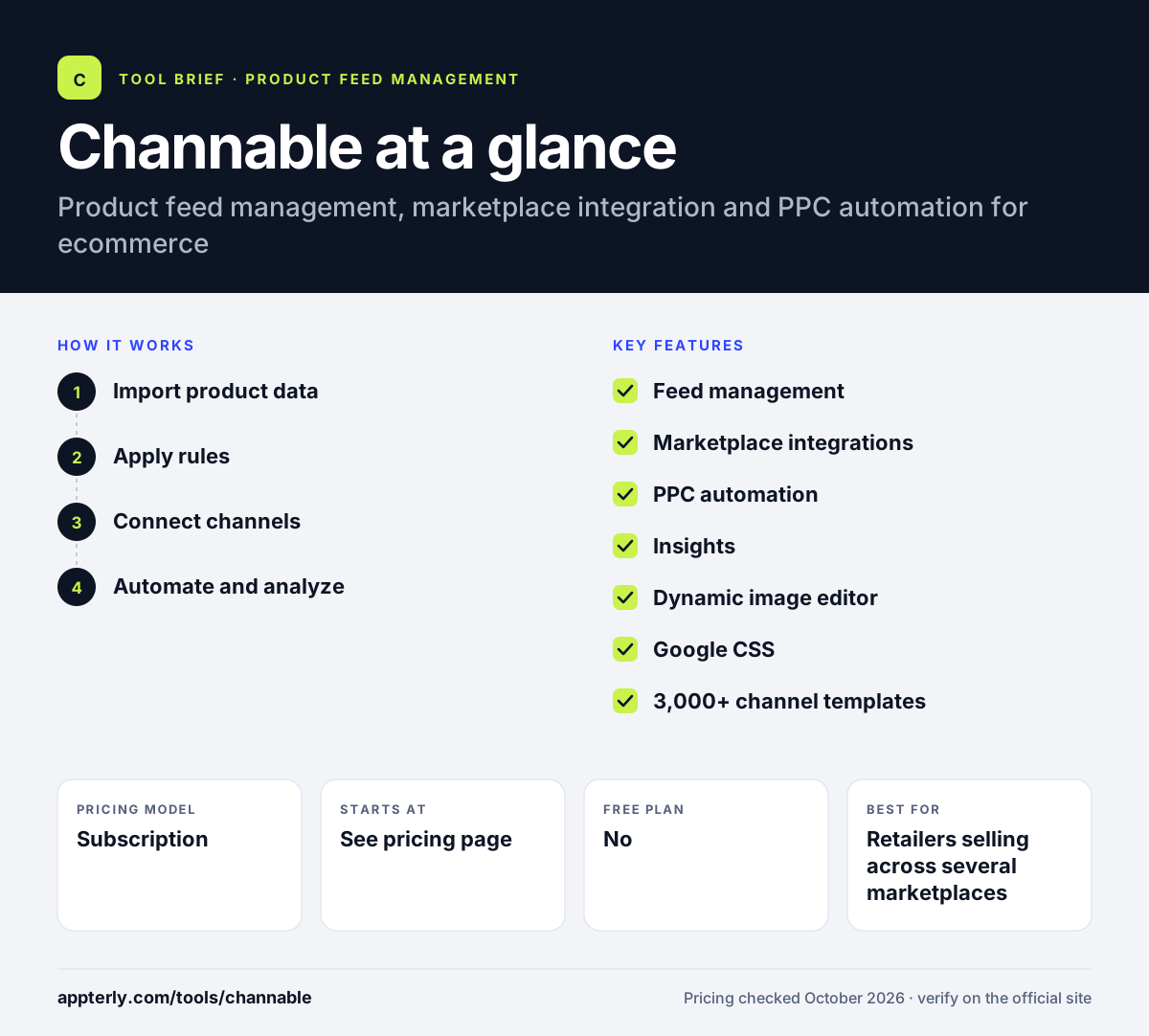
How does Channable work?
- Import product data
Connect your store platform, such as Shopify, Magento, WooCommerce or Shopware, or upload a feed file.
- Apply rules
Use if-then rules to filter, fix and enrich product data, with quality checks and automatic categorization.
- Connect channels
Pick from thousands of channel templates and send optimized feeds to marketplaces, comparison sites and ad platforms.
- Automate and analyze
Generate PPC ads, sync orders and stock with marketplaces, and review channel performance in Insights.
Channable key features
Feed management
Import, filter and enrich product data with rules, then output feeds that meet each channel's requirements.
Marketplace integrations
Sync listings, real-time stock and orders with marketplaces such as Amazon, bol, eBay, Zalando and Allegro.
PPC automation
Create search ads from product feeds and manage Google and retail media campaigns, bids and budgets.
Insights
A dashboard shows costs and revenue per channel and supports performance-based product segmentation.
Dynamic image editor
Build image templates in bulk for Google Shopping and social commerce ads.
Google CSS
Use Channable as a Comparison Shopping Service partner, including a CSS-only plan billed per active shop.
3,000+ channel templates
Ready-made integrations cover a wide range of marketplaces, comparison sites and ad networks.
Projects
Packages include multiple projects, which let agencies or multi-brand retailers keep separate catalogs and channel setups apart.
Why use Channable?
- One product catalog can feed many channels without manual spreadsheet work.
- Rules fix data issues that cause feed disapprovals.
- Marketplace order and stock syncing reduces overselling.
- Feed-based ads keep PPC campaigns aligned with the catalog.
- A trial with no time limit lets you build and test before paying.
Who is Channable best for?
A good fit for
- Retailers selling across several marketplaces
- Ecommerce agencies managing client feeds
- Brands running Google Shopping and retail media
- European sellers using CSS
Less suited to
- Very small stores selling on one channel only
- Businesses wanting public, fixed per-tier pricing
- Teams without time to learn rule-based feed logic
Channable pricing
| Pricing model | Subscription |
|---|---|
| Free plan | No |
| Free trial | Unlimited trial (channels require a paid plan) |
| Starting price | See the official pricing page |
Price is built from a package sized by items, projects and channels, plus a Core plan (Standard, Plus or Pro) and optional modules. Exact prices are not published on the pricing page.
Prices checked October 2026. Vendors change plans often, so confirm on the official Channable pricing page before you buy.
Channable pros and cons
Pros
- Very broad channel and marketplace coverage
- Flexible rule engine for feed optimization
- Combines feeds, marketplaces and PPC in one tool
- No time limit on the trial
Cons
- Pricing is not shown publicly as fixed amounts
- Every product variant counts as an item, which raises costs for large catalogs
- Rule setup has a learning curve
Channable integrations and platforms
Works with
Available on
Channable alternatives
See the full shortlist in Best Product Feed Management Tools.
Channable FAQ
Is Channable free?
Channable does not have a free plan, but its free trial has no time limit. You can create an account, import products and build rules for free. To activate channels and send product data to marketplaces or ad platforms, you need a paid subscription based on your item count and chosen plans.
What is Channable used for?
Channable is used by online retailers and agencies to manage product feeds, list products on marketplaces and automate shopping and search ads. It turns a store's catalog into optimized feeds for channels such as Google, Meta, Amazon and eBay, and syncs stock and orders with marketplaces.
How does Channable pricing work?
A Channable subscription combines a package sized by items, projects and channels with a Core plan and optional modules such as Marketplaces. Each product variant counts as one item, including items you import but do not advertise. If you exceed your package, Channable upgrades automatically. Exact prices require the help center or sales.
Does Channable integrate with Shopify?
Yes. Channable connects with Shopify as well as Magento, WooCommerce, PrestaShop, Shopware, Lightspeed and other store platforms. Once connected, it imports your product catalog so you can apply rules and export feeds to marketplaces, comparison shopping sites and ad networks.
Channable vs Feedonomics: what's the difference?
Both manage product feeds for many channels. Channable offers a self-service rule engine, marketplace order syncing, PPC automation and a Google CSS program, with a trial you can set up yourself. Feedonomics is known for a more managed, full-service approach. The better fit depends on whether you prefer doing feed work in-house.
Sources
This overview is based on Channable's official website and documentation, checked October 2026.