What is Sumo (now BDOW)?
Sumo, now called BDOW, is a popup and form builder that helps websites grow email lists with targeted popups, forms, countdown timers and social proof notifications. Sumo was one of the earliest free list-building tools for WordPress and small business sites. It was sold by the Sumo Group, which still runs AppSumo, and was renamed BDOW in April 2024 to avoid confusion with those brands.
Today BDOW is built by Showit, the website builder for photographers and creatives. The core product still covers what Sumo users relied on: drag-and-drop popups, branded forms, display rules and A/B testing. It adds evergreen countdown timers, social proof popups, ecommerce offers and agency tools such as white-label options and one login for many client sites. Existing Sumo accounts kept working through the transition, and the free plan remains.
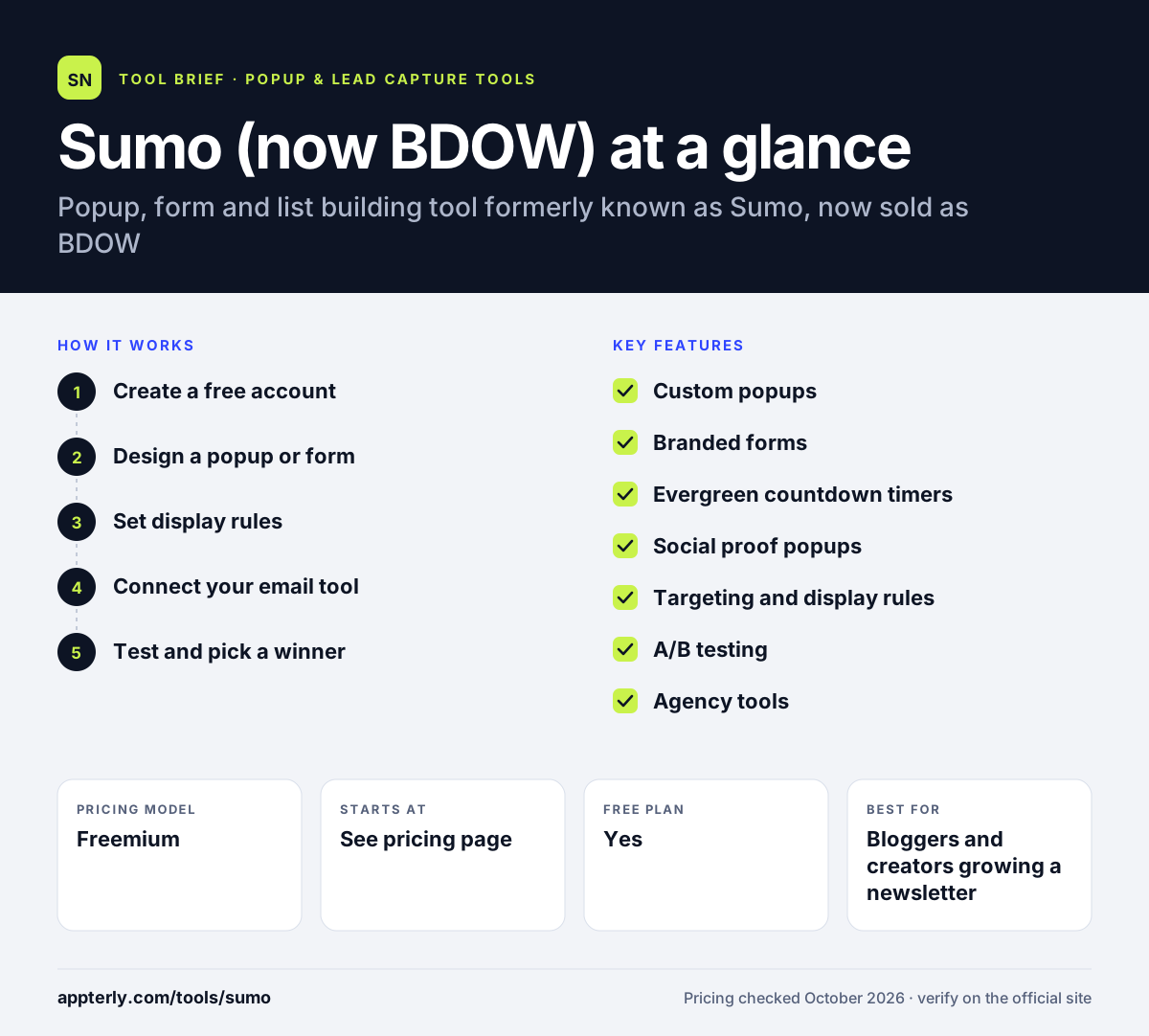
Sumo (now BDOW) at a glance
How does Sumo (now BDOW) work?
- Create a free account
Sign up without a credit card and connect your site through WordPress, Shopify, Showit or an embed code.
- Design a popup or form
Pick a template sorted by goal and style, then customize it in the drag-and-drop editor. Templates cover discounts, announcements and abandoned carts.
- Set display rules
Show content by URL, device, traffic source, behavior, exit intent or new versus returning visitor. Combine several rules to show the right offer to each visitor.
- Connect your email tool
Send signups to Mailchimp, Kit, Flodesk, Klaviyo or another integration, or use Zapier for more apps. Twenty or more direct integrations are listed.
- Test and pick a winner
Compare conversion rates and revenue across variants and keep the better design. Agencies can then share winning templates across client accounts.
Sumo (now BDOW) key features
Custom popups
Drag-and-drop popups built without code, with templates for lead capture, discounts, announcements and abandoned carts.
Branded forms
Inline and popup forms styled to match your site's look.
Evergreen countdown timers
Each visitor sees a personal deadline that starts when they arrive.
Social proof popups
Live notifications of recent signups and purchases to build trust.
Targeting and display rules
Rules by URL, page, device, source, behavior and exit intent.
A/B testing
Real-time comparisons of conversion rate and revenue for each variant.
Agency tools
White-label options, one login for every client site and shared templates.
Ecommerce offers
Discount codes, free shipping messages and upsells on cart pages, personalized with store data from Shopify or WooCommerce.
Why use Sumo (now BDOW)?
- A free plan lets small sites start building a list at no cost.
- Long-time Sumo users can keep their setup under the new BDOW name.
- Evergreen timers and social proof add urgency without extra plugins.
- It connects to popular creator email tools like Kit and Flodesk.
- Agencies get white-label options and one login for many clients.
Who is Sumo (now BDOW) best for?
A good fit for
- Bloggers and creators growing a newsletter
- Showit and WordPress site owners
- Small Shopify stores that want simple discount popups
- Agencies managing popups for several client sites
Less suited to
- Teams that need built-in email sending
- Buyers who want clear published pricing before signing up
- Users looking for the old Sumo share buttons and full legacy toolset
Sumo (now BDOW) pricing
| Pricing model | Freemium |
|---|---|
| Free plan | Yes |
| Free trial | Not confirmed |
| Starting price | See the official pricing page |
BDOW has a free plan and a paid Pro plan, but Pro prices were not published on the pages reviewed. Yearly Pro billing is 25% cheaper than monthly, and a 14-day money-back guarantee applies.
Prices checked October 2026. Vendors change plans often, so confirm on the official website before you buy.
Sumo (now BDOW) pros and cons
Pros
- Free plan with no credit card required
- Social proof and countdown timers included
- Good fit for creators using Showit, Kit or Flodesk
- Agency-friendly multi-site management
Cons
- Paid plan prices are not clearly published
- The rename may confuse users searching for Sumo
- No built-in email sending
Sumo (now BDOW) integrations and platforms
Works with
Available on
Sumo (now BDOW) alternatives
See the full shortlist in Best Popup Builders.
Sumo (now BDOW) FAQ
What happened to Sumo?
Sumo's list building product was acquired from the Sumo Group and renamed BDOW in April 2024. The Sumo Group kept the Sumo name for AppSumo and KingSumo, which is why the product changed brands. BDOW is now built by Showit, and existing accounts continued to work at the original app address during the transition. Sumo's social sharing tools are not part of the current BDOW feature list.
Is Sumo (BDOW) free?
Yes. BDOW, formerly Sumo, has a free plan and you can create an account without a credit card. A paid Pro plan adds more features and removes limits. Yearly Pro billing is 25 percent cheaper than monthly, and paid purchases have a 14-day money-back guarantee.
What is BDOW used for?
BDOW is used to collect email subscribers and promote offers with popups, inline forms, countdown timers and social proof notifications. Site owners target visitors by page, device, source or exit intent, test variants and send new signups to tools like Mailchimp, Kit, Flodesk or Klaviyo. Agencies also use it to manage popups across many client sites from a single login.
Does Sumo work with WordPress and Shopify?
Yes. BDOW, the product formerly called Sumo, lists WordPress and Shopify as direct integrations, along with Showit. It can also be added to other sites with an embed code. For email and CRM tools, it connects to Mailchimp, Klaviyo, HubSpot, ActiveCampaign, AWeber, Drip and others, plus Zapier.
Sumo vs OptinMonster: what's the difference?
Both build popups and forms for list growth. BDOW, formerly Sumo, has a free plan and adds social proof and evergreen timers, with a focus on creators and Showit users. OptinMonster has no free plan but offers a larger template library, revenue attribution and more advanced targeting on higher tiers.
Sources
This overview is based on Sumo (now BDOW)'s official website and documentation, checked October 2026.