What is Segment?
Segment is a customer data platform that collects event data from websites, mobile apps and servers once and sends it to analytics, marketing and advertising tools without separate tracking code for each. Owned by Twilio and now branded Twilio Segment, it is one of the best-known CDPs among startups and growth teams. Its catalog lists more than 550 destinations and over 750 integrations in total.
The product comes in two main packages. Connections is the data pipeline that collects and routes events, loads warehouses and supports reverse ETL. The full CDP adds Unify for identity-resolved profiles and Engage for audiences and journeys, plus AI predictions and recommendations. Protocols handles tracking plans and data quality. A free plan covers small volumes, while larger plans are quoted by sales.
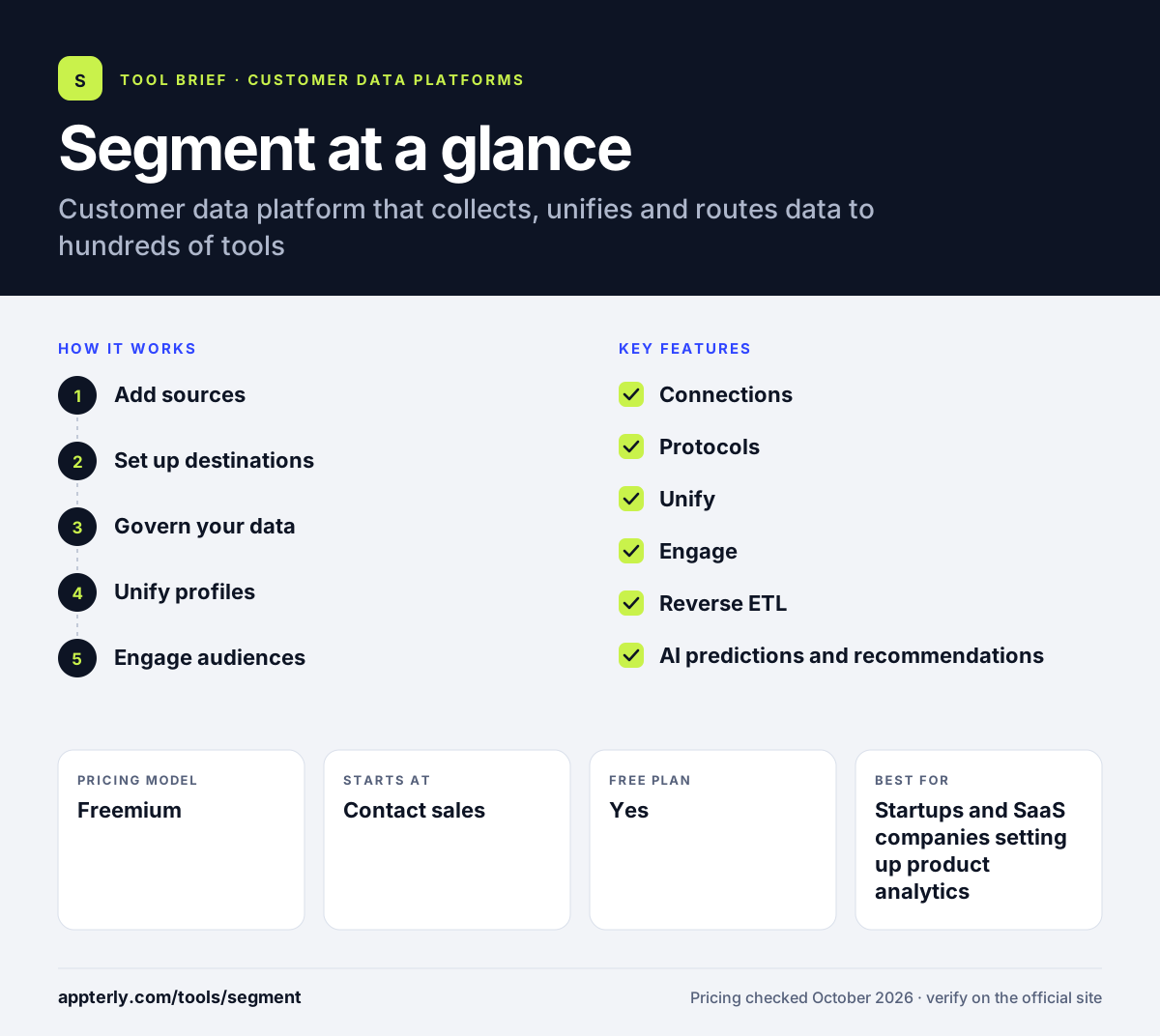
Segment at a glance
How does Segment work?
- Add sources
Install Segment's libraries on your website, app or server, or connect cloud apps and databases as sources.
- Set up destinations
Turn on destinations such as analytics tools, ad platforms, email tools or a data warehouse, and Segment forwards the same events to each.
- Govern your data
Use Protocols tracking plans to check events against an agreed schema and block or fix bad data.
- Unify profiles
Unify merges anonymous and known activity into one profile per person across devices and sources.
- Engage audiences
Build audiences and journeys in Engage and sync them to messaging and ad channels in real time.
Segment key features
Connections
The core pipeline that collects first-party data and sends it to 550+ destinations and warehouses.
Protocols
Tracking plans and validation rules that keep event names and properties consistent.
Unify
Identity resolution that builds unified customer profiles from many sources.
Engage
Audience builder and journey orchestration for real-time, multichannel campaigns.
Reverse ETL
Pull data from your warehouse back into Segment to sync with downstream tools.
AI predictions and recommendations
Predictive traits and recommendations that are included in the CDP package and available as add-ons for Connections.
Why use Segment?
- One tracking setup feeds many tools, so adding a new tool rarely needs new code.
- The large integration catalog covers most popular marketing and analytics apps.
- A free plan lets small teams start collecting data right away.
- Tracking plans reduce messy, inconsistent event data.
- The CDP package adds profiles and audiences without a separate vendor.
Who is Segment best for?
A good fit for
- Startups and SaaS companies setting up product analytics
- Growth teams that use several analytics and marketing tools
- Developers who want one API for all customer tracking
- Twilio customers adding customer data to messaging
Less suited to
- Budget-conscious teams with large anonymous traffic, since billing counts monthly tracked users
- Companies that want all data to stay only in their own warehouse
- Non-technical teams without developer help for implementation
Segment pricing
| Pricing model | Freemium |
|---|---|
| Free plan | Yes |
| Free trial | Free trial, length not stated |
| Starting price | Contact sales |
The Free plan covers up to 1,000 monthly tracked users (MTUs), and the Twilio Developer plan allows up to 10,000. Paid Connections and CDP plans are quoted by sales based on MTU volume and include unlimited seats.
Prices checked October 2026. Vendors change plans often, so confirm on the official Segment pricing page before you buy.
Segment pros and cons
Pros
- Very large integration catalog
- Free entry point and well-documented libraries
- Mature data governance through Protocols
- Can grow from a simple pipeline to a full CDP
Cons
- Paid pricing is quote-based and can rise quickly with MTUs
- Strict lockout rules on the free and developer tiers when you exceed limits
- Full CDP features need a higher-cost package
Segment integrations and platforms
Works with
Available on
Segment alternatives
See the full shortlist in Best Customer Data Platforms.
Segment FAQ
Is Segment free?
Yes, Segment has a free plan for up to 1,000 monthly tracked users, and the Twilio Developer plan raises that to 10,000 with up to 3 sources. Going over the limit can lock the account until you upgrade. Paid plans are quoted by sales, and a free trial is offered without a credit card.
What is Segment used for?
Segment is used to collect customer events from websites, apps and servers and send them to tools such as analytics platforms, email software, ad networks and data warehouses. Teams also use it to build unified customer profiles and real-time audiences for personalized campaigns.
Is Segment part of Twilio?
Yes. Twilio owns Segment, and the product is now called Twilio Segment. The segment.com website redirects to twilio.com, where the product pages, documentation and support now live. The CDP itself continues as before and connects with Twilio messaging products as well as hundreds of third-party tools.
Segment vs RudderStack: what's the difference?
Both collect events and route them to destinations. Segment is a packaged CDP that stores profiles in its own platform and has a larger catalog of integrations. RudderStack is warehouse-native and keeps customer data in your warehouse, which suits data teams that want more control and published entry pricing.
Is Segment good for beginners?
Segment is one of the easier CDPs to start with thanks to its free plan, clear docs and simple libraries. Basic setup still needs a developer to add tracking code. Non-technical users can then turn on destinations and build audiences in the web app without code.
Sources
This overview is based on Segment's official website and documentation, checked October 2026.