What is Adobe Real-Time CDP?
Adobe Real-Time CDP is an enterprise customer data platform that combines data from many sources into unified, real-time customer profiles and audiences. It pulls in data from websites, apps, call centers, point-of-sale systems and CRMs, resolves identities to a person or account, and lets marketers build segments that update as behavior changes. Those audiences are then sent to ad platforms, email tools and personalization systems.
The product runs on Adobe Experience Platform and is designed for large brands, often those already using Adobe Experience Cloud. It comes in B2C, B2B and B2P editions, each sold in Prime or Ultimate packages. Related capabilities include Real-Time CDP Collaboration, a data clean room for working with ad partners, and Real-Time CDP Connections for server-side data forwarding. Adobe's AI assistant also helps with data standardization and audience creation.
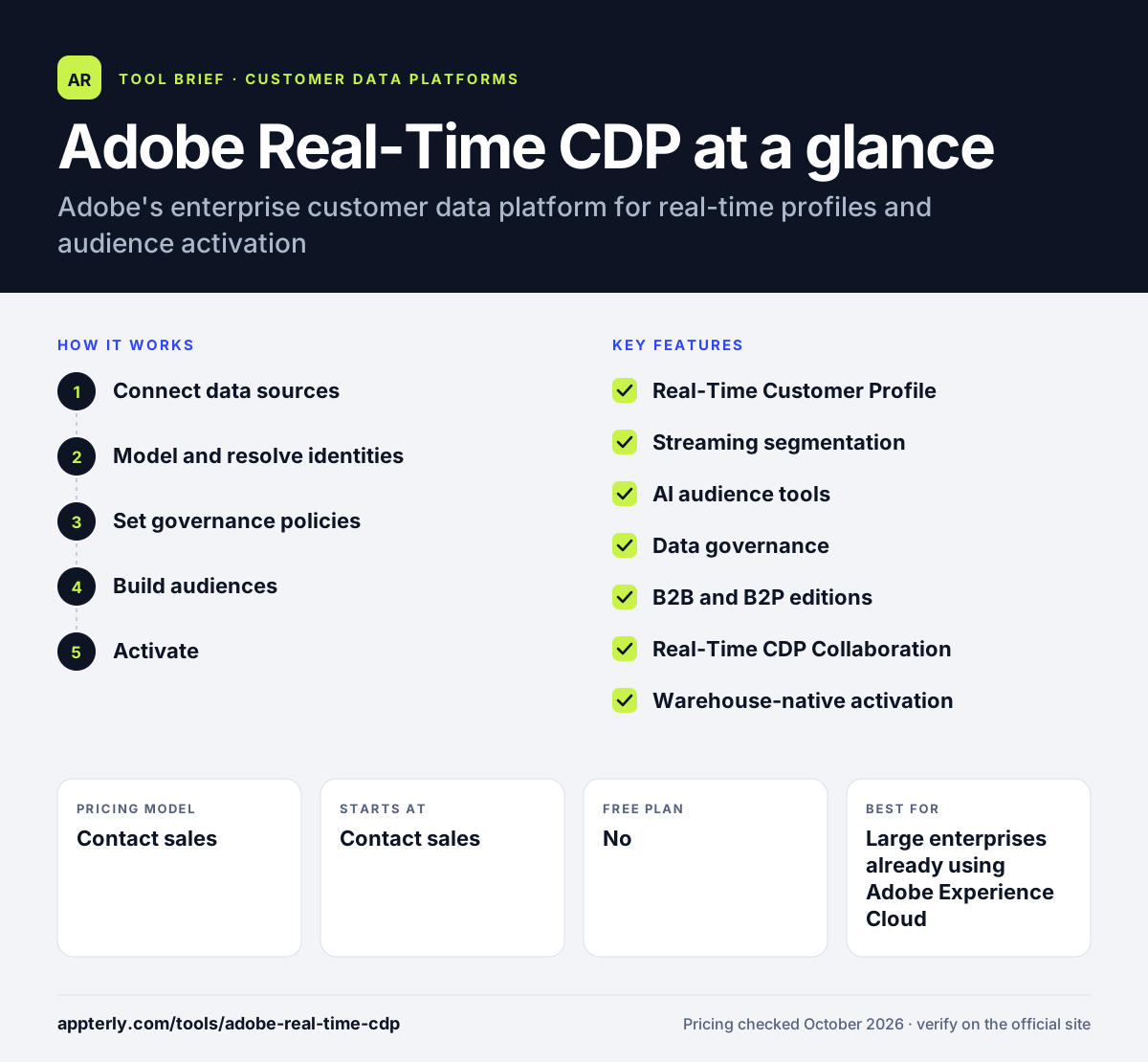
Adobe Real-Time CDP at a glance
How does Adobe Real-Time CDP work?
- Connect data sources
Ingest data from web, mobile, CRM, offline and warehouse sources, by streaming or in batches, or activate directly from a data warehouse.
- Model and resolve identities
Map data to the Experience Data Model schema, then configure identity rules and merge policies to build one profile per person or account.
- Set governance policies
Label data and define usage policies and permissions so it is only used in approved ways.
- Build audiences
Create segments with rules, natural language or AI propensity scores, with streaming segmentation keeping membership current.
- Activate
Send audiences to destinations such as ad platforms and Adobe Journey Optimizer through prebuilt connectors and APIs.
Adobe Real-Time CDP key features
Real-Time Customer Profile
A unified profile per person or account that updates as new events arrive.
Streaming segmentation
Audiences qualify people in real time as their behavior changes, not only on scheduled runs.
AI audience tools
Propensity scores, lookalike-style audiences and natural-language audience building through Adobe's AI assistant.
Data governance
Usage labels, policy enforcement and role permissions to control how sensitive data is used.
B2B and B2P editions
Account-based profiles with account hierarchies and a Marketo Engage connector, or person-level views across business lines.
Real-Time CDP Collaboration
A clean room for matching audiences with advertising and publisher partners without exposing raw customer data.
Warehouse-native activation
Activate data from an existing data warehouse without copying whole datasets into Adobe.
Why use Adobe Real-Time CDP?
- Real-time profiles and segments support timely personalization.
- Tight integration with Adobe Journey Optimizer and Customer Journey Analytics.
- Strong governance suits regulated industries and large data teams.
- Editions for consumer, B2B and multi-line businesses.
- Clean room features support privacy-safe advertising partnerships.
Who is Adobe Real-Time CDP best for?
A good fit for
- Large enterprises already using Adobe Experience Cloud
- B2B marketers running account-based programs with Marketo Engage
- Retail, finance and travel brands with many data sources
- Teams with dedicated data engineering support
- Enterprises that need privacy-safe data collaboration with media partners
Less suited to
- Small businesses and startups
- Teams without technical resources to model data and identities
- Buyers who want transparent self-serve pricing
Adobe Real-Time CDP pricing
| Pricing model | Contact sales |
|---|---|
| Free plan | No |
| Free trial | Not confirmed |
| Starting price | Contact sales |
Adobe Real-Time CDP is sold by quote in B2C, B2B and B2P editions, each in Prime or Ultimate packages. Capabilities and limits differ by package, and terms are set with an Adobe account team.
Prices checked October 2026. Vendors change plans often, so confirm on the official website before you buy.
Adobe Real-Time CDP pros and cons
Pros
- Real-time profiles and segmentation at enterprise scale
- Deep integration across Adobe's marketing products
- Robust data governance controls
- Separate editions for B2C, B2B and B2P
Cons
- Complex setup that usually needs specialist partners
- No public pricing and typically a large investment
- Most valuable when paired with other Adobe products
Adobe Real-Time CDP integrations and platforms
Works with
Available on
Adobe Real-Time CDP alternatives
See the full shortlist in Best Customer Data Platforms.
Adobe Real-Time CDP FAQ
Is Adobe Real-Time CDP free?
No. Adobe Real-Time CDP has no free plan or public price list. It is sold through Adobe's sales team in B2C, B2B and B2P editions, each with Prime and Ultimate packages. Costs depend on the edition, package, data volumes and contract terms agreed with Adobe.
What is Adobe Real-Time CDP used for?
Adobe Real-Time CDP is used to unify customer data from many systems into single profiles, build audiences and activate them across channels. Brands use it to personalize websites and emails, suppress existing customers from ads, target high-propensity buyers and run account-based B2B campaigns.
Is Adobe Real-Time CDP good for beginners?
Not really. It is an enterprise platform that requires data modeling, identity configuration and governance setup. Marketers can use the audience tools once it is running, but implementation usually involves data engineers, Adobe specialists or consulting partners. Smaller teams often start with simpler CDPs. Implementation partners are commonly used.
Adobe Real-Time CDP vs Segment: what's the difference?
Twilio Segment focuses on collecting and routing event data to many tools and is popular with product and engineering teams. Adobe Real-Time CDP focuses on enterprise profiles, governance and activation, especially within Adobe Experience Cloud. Adobe customers tend to choose Adobe, while others often prefer Segment's openness.
What is the difference between Adobe Experience Platform and Real-Time CDP?
Adobe Experience Platform is the underlying data foundation that handles schemas, identity and storage. Real-Time CDP is an application built on top of it that adds profile, audience, governance and activation features for marketers. Other Adobe apps, such as Journey Optimizer, run on the same platform.
Sources
This overview is based on Adobe Real-Time CDP's official website and documentation, checked October 2026.