What is Census?
Census is a reverse ETL tool that copies modeled customer data from a cloud data warehouse into the business apps that sales, marketing and support teams use every day. After Fivetran acquired the company in 2025, the product was renamed Fivetran Activations, and the old Census (Fivetran) brand now points to that offering. The goal is simple: keep tools like HubSpot, Braze or Facebook Ads fed with the same clean data your analysts already trust.
The product now lives inside the main Fivetran platform, next to Fivetran's ingestion connectors and transformations. That means one account can pull data from hundreds of sources into the warehouse and push it back out to more than 200 activation destinations. Marketers can build audiences without SQL through Audience Hub on higher plans, while data teams keep control of models, permissions and sync schedules.
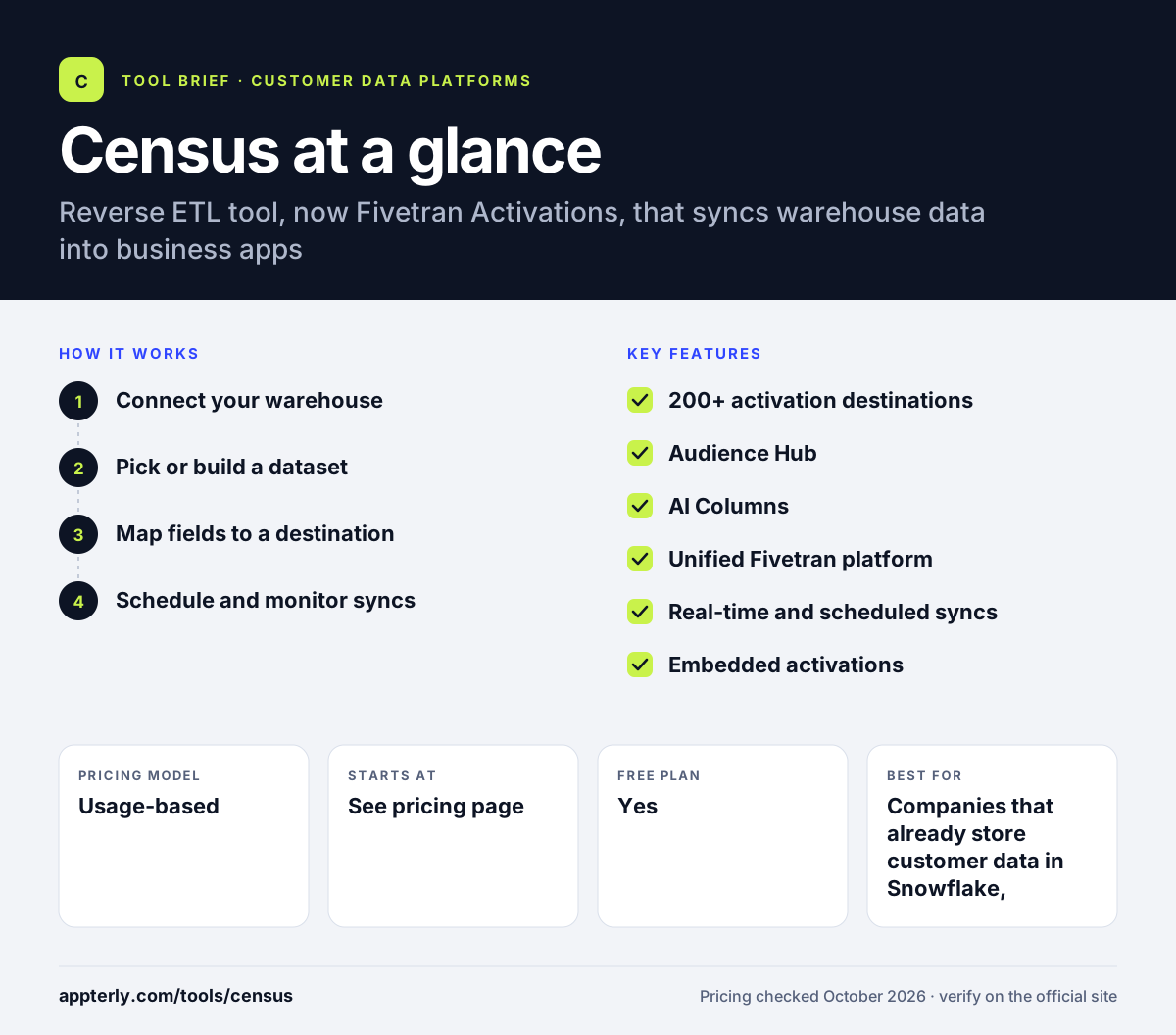
Census at a glance
How does Census work?
- Connect your warehouse
Link a source such as Snowflake, Google BigQuery or Databricks. Activations are grouped by this source, so each one bundles the syncs between that source and a destination.
- Pick or build a dataset
Choose an existing table or model, write SQL, or build an audience visually. Self-service datasets let non-technical users create their own views.
- Map fields to a destination
Select a destination such as HubSpot, Braze or Facebook Ads and match warehouse columns to the fields in that app.
- Schedule and monitor syncs
Run syncs on a regular schedule, as often as every 15 minutes on Standard or every minute on Enterprise, and review results in the Fivetran dashboard.
Census key features
200+ activation destinations
Prebuilt connectors push data into CRMs, ad networks, email platforms, support desks and storage such as Amazon S3.
Audience Hub
A no-code segment builder that works directly on warehouse data, with governance and testing tools. It is part of the Enterprise plan.
AI Columns
Generate new fields in a dataset with large language models from OpenAI, Anthropic or Google, for example to classify or summarize records.
Unified Fivetran platform
Ingestion, transformations and activations share one account, billing model and user management, including SCIM and teams.
Real-time and scheduled syncs
Key workflows can sync close to real time, while others run on recurring schedules without manual work.
Embedded activations
Former Census Embedded use cases continue through Powered by Fivetran, so software vendors can offer syncs inside their own products.
Why use Census?
- It keeps your warehouse as the single source of truth instead of building separate customer lists in each app.
- Data teams can manage both ingestion and reverse ETL in one place, which reduces vendor sprawl.
- Marketers on Enterprise plans can build segments without waiting on SQL requests.
- Usage-based billing means small projects can start on the free tier and scale gradually.
- AI Columns add enrichment such as lead scoring or categorization without extra tools.
Who is Census best for?
A good fit for
- Companies that already store customer data in Snowflake, BigQuery or Databricks
- Teams that already use Fivetran for data ingestion
- RevOps and growth teams that need warehouse data inside CRMs and ad platforms
- Software companies embedding data syncs in their own product
Less suited to
- Small businesses without a cloud data warehouse or a data person to manage it
- Teams that want a packaged CDP with event collection and a ready-made customer profile UI
- Buyers who need fixed, predictable monthly pricing
Census pricing
| Pricing model | Usage-based |
|---|---|
| Free plan | Yes |
| Free trial | 14 days |
| Starting price | See the official pricing page |
Activations are billed on monthly active rows (MAR) and per-unit costs fall as usage grows. The Free plan includes 3,500 activation MAR, and paid tiers (Standard, Enterprise, Business Critical) add faster syncs, Audience Hub and security features; list prices are not published.
Prices checked October 2026. Vendors change plans often, so confirm on the official Census pricing page before you buy.
Census pros and cons
Pros
- Tight pairing with Fivetran ingestion gives a single data movement platform
- Large library of activation destinations
- Free tier and 14-day trials on new activations lower the cost of testing
- AI Columns and Audience Hub add value beyond plain syncing
Cons
- The migration from Census to Fivetran removes some older features, such as sync folders and workspace templates
- Paid list prices are not published, and MAR-based bills can be hard to forecast
- Still requires a data warehouse and some technical setup
Census integrations and platforms
Works with
Available on
Census alternatives
See the full shortlist in Best Customer Data Platforms.
Census FAQ
What happened to Census?
Census joined Fivetran in 2025, and its reverse ETL product is now called Fivetran Activations. Existing Census customers are being migrated to the Fivetran platform. Month-to-month Census plans ended in March 2026, annual contracts run until renewal, and old workspaces plus API V1 are scheduled to retire on January 15, 2027.
Is Census free?
There is a free option. The Fivetran Free plan includes 3,500 monthly active rows for activations, along with limited ingestion and transformation usage. New accounts also get a 14-day trial, and each new activation gets 14 days of free use. Larger volumes move to usage-based paid plans with unpublished list prices.
What is Census used for?
Census is used for reverse ETL, which means syncing modeled data from a warehouse into business tools. Common examples include sending lead scores to a CRM, pushing audiences to ad platforms, and keeping email tools like Braze or Iterable updated with product usage data so campaigns use accurate, current information.
Census vs Hightouch: what's the difference?
Both started as reverse ETL tools that sync warehouse data to business apps. Census is now part of Fivetran, so it pairs naturally with Fivetran's ingestion connectors under one bill. Hightouch remains independent and has grown into a broader composable CDP with event collection, identity resolution and AI marketing agents.
Is Census good for beginners?
Census is easier than writing custom scripts, but it still assumes you have a cloud data warehouse and someone who understands your data models. Marketers can use Audience Hub to build segments without SQL on Enterprise plans, while initial setup is usually handled by a data or analytics engineer.
Sources
This overview is based on Census's official website and documentation, checked October 2026.