What is Salesforce Data Cloud?
Salesforce Data Cloud is a customer data platform built into Salesforce that pulls data from CRM records, marketing tools, websites, apps and external warehouses into unified customer profiles. Salesforce now sells it under the name Data 360. Its job is to give sales, service and marketing teams, and the Agentforce AI agents, one current view of each customer, so every action draws on the same facts.
A key idea is zero copy: Data 360 can read data that lives in Snowflake, Databricks, Google BigQuery or Amazon Redshift without moving it. It also ingests data through more than 200 connectors, resolves identities across devices and channels, and turns documents such as PDFs and call logs into structured knowledge for AI. Pricing is consumption-based, using Flex Credits and per-profile licenses.
Salesforce Data Cloud at a glance
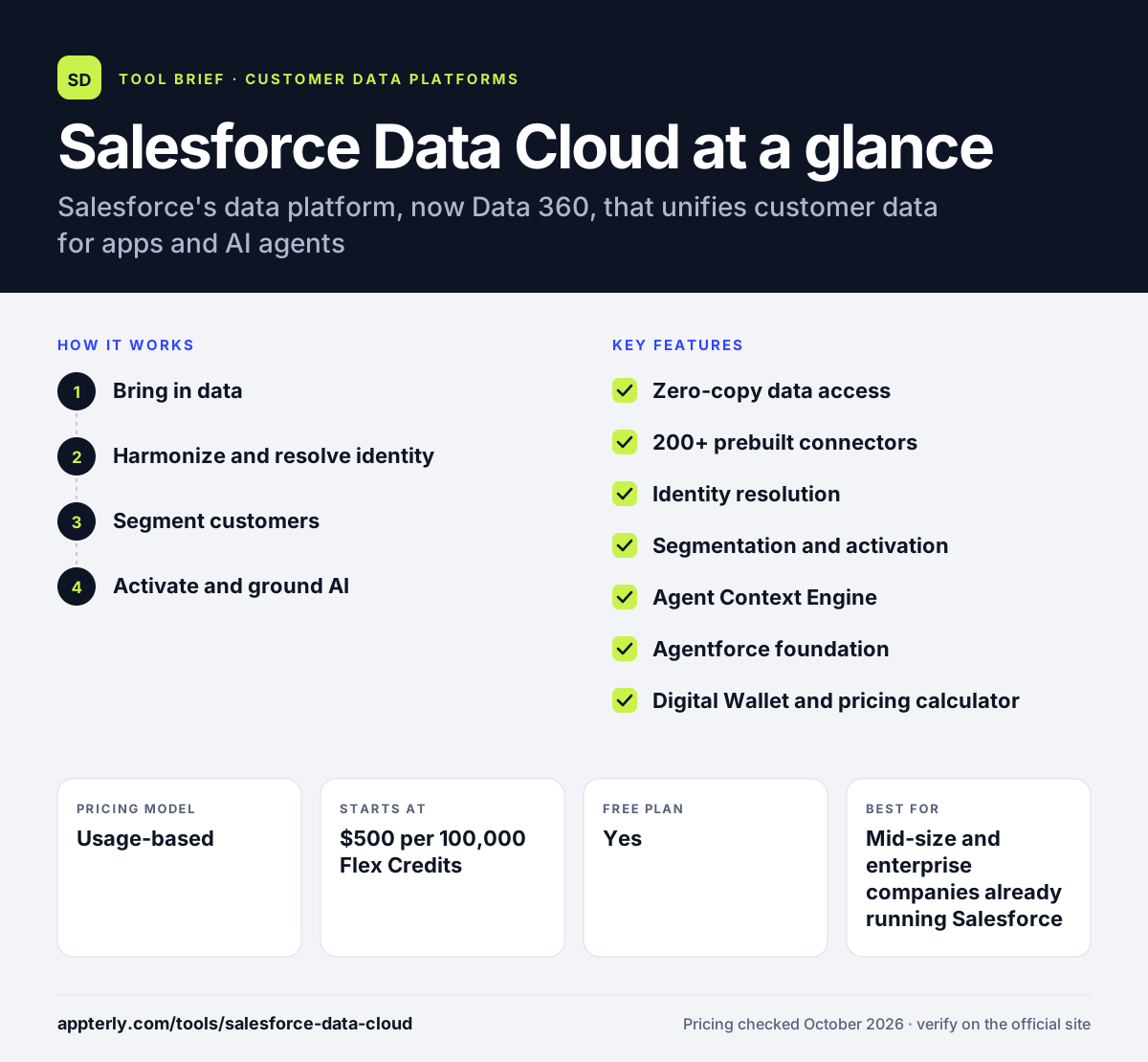
How does Salesforce Data Cloud work?
- Bring in data
Connect Salesforce clouds, MuleSoft, databases and third-party apps through 200+ connectors, or link warehouses through zero-copy access. Ingestion itself is free on current plans.
- Harmonize and resolve identity
Map data to a common model and match records across devices, channels and anonymous sessions into unified profiles.
- Segment customers
Build segments and calculated insights on top of the unified profiles and reuse them across Salesforce apps.
- Activate and ground AI
Send segments to Marketing Cloud and other channels, trigger actions in Sales and Service Cloud, and feed trusted context to Agentforce agents.
Salesforce Data Cloud key features
Zero-copy data access
Query and activate data in Snowflake, Databricks, BigQuery, S3 and Redshift without building ETL pipelines or duplicating it.
200+ prebuilt connectors
Native links to Salesforce clouds and MuleSoft, plus connectors for databases and outside apps, with SDKs and APIs for the rest.
Identity resolution
Matching rules merge records from many sources into one known customer profile.
Segmentation and activation
Build audiences once and use them across Sales, Service and Marketing Cloud for consistent targeting.
Agent Context Engine
Turns unstructured content such as PDFs, call logs and wikis into structured knowledge that AI agents can use.
Agentforce foundation
Supplies grounded, real-time customer context to Salesforce's AI agents.
Digital Wallet and pricing calculator
Track credit consumption in near real time and estimate costs by use case before you buy.
Why use Salesforce Data Cloud?
- It connects natively to Salesforce CRM, so unified profiles show up where sales and service teams already work.
- Zero-copy access avoids copying large warehouse tables and the cost of extra pipelines.
- It is the data layer for Agentforce, so AI agents act on current customer context.
- Free data ingestion on current plans lowers the cost of bringing sources in.
- Salesforce customers can provision a limited version at no cost to explore it.
Who is Salesforce Data Cloud best for?
A good fit for
- Mid-size and enterprise companies already running Salesforce
- Teams planning to deploy Agentforce AI agents
- Marketing Cloud users who need richer, unified segments
- Companies with data in Snowflake, Databricks or BigQuery that want zero-copy access
Less suited to
- Small businesses that do not use Salesforce
- Teams wanting simple, flat monthly pricing
- Organizations without admin or consulting resources for setup
Salesforce Data Cloud pricing
| Pricing model | Usage-based |
|---|---|
| Free plan | Yes |
| Free trial | Not confirmed |
| Starting price | $500 per 100,000 Flex Credits |
Usage is billed in Flex Credits, or through Profiles at $240 per 1,000 profiles per year and Enterprise Profiles at $420 per 1,000 profiles per year. Salesforce customers can provision Data 360 free with limited storage and credits.
Prices checked October 2026. Vendors change plans often, so confirm on the official Salesforce Data Cloud pricing page before you buy.
Salesforce Data Cloud pros and cons
Pros
- Deep native integration across the Salesforce platform
- Zero-copy links to major cloud warehouses
- Published list prices for credits and profiles
- Strong fit for grounding AI agents in customer data
Cons
- Credit-based billing can be hard to predict without careful monitoring
- Most valuable only inside the Salesforce ecosystem
- Implementation usually needs experienced admins or partners
Salesforce Data Cloud integrations and platforms
Works with
Available on
Salesforce Data Cloud alternatives
See the full shortlist in Best Customer Data Platforms.
Salesforce Data Cloud FAQ
Is Salesforce Data Cloud the same as Data 360?
Yes. Salesforce renamed Data Cloud to Data 360. The product covers the same job of unifying customer data across Salesforce and external systems, with a stronger focus on powering Agentforce AI agents. Existing Data Cloud contracts are honored through the end of their current term, and renewals move to Data 360.
How much does Salesforce Data Cloud cost?
Salesforce lists Flex Credits at $500 per 100,000 credits, consumed as you run actions. Profile-based options cost $240 per 1,000 profiles per year, or $420 for Enterprise Profiles with more segments and add-ons. Ingestion is free, and a pricing calculator helps estimate costs by use case.
Is Salesforce Data Cloud free?
Salesforce customers can provision Data 360 for free with a limited amount of storage and consumption credits. This is useful for testing small use cases. Production workloads usually require buying Flex Credits or profile licenses, depending on how your organization is contracted.
What is Salesforce Data Cloud used for?
It is used to unify customer data from Salesforce, websites, apps and warehouses into single profiles, build segments, personalize marketing and service, and give Agentforce AI agents trusted context. For example, a service agent can see a customer's recent orders and web activity next to their case history.
Salesforce Data Cloud vs Segment: what's the difference?
Data Cloud is tightly tied to Salesforce and is strongest when your CRM, marketing and service teams already work there. Segment is a standalone CDP from Twilio that collects events from websites and apps and routes them to hundreds of tools from many vendors, making it more neutral across tech stacks.
Sources
This overview is based on Salesforce Data Cloud's official website and documentation, checked October 2026.