What is RudderStack?
RudderStack is a warehouse-native customer data platform that collects event data from websites, apps and servers, cleans it in flight and sends it to your data warehouse and more than 200 business tools. It is built for data and engineering teams who want the warehouse, such as Snowflake, to be the central store for customer data instead of a separate vendor database.
Beyond event streaming, RudderStack offers transformations written in code, reverse ETL, identity resolution through Profiles, and toolkits for data quality and compliance. It now calls itself an agentic CDP: AI agents can help set up pipelines, generate tracking code and debug instrumentation, and business users can build audiences by chat. A free plan covers 250,000 events per month, and paid plans start at Growth.
RudderStack at a glance
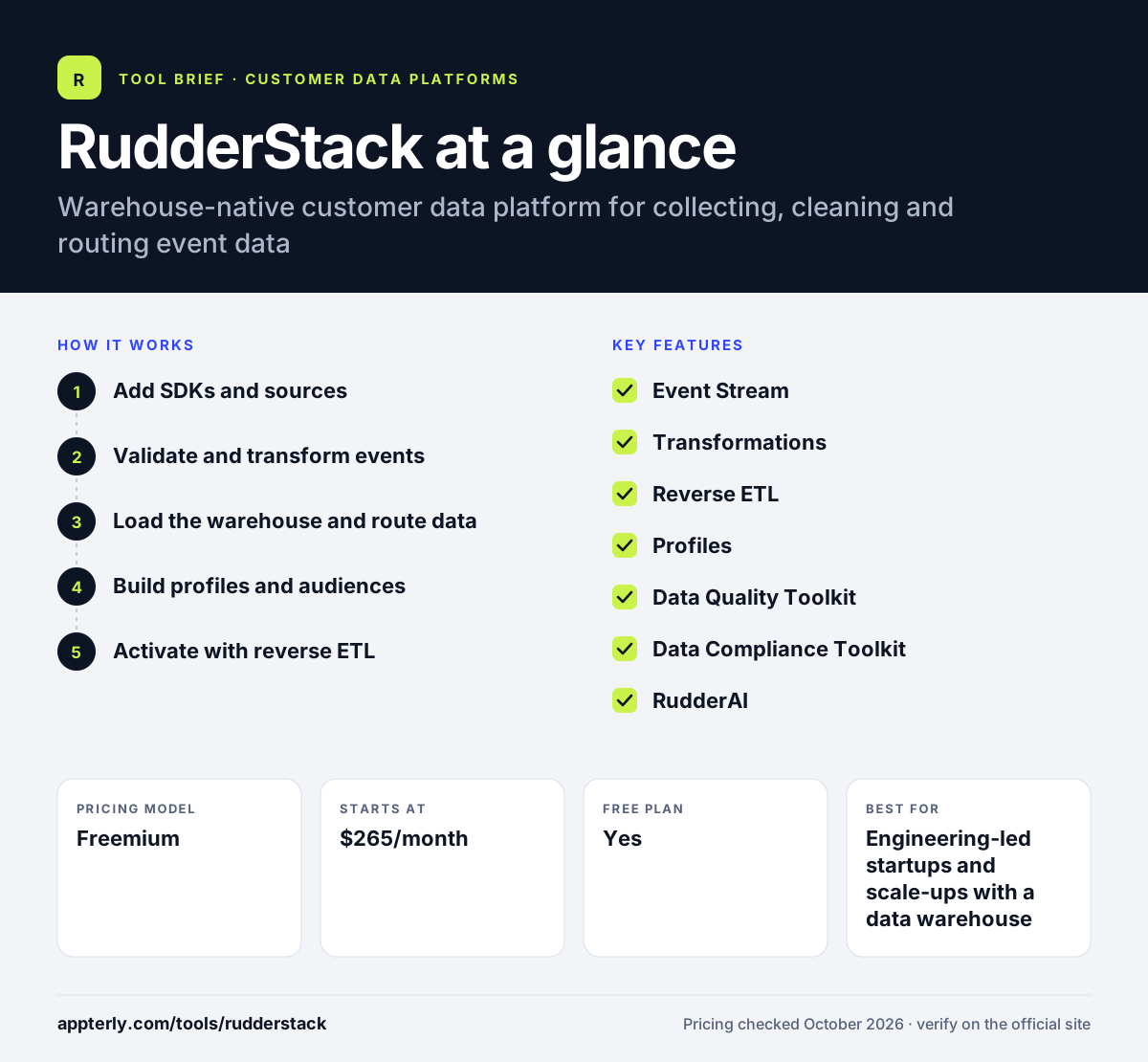
How does RudderStack work?
- Add SDKs and sources
Install one of 16 SDKs for web, mobile or server, or send data through webhooks. Cloud and warehouse sources can also feed in.
- Validate and transform events
Tracking plans check events against your schema, and transformations clean data, enrich events or mask personal information before delivery.
- Load the warehouse and route data
Events stream to destinations in real time and land in warehouses like Snowflake on a schedule set by your plan.
- Build profiles and audiences
Profiles stitches identifiers into an identity graph in the warehouse, and Agentic Audiences lets users create segments through chat or the UI.
- Activate with reverse ETL
Send modeled warehouse data and audiences back to CRMs, ad platforms and marketing tools.
RudderStack key features
Event Stream
Real-time collection and routing of events from sites, apps and backends to 200+ destinations.
Transformations
Code-based functions that reshape, filter or enrich events in flight, including masking of personal data.
Reverse ETL
Sync tables and models from your warehouse back into business tools, with connection limits by plan.
Profiles
Builds an identity graph and customer 360 tables in the warehouse, with features like lifetime value and propensity.
Data Quality Toolkit
Tracking plans, schema management and event validation to keep instrumentation consistent.
Data Compliance Toolkit
Consent automation and PII handling, with SOC 2 Type 2, GDPR, CCPA and HIPAA support.
RudderAI
Agent access through a CLI, MCP and APIs, so AI tools can configure pipelines and debug tracking with guardrails.
Why use RudderStack?
- It keeps customer data in your own warehouse rather than storing it with the vendor.
- A generous free plan lets teams start tracking without a contract.
- Transformations fix data problems before they reach every downstream tool.
- Event collection and reverse ETL in one product reduce the number of vendors.
- Published Growth pricing makes it easier to budget than many enterprise CDPs.
Who is RudderStack best for?
A good fit for
- Engineering-led startups and scale-ups with a data warehouse
- Data teams replacing a traditional CDP with a warehouse-first setup
- Companies in regulated industries that need HIPAA support on Enterprise
- Teams that want code-level control over event transformations
Less suited to
- Non-technical marketing teams without engineering support
- Businesses with no data warehouse
- Teams wanting a full marketing suite with email or ad creation built in
RudderStack pricing
| Pricing model | Freemium |
|---|---|
| Free plan | Yes |
| Free trial | 30 days |
| Starting price | $265/month |
Free includes 250,000 events per month. Growth starts at $265/month for 1 million events with a 30-day trial and 15% off annual billing, while Enterprise adds Profiles, SSO, HIPAA and faster syncs at a custom price.
Prices checked October 2026. Vendors change plans often, so confirm on the official RudderStack pricing page before you buy.
RudderStack pros and cons
Pros
- Warehouse-native design with no vendor-side customer data store
- Free forever plan and transparent entry pricing
- Flexible code-based transformations
- Broad SDK and destination coverage
Cons
- Best results require engineering and data skills
- Key features like Profiles and fast syncs are Enterprise-only
- Event-volume pricing can climb quickly for high-traffic apps
RudderStack integrations and platforms
Works with
Available on
RudderStack alternatives
See the full shortlist in Best Customer Data Platforms.
RudderStack FAQ
Is RudderStack free?
Yes, RudderStack has a free forever plan with 250,000 events per month, 5 transformations, 10 reverse ETL connections and a 3-hour warehouse sync. If you go over the limit two months in a row, processing stops until you upgrade. The Growth plan adds higher limits and comes with a 30-day free trial.
How much does RudderStack cost?
RudderStack's Growth plan starts at $265 per month for 1 million events, with higher event tiers available and a 15% discount for annual billing. The Enterprise plan has custom pricing and adds Profiles, SSO, HIPAA support, VPC deployment and dedicated support.
What is RudderStack used for?
RudderStack is used to collect customer events from websites, apps and servers, clean them and deliver them to a data warehouse and business tools in real time. Teams also use it to build identity-resolved customer profiles and to sync warehouse data back into CRMs and ad platforms.
RudderStack vs Segment: what's the difference?
Both collect events and route them to destinations. RudderStack is warehouse-native and does not store customer data itself, which appeals to data teams that want ownership and control. Segment stores profiles in its own platform and offers a more packaged experience that many marketing teams find easier to start with.
Is RudderStack good for beginners?
RudderStack is approachable for developers thanks to its SDKs and free plan, but it is not aimed at non-technical users. Setting up tracking plans, transformations and warehouse models usually needs an engineer or data analyst. Its AI agents can help generate tracking code and debug issues.
Sources
This overview is based on RudderStack's official website and documentation, checked October 2026.