What is Pulsar?
Pulsar is an audience intelligence and social listening platform that shows not just what people say online, but which communities are saying it and how ideas spread. It analyzes social media, news, search and first-party data, then uses AI to detect sentiment, topics, emotion and visual content. Its main listening product, Pulsar TRAC, focuses on segmenting audiences so teams can compare how different groups discuss the same subject.
Pulsar is part of Pulsar Group, alongside media brands such as Vuelio, Isentia and ResponseSource. The platform includes several modules, including Narratives AI for tracking how stories evolve, CORE for audience analysis, TRENDS for trend discovery and Crisis Oracle for reputation risk. Pricing is not published, and access starts with a demo. It is aimed at brand, insights, PR and communications teams. The company packages it as Pulsar for Marketing and Pulsar for Communications.
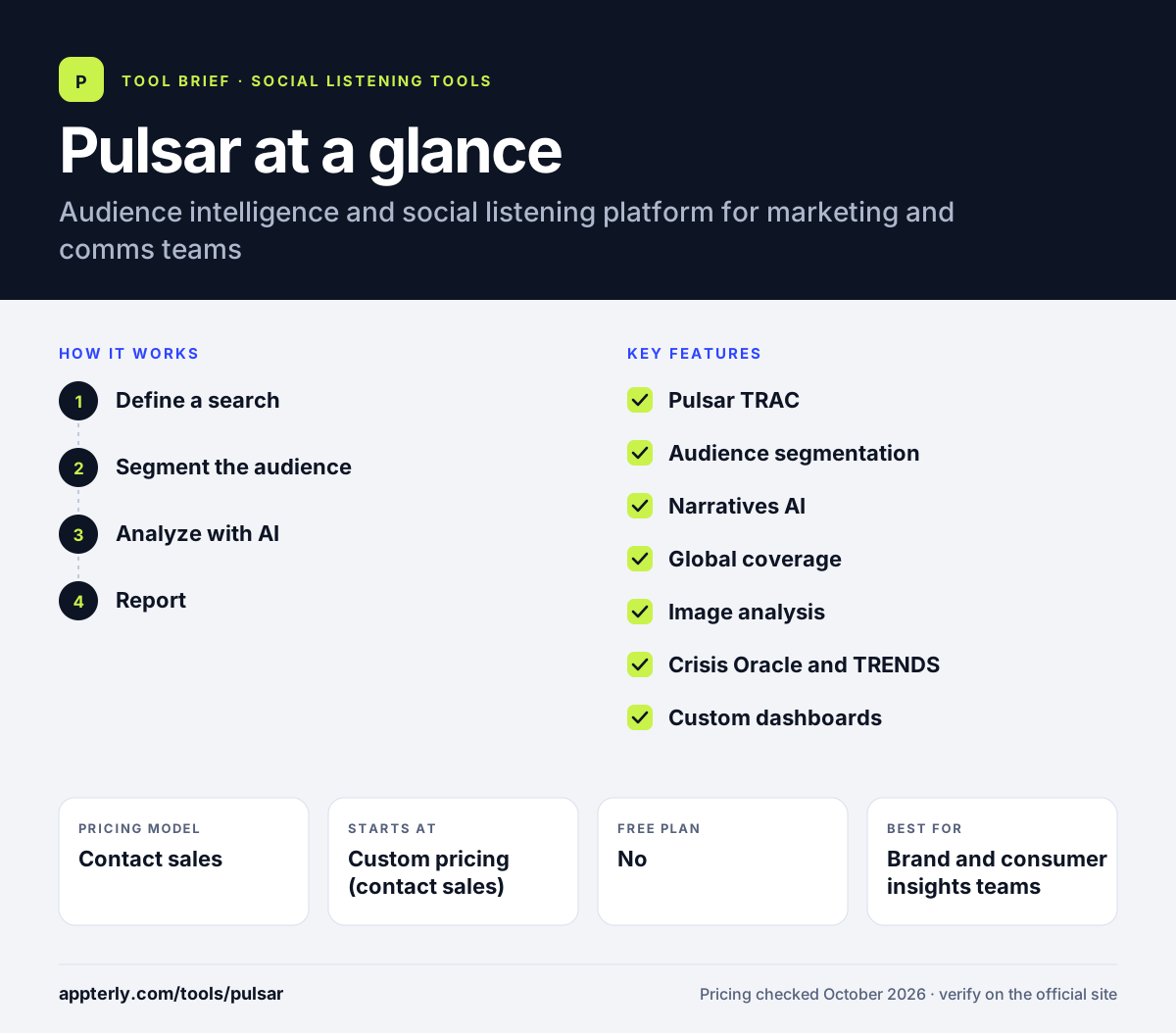
Pulsar at a glance
How does Pulsar work?
- Define a search
Set up keyword tracking for a brand, topic or campaign and choose sources such as social networks, news, broadcast, podcasts and forums.
- Segment the audience
Use more than 50 filters to split the conversation by audience segment, demographics, behaviors and affinities.
- Analyze with AI
Apply sentiment, topic, emotion and image analysis, and use Narratives AI to see how stories and themes develop.
- Report
Build templated or custom dashboards and automate report delivery to your team.
Pulsar key features
Pulsar TRAC
The core social listening tool, covering platforms such as Instagram, Pinterest and Twitch plus news, print, TV, radio, podcasts, forums and blogs.
Audience segmentation
Build custom segments, such as journalists or doctors, and follow them over time as social panels.
Narratives AI
Groups conversations into narratives so teams can track how stories form and spread.
Global coverage
Data from 195 countries in all languages, including regional sources such as Weibo, WeChat, Naver and VK.
Image analysis
AI-driven image analysis and logo recognition detect brand appearances in visual content.
Crisis Oracle and TRENDS
Modules for spotting reputation risks early and finding emerging cultural and consumer trends.
Custom dashboards
Templated and custom dashboards with automated report delivery.
Why use Pulsar?
- Audience segmentation shows which communities drive a conversation, not just how many posts there are.
- Coverage of regional platforms helps brands working in Asia and Eastern Europe.
- Narrative tracking helps comms teams see how stories spread and change.
- Data visualization makes findings easier to share with stakeholders.
- Industry-trained AI models improve the relevance of sentiment and topic tagging.
Who is Pulsar best for?
A good fit for
- Brand and consumer insights teams
- PR and communications teams tracking narratives
- Agencies doing audience and cultural research
- Global brands monitoring regional platforms
Less suited to
- Small businesses that only need low-cost brand alerts and a basic mention feed
- Teams wanting self-serve signup and published prices
- Users who need simple keyword monitoring only
Pulsar pricing
| Pricing model | Contact sales |
|---|---|
| Free plan | No |
| Free trial | Not confirmed |
| Starting price | Custom pricing (contact sales) |
Pulsar does not publish prices. Teams book a demo and receive a quote based on the modules, data sources and coverage they need, so costs vary widely between a single listening module and a multi-module setup.
Prices checked October 2026. Vendors change plans often, so confirm on the official website before you buy.
Pulsar pros and cons
Pros
- Strong audience segmentation and community analysis
- Wide global and regional source coverage
- Several specialist modules for narratives, trends and crisis risk
Cons
- No published pricing or self-serve trial
- Module-based product range can be confusing to compare when you are new to it
- More analytical than teams needing basic alerts require
Pulsar integrations and platforms
Available on
Pulsar alternatives
See the full shortlist in Best Social Listening Tools.
Pulsar FAQ
What is Pulsar used for?
Pulsar is used for social listening and audience intelligence. Marketing, insights and communications teams use it to understand which communities talk about a brand or topic, how narratives spread, and which trends are emerging. It also supports campaign analysis, brand reputation tracking and crisis monitoring across social, news and broadcast sources.
How much does Pulsar cost?
Pulsar does not list prices on its website. Pricing is custom and depends on which modules you need, such as TRAC, CORE, TRENDS or Narratives AI, and the data coverage involved. To get a quote, you book a demo or contact the sales team.
What is Pulsar TRAC?
Pulsar TRAC is the platform's main social listening product. It tracks keywords across social networks, news, print, TV, radio, podcasts and forums in 195 countries, then lets you segment the conversation by audience, demographics and interests. It includes sentiment, topic and emotion detection, image analysis and custom dashboards.
Pulsar vs Brandwatch: what's the difference?
Both are advanced social listening platforms for large teams. Brandwatch is known for its huge historical archive and bundled social management and influencer tools. Pulsar puts more focus on audience segmentation, community mapping and narrative tracking, and it covers many regional platforms such as Weibo and VK.
Who owns Pulsar?
Pulsar is part of Pulsar Group, which also includes Vuelio, Isentia and ResponseSource. The group offers media intelligence and PR tools alongside Pulsar's audience intelligence platform, so communications teams can combine listening with media monitoring and outreach products from the same company.
Sources
This overview is based on Pulsar's official website and documentation, checked October 2026.