What is Poptin?
Poptin is a lead capture and email marketing platform that lets small businesses build popups, embedded forms and email campaigns from one account. Its popups come in many formats, including lightbox, floating bar, full-screen, slide-in, gamified and social widgets, and they can be shown based on exit intent, scrolling, time on page and other behavior. A small teaser icon can also expand into a full popup when clicked.
Over time Poptin has added an email product with a drag-and-drop builder, segments, campaigns and behavior-based automations, so captured contacts can be emailed without a separate tool. It also connects natively to more than 70 email, CRM and messaging platforms. Poptin works on WordPress, Shopify, Wix, BigCommerce, Weebly and other sites, and its free plan lets very small sites start without paying. The same company also runs Chatway, a live chat product.
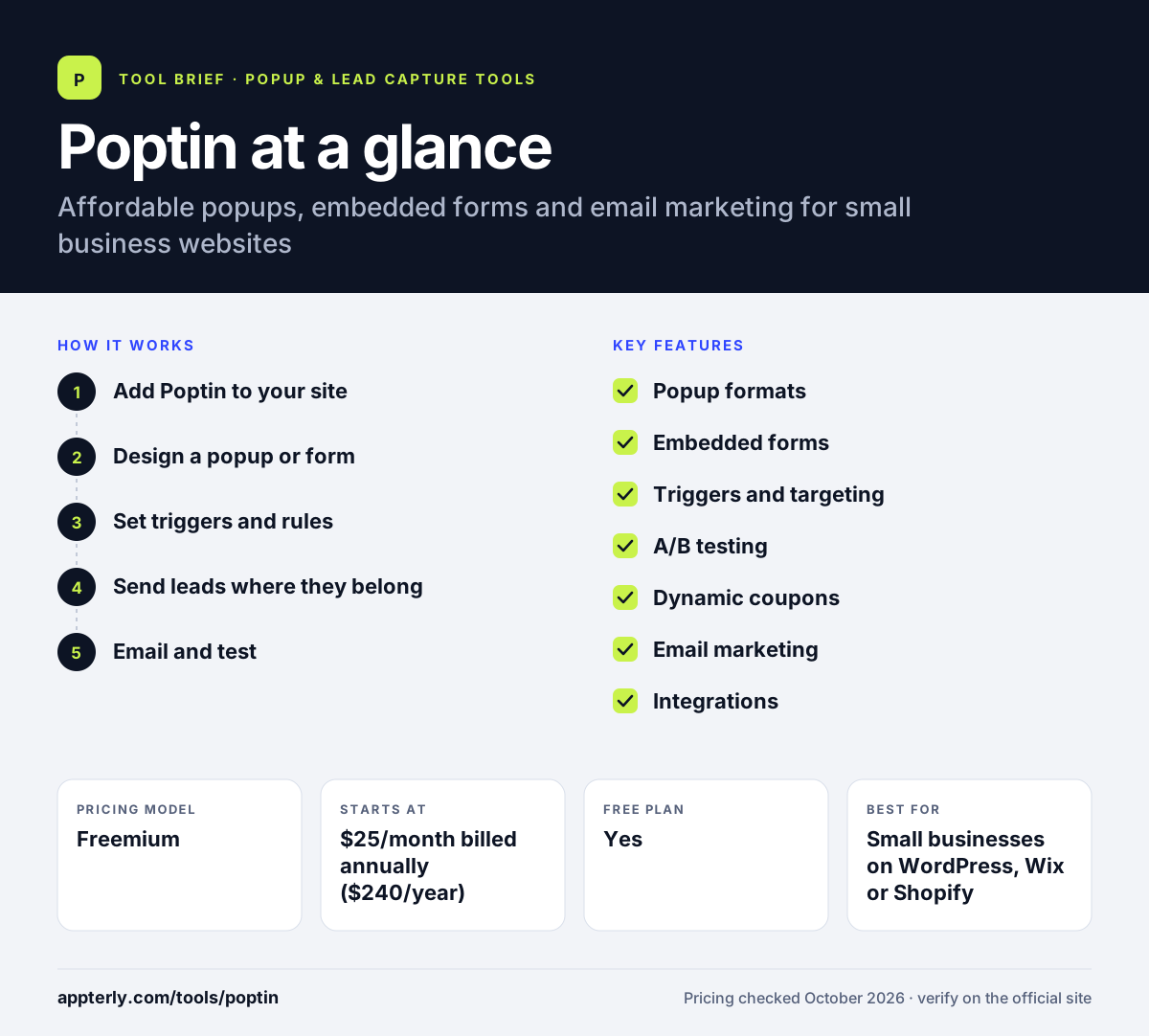
Poptin at a glance
How does Poptin work?
- Add Poptin to your site
Install a plugin or app for platforms like WordPress, Shopify or Wix, or paste a code snippet on any site. Poptin also lists modules for Magento and Drupal.
- Design a popup or form
Start from a template, then change fields, colors, fonts and copy in the drag-and-drop editor. Brand fonts and colors can be saved and reused.
- Set triggers and rules
Choose exit intent, scroll, delay or click triggers and apply targeting by page, device, location or traffic source.
- Send leads where they belong
Pass contacts to an integrated email or CRM tool, or keep them in Poptin's own email product. Contacts can be tagged and segmented.
- Email and test
Run campaigns and automations, and A/B test popup timing, templates and triggers to improve results.
Poptin key features
Popup formats
Lightbox, floating bar, full-screen, slide-in, gamified, mobile and social widget popups, plus a clickable teaser.
Embedded forms
Inline forms with advanced fields and accessibility-focused designs for contact and signup pages.
Triggers and targeting
More than 15 targeting rules covering behavior, location, device, pages and display frequency, including exit intent.
A/B testing
Compares timing, interactions, templates and triggers to find the better-performing popup.
Dynamic coupons
Generates unique discount codes inside popups to reward signups.
Email marketing
Drag-and-drop email builder, merge tags, segments, campaigns and behavior-based automations.
Integrations
More than 70 native connections, with access to many more through Zapier and Make.
Agency account management
The Agency plan adds unlimited domains, client account management, extra users and premium support.
Why use Poptin?
- Paid plans are cheaper than many popup tools with similar features.
- Popups, forms and email can live in one account.
- It supports a wide range of website builders and ecommerce platforms.
- Unlimited popups are included on every plan.
- A free plan covers small sites with up to 1,000 visitors a month.
Who is Poptin best for?
A good fit for
- Small businesses on WordPress, Wix or Shopify
- Bloggers starting an email list
- Agencies managing popups on many client domains
- Budget-conscious marketers who want popups and email together
Less suited to
- Large stores that need AI personalization or visitor identification
- Sites with heavy traffic that would outgrow the visitor-based tiers quickly
Poptin pricing
| Pricing model | Freemium |
|---|---|
| Free plan | Yes |
| Free trial | Not confirmed |
| Starting price | $25/month billed annually ($240/year) |
Popup plans move from Basic to Pro ($59) and Agency ($119), raising monthly visitors and domains; Agency also adds account and user management. Separate email plans are priced by active contacts, and Enterprise is quoted.
Prices checked October 2026. Vendors change plans often, so confirm on the official Poptin pricing page before you buy.
Poptin pros and cons
Pros
- Low entry price and a free plan
- Many popup formats with unlimited popups
- Built-in email marketing and automations
- Large integration list
Cons
- Free plan carries Poptin branding and a 1,000 visitor limit
- Pricing tiers are based on visitors, so costs rise with traffic
- Fewer advanced ecommerce features than store-focused competitors
Poptin integrations and platforms
Works with
Available on
Poptin alternatives
See the full shortlist in Best Popup Builders.
Poptin FAQ
Is Poptin free?
Yes. Poptin has a free plan with unlimited popups for one domain and up to 1,000 visitors per month, though popups show Poptin branding. A free email plan covers 250 active contacts and 500 emails. Paid popup plans start at $25 per month on annual billing and remove the branding.
What is Poptin used for?
Poptin is used to capture leads and sales on a website with popups, floating bars, slide-ins and embedded forms. Businesses use exit intent and other triggers to offer discounts or newsletter signups, then send the contacts to an email tool or to Poptin's own email product for campaigns and automations. It suits small businesses that want popups and email at a low price.
Does Poptin work with WordPress and Shopify?
Yes. Poptin works with WordPress, Shopify, Wix, BigCommerce, Weebly, Ecwid and other platforms, and it can be added to any site with a code snippet. It also integrates with email and CRM tools such as Mailchimp, Klaviyo, HubSpot and Salesforce.
Poptin vs OptinMonster: what's the difference?
Both build targeted popups with exit intent and A/B testing. Poptin is cheaper, has a free plan and includes its own email marketing tools. OptinMonster has a larger template library, deeper WordPress integration and advanced features like onsite retargeting, but it has no free plan and bills annually.
How much does Poptin cost?
Poptin's popup plans, billed annually, are Basic at $25 per month for 10,000 visitors, Pro at $59 per month for 50,000 visitors and four domains, and Agency from $119 per month with unlimited domains. Annual billing saves about 20 percent compared with paying monthly. Email plans are priced separately by contacts. Enterprise pricing is available on request.
Sources
This overview is based on Poptin's official website and documentation, checked October 2026.