What is mParticle?
mParticle is a customer data platform that collects event data from mobile apps, websites and servers, cleans and unifies it into customer profiles, and sends it to hundreds of marketing, analytics and advertising tools. It is now part of Rokt and positions itself as a performance CDP, meaning the focus is on using first-party data to improve ad match rates, audience reach and campaign results rather than just storing profiles.
The platform is aimed at larger consumer brands with complex app and web stacks. Developers install client SDKs for iOS, Android and the web or send data through the Events API, and marketers then build audiences, predictive segments and real-time profiles. The platform describes its design as a hybrid architecture. Pricing is quote-based and not published.
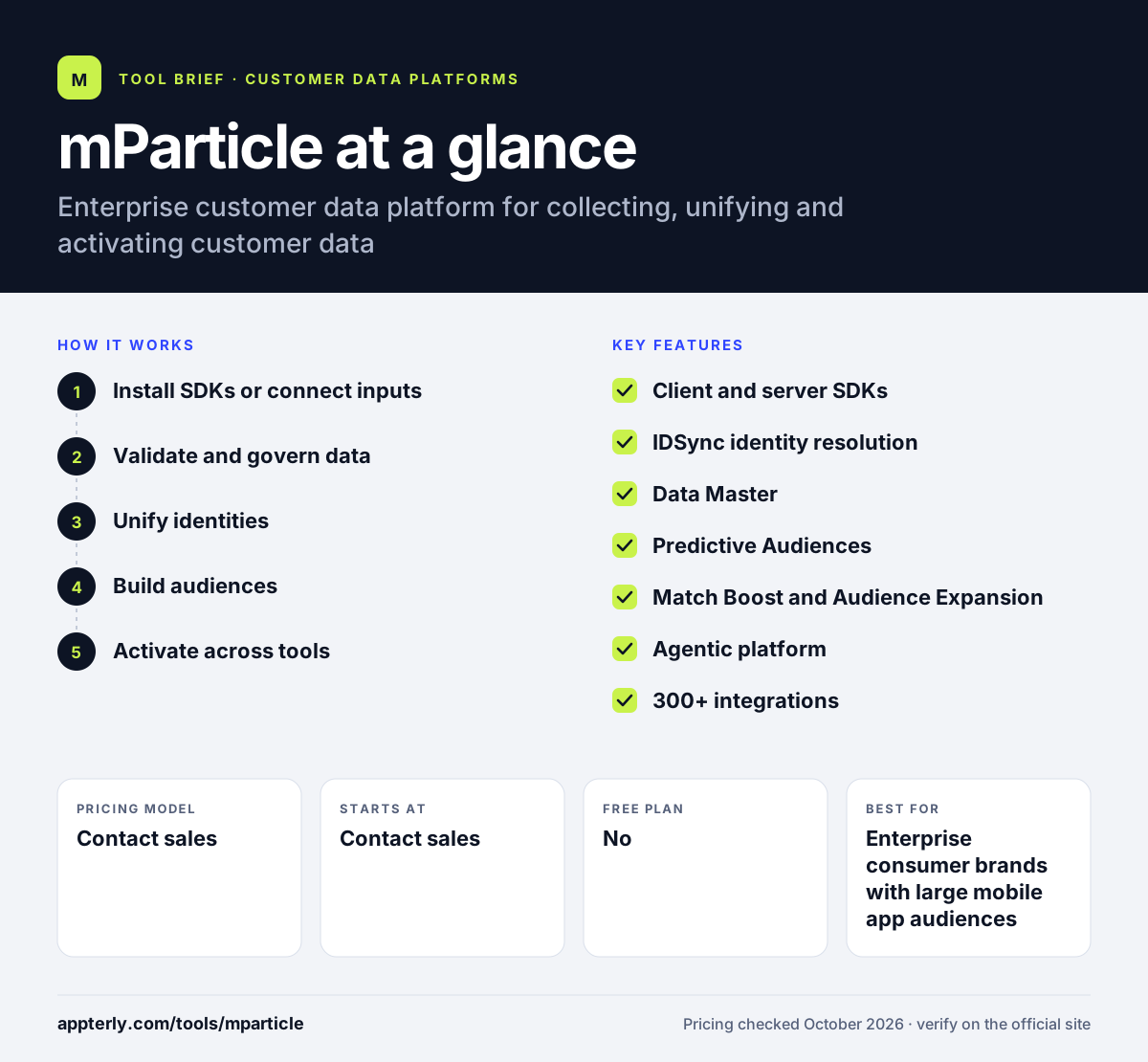
mParticle at a glance
How does mParticle work?
- Install SDKs or connect inputs
Add the iOS, Android or Web SDK, send server events through the Events API, or bring in partner feeds such as Branch, AppsFlyer or Braze.
- Validate and govern data
Use Data Master to define expected events, check the live stream and block or fix bad data, with custom rules to transform events on the way in and out.
- Unify identities
IDSync matches identifiers such as emails, device IDs and customer IDs so each person has one profile across devices.
- Build audiences
Create segments with the audience builder, predictive scores or plain-language prompts in the agentic platform.
- Activate across tools
Forward events and audiences to destinations like Amplitude, Mixpanel, Braze, Meta or Snapchat in real time.
mParticle key features
Client and server SDKs
SDKs for iOS, Android and Web, plus an Events API with HTTP, Node, Python and Ruby options.
IDSync identity resolution
Real-time identity management that links anonymous and known users, with Household Reach to group related people.
Data Master
Tools to define a data plan, view incoming data and enforce quality rules before data reaches other systems.
Predictive Audiences
Scores each user on likelihood to churn, convert or grow in value, so marketers can target or suppress them.
Match Boost and Audience Expansion
Improves match rates when sending audiences to Meta and Google Ads, and finds similar people to reach.
Agentic platform
Suggests audience logic from plain-language goals to cut down on manual segment building.
300+ integrations
Event and audience outputs to analytics, messaging and ad tools, plus a Profile API for real-time personalization.
Why use mParticle?
- It gives mobile-first brands strong SDK coverage and real-time event forwarding.
- Data quality controls catch tracking errors before they spread to every tool.
- Identity resolution builds one profile per customer across app and web.
- Better audience match rates can make paid media spend go further.
- Privacy tools help with GDPR and CCPA requests across connected systems.
Who is mParticle best for?
A good fit for
- Enterprise consumer brands with large mobile app audiences
- Retail, media and travel companies running paid and lifecycle marketing
- Data and engineering teams that need strict governance over tracking
- Marketers who want predictive and lookalike audiences from first-party data
Less suited to
- Small businesses and startups with simple tracking needs
- Teams that want transparent self-serve pricing
- Companies that want a purely warehouse-native setup with no separate data store
mParticle pricing
| Pricing model | Contact sales |
|---|---|
| Free plan | No |
| Free trial | Not confirmed |
| Starting price | Contact sales |
mParticle does not publish prices. Buyers request a quote or demo, and cost depends on the modules and data volume needed.
Prices checked October 2026. Vendors change plans often, so confirm on the official mParticle pricing page before you buy.
mParticle pros and cons
Pros
- Mature SDKs for mobile and web apps
- Strong data quality and identity tooling
- Large integration catalog for events and audiences
- Predictive and ad match features aimed at measurable results
Cons
- No public pricing and no free tier
- Requires developer time to implement and maintain SDKs
- Likely more platform than small teams need
mParticle integrations and platforms
Works with
Available on
mParticle alternatives
See the full shortlist in Best Customer Data Platforms.
mParticle FAQ
Is mParticle free?
No. mParticle does not offer a free plan or a published free trial. Pricing is quote-based, and you request a quote or demo through the website. The final cost depends on your data volume, the features you need, such as predictions or identity, and your support requirements.
What is mParticle used for?
mParticle is used to collect customer events from apps, websites and servers, clean them, merge them into unified profiles and send them to marketing, analytics and ad tools. Common uses include feeding analytics tools like Amplitude, syncing audiences to Meta and personalizing messages in Braze.
Is mParticle owned by Rokt?
Yes. mParticle merged with Rokt, the ecommerce marketing company, and the product is now presented as mParticle by Rokt. The CDP continues as its own platform, with a stronger focus on performance marketing features such as audience match rates, predictive audiences and real-time relevance.
mParticle vs Segment: what's the difference?
Both collect events through SDKs and route them to other tools. mParticle is aimed more at enterprise consumer brands with large mobile apps and emphasizes data governance, identity and performance marketing. Segment has a self-serve free plan and is often easier for smaller teams and startups to adopt.
Does mParticle integrate with Braze?
Yes. Braze is listed as both an event output and an audience output in mParticle's documentation, and it can also send data back in as a partner feed. This lets teams forward app events and synced segments into Braze for push, email and in-app messaging.
Sources
This overview is based on mParticle's official website and documentation, checked October 2026.