What is Invoca?
Invoca is an enterprise revenue platform that uses call tracking and AI to link marketing spend to phone conversations and the revenue they produce. It attributes inbound calls to the ads, keywords and pages behind them, then analyzes what happened on each call so marketers can see which campaigns drive sales rather than just rings. Large brands in healthcare, insurance, telecom, automotive and financial services are its core market.
Invoca has grown well past basic attribution. Signal AI scores conversations for outcomes like sales or appointments, PreSense passes a caller's digital journey to agents before they answer, and Quality Management grades and coaches agents automatically. Newer AI Voice and Messaging Agents can answer, qualify and route leads by phone or text. The platform holds compliance credentials such as HIPAA support, PCI DSS and SOC 2 Type 2, which matters for regulated industries.
Invoca at a glance
How does Invoca work?
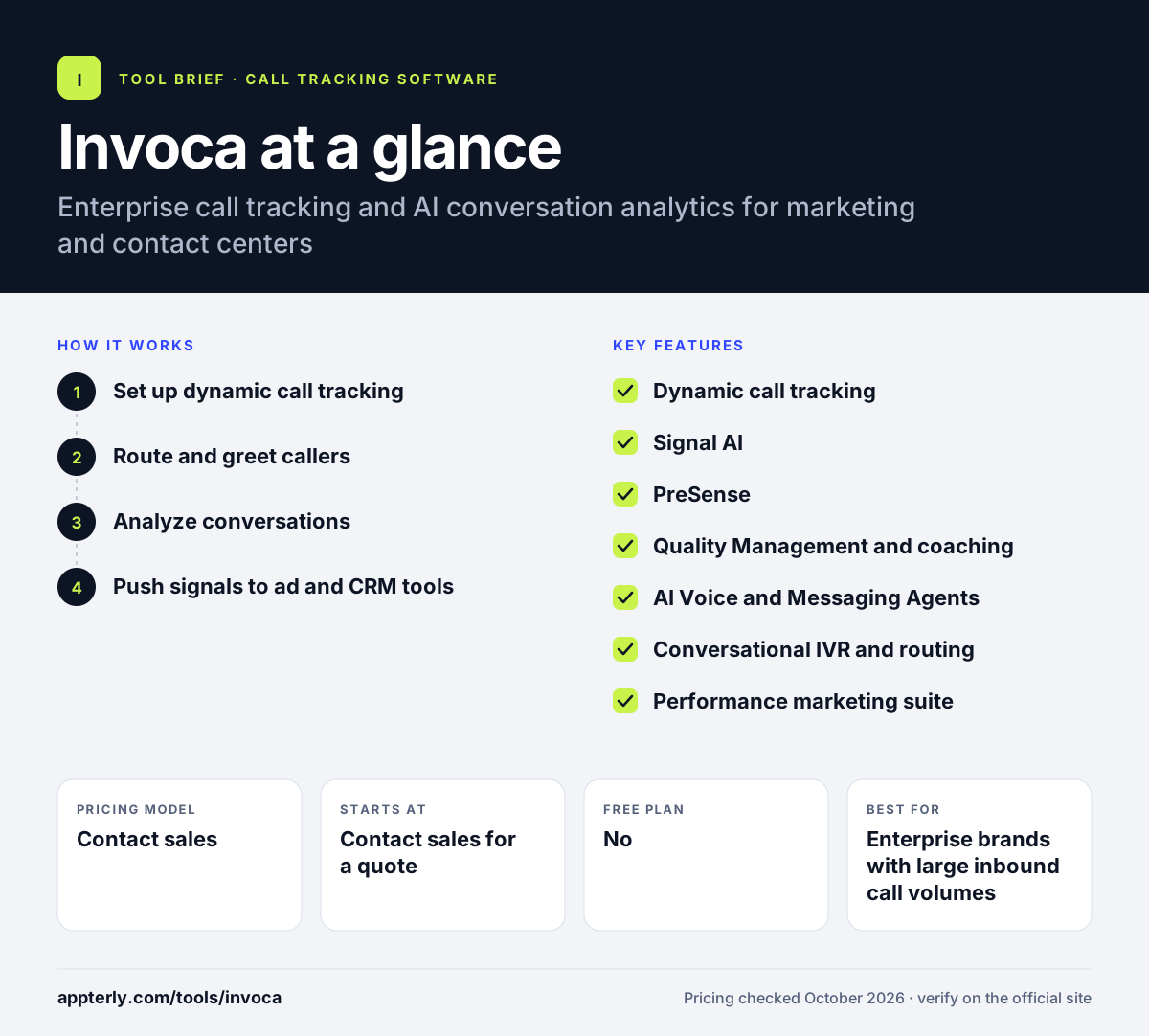
- Set up dynamic call tracking
Invoca assigns tracking numbers to campaigns and swaps them on your website so each call carries its ad, keyword and session data.
- Route and greet callers
Custom or conversational IVRs and data-driven routing send callers to the right agent or location, optionally using PreSense context.
- Analyze conversations
Calls are recorded and transcribed, and Signal AI models classify outcomes such as a sale, quote or appointment.
- Push signals to ad and CRM tools
Conversion signals are sent to Google Ads, Meta, Salesforce, Adobe and others so bidding and reporting reflect real phone results.
Invoca key features
Dynamic call tracking
Attributes each call to its marketing source and captures digital data from the visitor's session.
Signal AI
Conversation analytics with custom AI models, keyword spotting, transcripts, redaction, summaries and sentiment, sold as an add-on.
PreSense
Uses a caller's online activity to route them and give agents context before the conversation starts.
Quality Management and coaching
AI scorecards and agent voice identification help managers review every call rather than a small sample.
AI Voice and Messaging Agents
Automated agents that answer, qualify and route leads by phone and SMS at any hour.
Conversational IVR and routing
Speech-enabled IVR and data-driven routing direct callers based on intent and journey data.
Performance marketing suite
Dedicated plans support campaign syndication, payout rules and affiliate call programs.
Why use Invoca?
- It connects offline phone sales to online ad spend, closing a common attribution gap for big brands.
- AI outcome detection lets ad platforms optimize toward calls that actually convert.
- Agents get caller context up front, which can shorten calls and improve conversion rates.
- Strong compliance credentials make it workable for healthcare and financial services.
- A broad integration catalog fits into established enterprise marketing stacks.
Who is Invoca best for?
A good fit for
- Enterprise brands with large inbound call volumes
- Healthcare, insurance and financial services companies with compliance needs
- Contact centers wanting AI scoring and agent coaching
- Performance marketers running affiliate call programs
Less suited to
- Small businesses that need low-cost, self-serve tracking
- Teams wanting transparent published pricing or a free trial
Invoca pricing
| Pricing model | Contact sales |
|---|---|
| Free plan | No |
| Free trial | Not confirmed |
| Starting price | Contact sales for a quote |
Pro, Enterprise and Elite plans scale by annual tracking numbers (6,000 to 18,000) and custom signals; separate Performance plans serve affiliate programs. Signal AI, Quality Management and PreSense are add-ons on most tiers.
Prices checked October 2026. Vendors change plans often, so confirm on the official Invoca pricing page before you buy.
Invoca pros and cons
Pros
- Deep AI conversation analytics built for marketing outcomes
- Extensive enterprise integrations and APIs
- Strong compliance coverage for regulated industries
- Contact center features such as PreSense and AI quality scoring
Cons
- No public prices, so costs require a sales conversation
- Built for enterprises, which makes it heavy for small teams
- Key AI features are add-ons rather than included
Invoca integrations and platforms
Works with
Available on
Invoca alternatives
See the full shortlist in Best Call Tracking Software.
Invoca FAQ
How much does Invoca cost?
Invoca does not publish prices. Its plans, named Pro, Enterprise and Elite plus two Performance plans, are quoted individually based on factors such as tracking number volume, custom signals and add-ons. You request a quote or book a demo, and there is no free trial listed.
What is Invoca used for?
Invoca is used by large companies to track which marketing campaigns drive phone calls and to analyze those calls with AI. It reveals whether a call led to a sale or appointment, sends that signal back to ad platforms, and helps contact centers route callers and coach agents.
Invoca vs CallRail: what's the difference?
CallRail targets small businesses and agencies with self-serve plans starting around $50 per month. Invoca targets enterprises with quote-based pricing, deeper AI models, compliance certifications, advanced routing and contact center tools. Smaller teams usually find CallRail sufficient, while large regulated brands lean toward Invoca.
Is Invoca HIPAA compliant?
Invoca lists HIPAA support and offers a business associate agreement, along with PCI DSS, SOC 2 Type 2, ISO 27001 and CCPA credentials. That is why healthcare providers and insurers use it for call tracking. Confirm the exact terms for your account with Invoca's sales team.
Does Invoca integrate with Salesforce and Google Ads?
Yes. Invoca integrates with Salesforce, Google Ads, Google Analytics, Meta, Adobe, HubSpot and many other platforms. Some premium connectors, including certain Salesforce and Adobe integrations, are sold as add-ons on lower tiers, and APIs and webhooks cover custom needs.
Sources
This overview is based on Invoca's official website and documentation, checked October 2026.