What is HeyGen?
HeyGen is an AI video platform that creates presenter-style videos with AI avatars, including a personal avatar built from your own face and voice, so you do not need to film every video. Marketers, sales teams, trainers, founders and creators use it for explainers, product demos, onboarding, social content and personalized outreach. It runs in the browser and also offers APIs for developers.
HeyGen's AI Studio is a script-based editor where you control delivery, gestures and emotion, with brand kits, captions and team collaboration. Video Agent builds a full video from a text prompt, and video translation converts content into 175+ languages and dialects with voice cloning and lip sync. Other tools turn PowerPoint or PDF files, images and audio into video, and the Avatar IV and Avatar V models power its avatars.
HeyGen at a glance
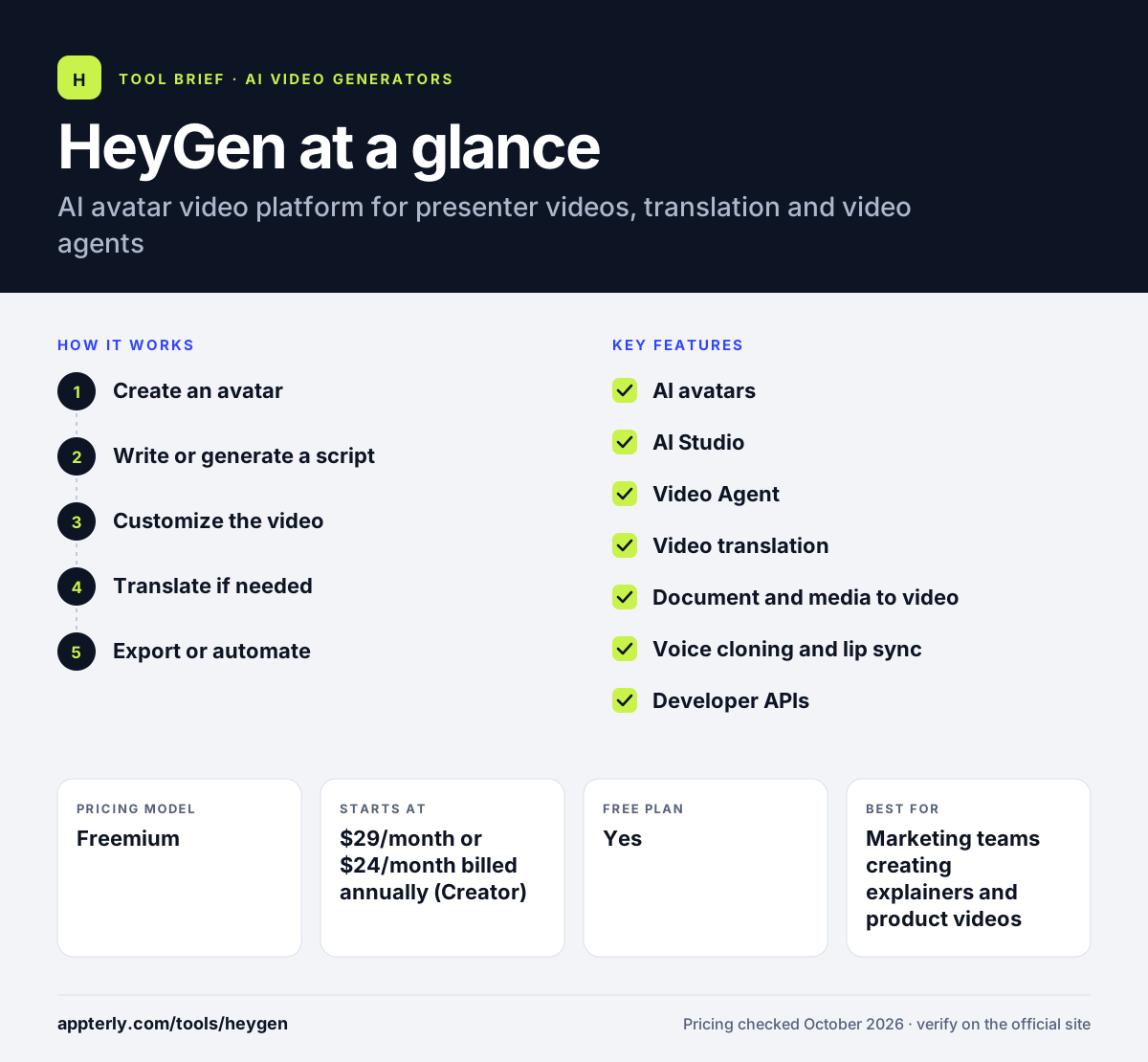
How does HeyGen work?
- Create an avatar
Pick from stock presenters or record a short clip to create a custom avatar of yourself. Business plans include five custom video avatars.
- Write or generate a script
Type your script in AI Studio, or describe the video and let Video Agent draft it.
- Customize the video
Add scenes, branding, captions, media and gestures, and choose voice and language.
- Translate if needed
Translate the finished video into other languages with cloned voice and lip sync. Pro users can edit translation scripts before rendering.
- Export or automate
Download in up to 4K on higher plans, or generate videos at scale through the API.
HeyGen key features
AI avatars
Stock presenters and custom avatars, with Avatar V designed to keep identity consistent across angles and expressions.
AI Studio
A script-based editor with control over delivery, gestures and emotion, plus brand kits and captions.
Video Agent
Generates complete videos from a text prompt, with editable motion elements.
Video translation
Translates videos into 175+ languages and dialects with voice cloning and lip sync.
Document and media to video
Turns PowerPoint, PDF, text, images and audio into videos.
Voice cloning and lip sync
Clones voices and syncs lip movement to new audio.
Developer APIs
APIs for Video Agent, video generation, translation and lip sync.
Why use HeyGen?
- Teams can produce presenter videos without cameras, studios or retakes.
- One video can be translated into many languages with matching lip movement.
- A personal avatar lets founders and creators scale their on-camera presence.
- Business plans support SCORM export, SSO and shared workspaces for larger teams.
- Credits roll over for a limited period, reducing waste between months.
Who is HeyGen best for?
A good fit for
- Marketing teams creating explainers and product videos
- Sales teams sending personalized video outreach
- Training and L&D teams producing onboarding content
- Creators and founders scaling talking-head content
- Global brands localizing videos into many languages
Less suited to
- Cinematic or highly creative productions
- Users who need watermark-free output on a free plan
- Teams needing very long videos on lower tiers
HeyGen pricing
| Pricing model | Freemium |
|---|---|
| Free plan | Yes |
| Free trial | Not confirmed |
| Starting price | $29/month or $24/month billed annually (Creator) |
Pro starts at $49 per month with 4K export and scales by credit volume, Business is $149 per month plus $20 per seat, and Enterprise is custom; credits are used across features.
Prices checked October 2026. Vendors change plans often, so confirm on the official HeyGen pricing page before you buy.
HeyGen pros and cons
Pros
- Realistic avatars with strong lip sync
- Translation into 175+ languages
- Prompt-to-video with Video Agent
- Free plan to test the platform
Cons
- Free videos are watermarked and limited to one minute
- Credit usage varies by model and length
- Advanced team features require the Business plan
HeyGen integrations and platforms
Works with
Available on
HeyGen alternatives
See the full shortlist in Best AI Video Generators.
HeyGen FAQ
Is HeyGen free?
Yes, HeyGen has a free plan that allows up to three watermarked videos a month, each up to one minute long, with one custom video avatar and limited trial access to premium features. Paid plans start with Creator at $29 per month, or $24 per month billed annually, which removes branding and allows longer 1080p videos. Annual billing gives two months free compared with monthly billing.
What is HeyGen used for?
HeyGen is used to create videos with AI avatars instead of filming. Businesses use it for marketing explainers, product demos, sales outreach, training and onboarding, while creators use personal avatars for social content. It also translates videos into 175+ languages and turns slides, PDFs and prompts into videos. Business plans add SCORM export, so training videos can be delivered through a learning management system.
Is HeyGen good for beginners?
Yes, HeyGen is designed for people without video skills. You can choose an avatar, type a script and generate a video, or describe what you want and let Video Agent build it. AI Studio offers more control over gestures and delivery once you are comfortable with the basics. Templates and brand kits also help new users produce consistent videos quickly.
HeyGen vs Synthesia: what's the difference?
HeyGen and Synthesia both create AI avatar videos for business. HeyGen is known for personal avatars, Video Agent prompt-to-video, translation with lip sync in 175+ languages and a ChatGPT plugin. Synthesia focuses strongly on enterprise training and communications. Compare avatar realism, language coverage, team features and pricing for your use case. Both offer ways to test the product before committing.
Does HeyGen have an API?
Yes, HeyGen for Developers offers APIs for Video Agent, video generation, translation and lip sync models. Product teams use them to generate avatar videos automatically, for example personalized sales videos or localized content at scale. API pricing is listed separately from the main subscription plans.
Sources
This overview is based on HeyGen's official website and documentation, checked October 2026.