What is Chatfuel?
Chatfuel is a no-code AI agent platform that automates customer conversations on WhatsApp, Instagram, Facebook, TikTok and website chat. It replies to messages and comments, qualifies leads, sends payment links, books appointments and follows up, without requiring developers. Chatfuel is an official Meta Business Partner and WhatsApp Business Solution Provider, which matters for brands that want to use the official WhatsApp Business API.
Chatfuel targets small businesses, creators and marketing agencies. Agencies can resell it under their own brand, while developers can use its SDK and API. Pricing works on a wallet model: each plan includes credits that pay for AI replies and Meta-billed WhatsApp messages. Contacts are unlimited on every plan, and more than 50 templates help teams launch common sales and support flows quickly.
Chatfuel at a glance
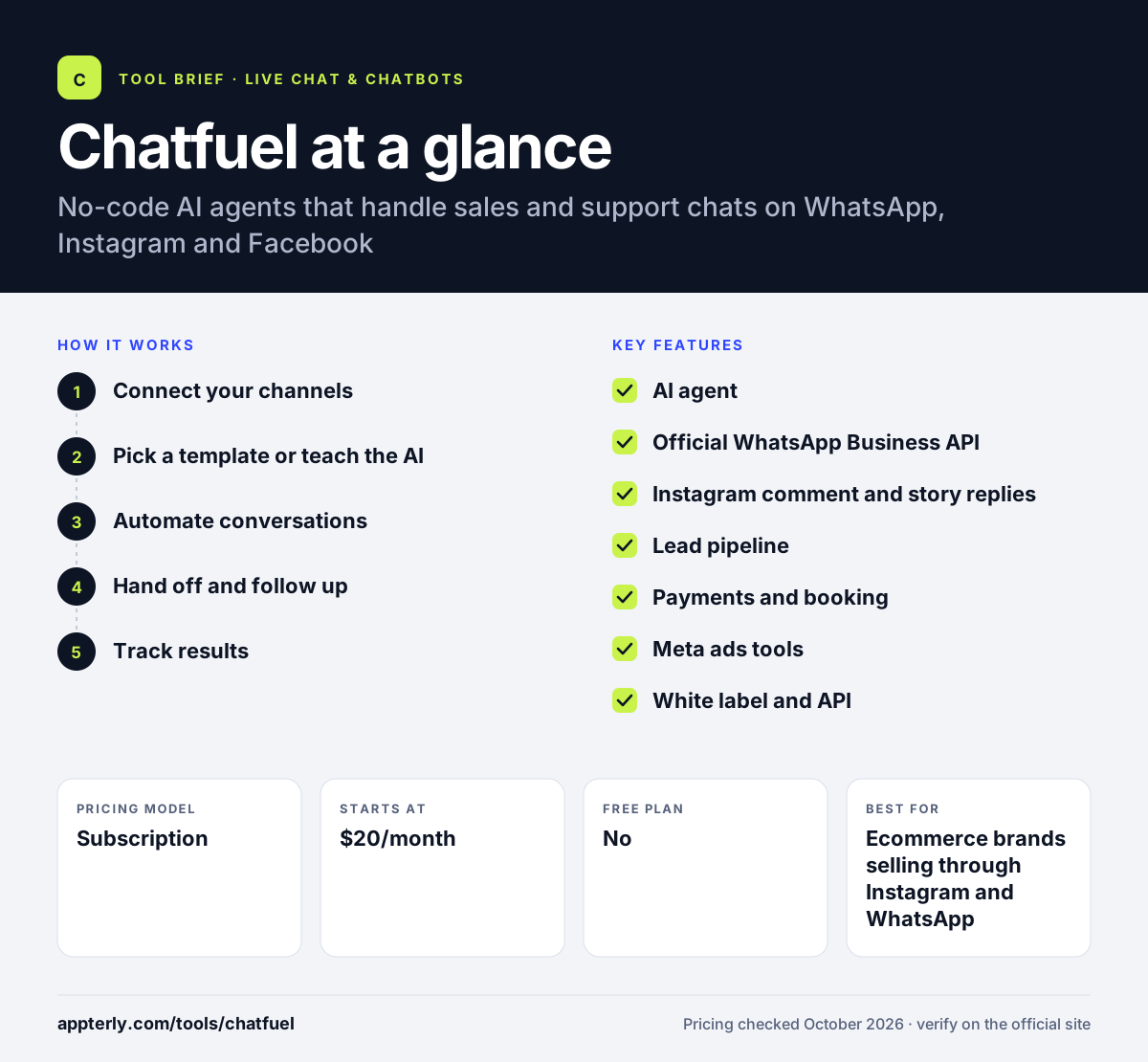
How does Chatfuel work?
- Connect your channels
Link WhatsApp, Instagram, Facebook, TikTok or your website chat widget to Chatfuel.
- Pick a template or teach the AI
Start from one of 50+ templates and train the AI agent on your recurring questions, products and policies.
- Automate conversations
The agent replies to DMs and comments, qualifies leads, sends payment links and books appointments around the clock.
- Hand off and follow up
Team members step in when needed, while AI follow-ups re-engage leads who went quiet.
- Track results
Review the lead pipeline and creative-level ad reporting to see which campaigns drive conversations and sales.
Chatfuel key features
AI agent
Answers questions, qualifies leads and handles after-hours messages across all connected channels.
Official WhatsApp Business API
Send and receive WhatsApp messages, including template broadcasts, through an official Meta solution provider.
Instagram comment and story replies
Automatically respond to comments, Reels and Story replies, and move people into DMs.
Lead pipeline
A pipeline that builds itself from chats, so leads are tracked without manual entry.
Payments and booking
Send payment links inside the chat and book appointments with confirmations, reminders and calendar sync.
Meta ads tools
Connects to Meta ads and the Meta Conversions API, generates AI ad creatives and reports ad performance at the creative level.
White label and API
Agency plans support reselling under your brand, and developers can build on the SDK, API and MCP access.
AI Co-pilot and voice messages
An AI co-pilot helps human team members draft replies, and the agent can handle voice messages as well as text.
Why use Chatfuel?
- Handles repetitive sales and support chats around the clock without hiring more staff.
- One platform covers WhatsApp, Instagram, Facebook, TikTok and web chat.
- No-code templates let non-technical marketers launch quickly.
- Unlimited contacts on every plan keep costs predictable as your audience grows.
- Agency plans make it practical to manage and resell bots for many clients.
Who is Chatfuel best for?
A good fit for
- Ecommerce brands selling through Instagram and WhatsApp
- Service businesses that book appointments through chat
- Marketing agencies building bots for clients
- Creators who get many DMs and comments
Less suited to
- Teams that need a full support help desk with ticketing, SLAs and detailed agent reporting
- Businesses with almost no social or messaging traffic
- Companies that want a single flat price with no usage-based credits
Chatfuel pricing
| Pricing model | Subscription |
|---|---|
| Free plan | No |
| Free trial | 7 days |
| Starting price | $20/month |
Each plan includes wallet credits that pay for AI replies and Meta-billed WhatsApp messages. Business covers one bot, while Agency plans add more bots, shared wallets and larger credit bundles, and annual billing is discounted.
Prices checked October 2026. Vendors change plans often, so confirm on the official Chatfuel pricing page before you buy.
Chatfuel pros and cons
Pros
- Official WhatsApp Business API access
- Strong Instagram comment and DM automation
- Unlimited contacts on all plans
- White-label reselling options for agencies, with shared wallets across client bots
Cons
- Usage-based credits make monthly costs vary with volume
- No permanent free plan
- Not a full help desk for complex support teams
Chatfuel integrations and platforms
Works with
Available on
Chatfuel alternatives
See the full shortlist in Best Live Chat Software.
Chatfuel FAQ
Is Chatfuel free?
Chatfuel does not offer a permanent free plan. It provides a 7-day free trial with full product access and $15 in credits for AI and messaging. After that, the Business plan costs $20 per month and includes $20 in credits, with larger Agency plans for teams that manage several bots.
What is Chatfuel used for?
Chatfuel is used to automate customer conversations on messaging and social channels. Businesses set up AI agents that answer questions, reply to Instagram comments, qualify leads, send payment links and book appointments on WhatsApp, Instagram, Facebook, TikTok and web chat. Agencies also use it to build and resell bots for clients.
Chatfuel vs ManyChat: what's the difference?
Both are no-code chat automation tools focused on Instagram, Facebook and WhatsApp. Chatfuel puts more emphasis on AI agents, the official WhatsApp Business API and agency white-label plans, and it bills usage through a credit wallet. ManyChat is widely used for Instagram marketing flows and has its own plan structure.
Does Chatfuel work with WhatsApp?
Yes. Chatfuel is an official WhatsApp Business Solution Provider, so it connects to the official WhatsApp Business API. You can automate replies, run AI agents and send template messages on WhatsApp. Meta-billed message fees are paid from your Chatfuel credit wallet.
Is Chatfuel good for beginners?
Yes, Chatfuel is designed for non-technical users. It uses a no-code builder, offers more than 50 templates and provides 24/7 support. Beginners can start with a template for lead capture or booking, train the AI on common questions, and expand to more channels later.
Sources
This overview is based on Chatfuel's official website and documentation, checked October 2026.