What is ZeroBounce?
ZeroBounce is an email validation and deliverability platform that cleans contact lists and helps senders reach the inbox. It flags invalid, disposable and inactive addresses, as well as spam traps and abuse emails, and includes catch-all validation. Beyond list cleaning, it adds tools to build sender reputation and monitor inbox health, which makes it more of a deliverability suite than a single-purpose verifier.
The platform includes AI email scoring, activity data that shows recent opens and clicks, an email finder for B2B addresses, warm-up, inbox placement tests, server testing, blacklist monitoring and a DMARC monitor. ZeroBounce offers bulk and real-time validation through an API with wrappers for many languages, a free tier with 100 monthly credits, and a subscription called ZeroBounce ONE that bundles the full toolset.
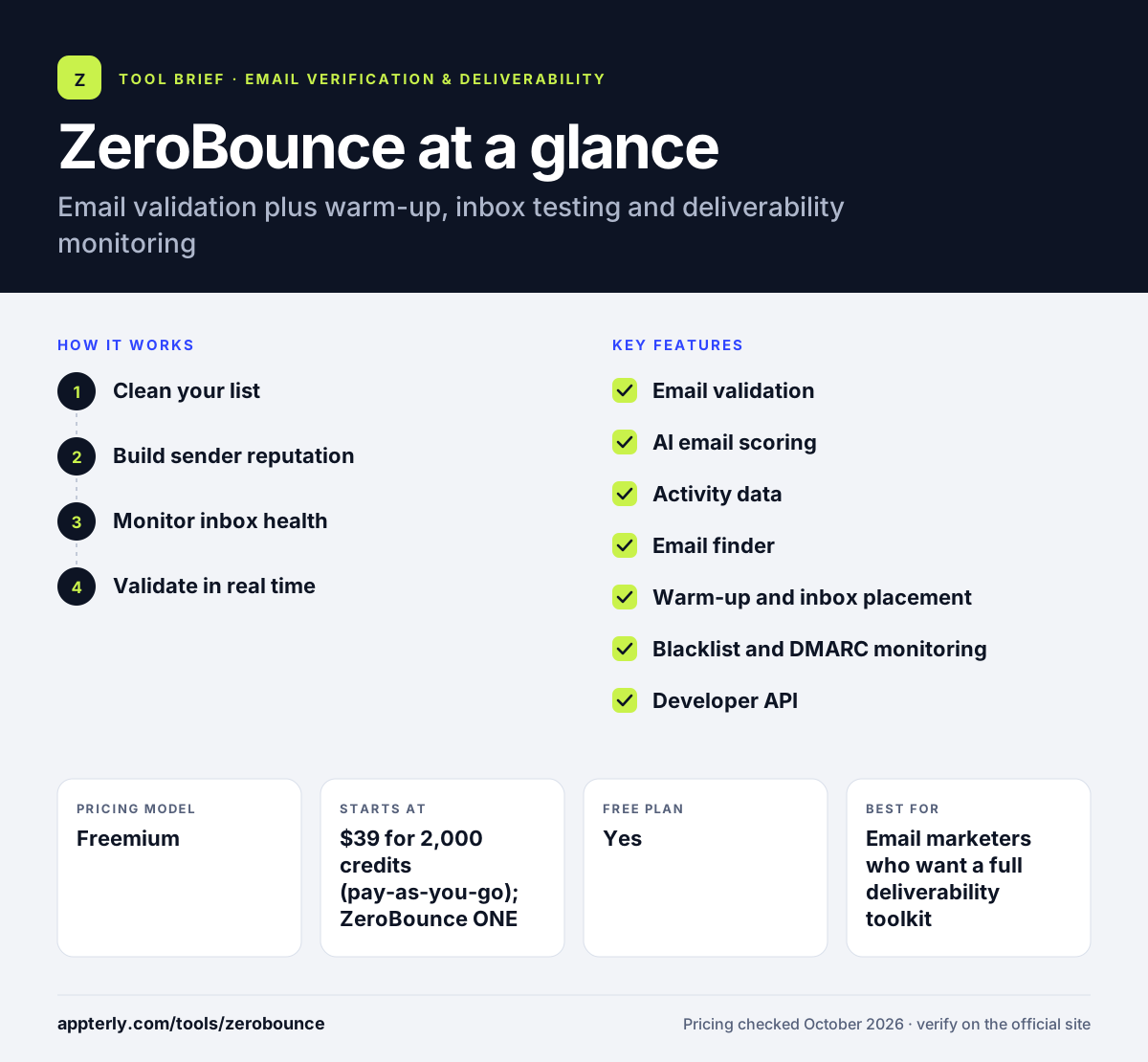
ZeroBounce at a glance
How does ZeroBounce work?
- Clean your list
Upload a list or connect an app to validate and score contacts before sending.
- Build sender reputation
Warm up domains, test inbox placement across major providers and check SPF, DKIM and DMARC setup.
- Monitor inbox health
Track blacklist status, authentication results and spam rates on a deliverability dashboard.
- Validate in real time
Add the API to sign-up forms so new addresses are checked as they arrive.
ZeroBounce key features
Email validation
Detects invalid, disposable, catch-all and spam trap addresses in bulk or in real time.
AI email scoring
Rates valid and catch-all addresses from 1 to 10 based on the likelihood of real engagement.
Activity data
Shows whether contacts have opened or clicked emails in recent months.
Email finder
Finds and verifies B2B email addresses from a name and company domain.
Warm-up and inbox placement
Builds sender trust and shows whether test emails land in the inbox or spam.
Blacklist and DMARC monitoring
Watches more than 200 blacklists and tracks email authentication for your domain.
Developer API
Real-time and bulk endpoints with wrappers for many programming languages.
Why use ZeroBounce?
- Handle verification, warm-up and monitoring in one account instead of three tools.
- Prioritize engaged contacts using scoring and activity data.
- Catch authentication and blacklist problems before they cut deliverability.
- Start small with 100 free monthly credits before paying.
- Meet security requirements with SOC 2 Type II, ISO 27001 and GDPR compliance listed.
Who is ZeroBounce best for?
A good fit for
- Email marketers who want a full deliverability toolkit
- Ecommerce brands cleaning large customer lists
- B2B sales teams that also need an email finder
- Developers verifying signups in real time
Less suited to
- Buyers who only want the cheapest possible bulk verification
- Very small senders who will not use warm-up or monitoring features
ZeroBounce pricing
| Pricing model | Freemium |
|---|---|
| Free plan | Yes |
| Free trial | Not confirmed |
| Starting price | $39 for 2,000 credits (pay-as-you-go); ZeroBounce ONE from $99/month |
The free plan includes 100 validation credits that refill monthly. Pay-as-you-go packs start at 2,000 credits, while ZeroBounce ONE bundles validation, warm-up, inbox tests, DMARC and finder credits, with a discount for annual billing.
Prices checked October 2026. Vendors change plans often, so confirm on the official ZeroBounce pricing page before you buy.
ZeroBounce pros and cons
Pros
- Broad deliverability suite beyond verification
- Free monthly credits for small checks
- Scoring and activity data help prioritize contacts
- Strong security and compliance credentials
Cons
- Pay-as-you-go rates are higher than budget verifiers
- The full suite can be more than a small sender needs
ZeroBounce integrations and platforms
Works with
Available on
ZeroBounce alternatives
See the full shortlist in Best Email Verification Tools.
ZeroBounce FAQ
Is ZeroBounce free?
ZeroBounce has a free plan that includes 100 email validation credits each month, and those credits refill monthly. This works for checking a handful of addresses or testing the service. For larger lists you buy pay-as-you-go credits, starting at 2,000 credits for $39, or subscribe to ZeroBounce ONE from $99 per month.
What is ZeroBounce used for?
ZeroBounce is used to validate email lists and improve deliverability. Marketers remove invalid, disposable and spam trap addresses before sending, while also using warm-up, inbox placement tests, blacklist monitoring and DMARC tracking to keep their domain healthy. Sales teams use its email finder and scoring to target real, engaged contacts.
Do ZeroBounce credits expire?
Credits never expire while you have an active ZeroBounce ONE subscription, according to the pricing page. Without a subscription, expiry rules can depend on when the account was created or when the credits were bought, so check the terms in your account. Free plan credits refill every month.
ZeroBounce vs NeverBounce: what's the difference?
Both verify email lists and offer APIs. NeverBounce focuses on list cleaning, real-time checks and automated syncing with CRMs. ZeroBounce adds email scoring, activity data, an email finder, warm-up, inbox placement tests and DMARC monitoring. Pick NeverBounce for straightforward cleaning and ZeroBounce if you want deliverability tools in the same place.
Does ZeroBounce integrate with HubSpot?
Yes. ZeroBounce lists HubSpot among its integrations, along with Mailchimp, Salesforce, Klaviyo, Brevo, WordPress and others. It also connects through Zapier to thousands of other apps. You can validate contacts stored in HubSpot without exporting files, and use the API for custom connections.
Sources
This overview is based on ZeroBounce's official website and documentation, checked October 2026.