What is Wincher?
Wincher is a search visibility platform built around daily Google rank tracking for marketers, agencies and business owners. It started as a straightforward position tracker and has grown into a wider SEO toolkit. The Stockholm-based company now adds keyword research, competitor comparisons, on-page checks and AI-assisted content outlines, while keeping keyword rankings at the center of the dashboard.
Plans scale by the number of tracked keywords, websites and users. Every plan includes daily updates, local rank tracking and Google Search Console data. Higher tiers add share of voice, keyword gap analysis, white-label reports, API access and a Google Looker Studio connector. Wincher also connects with WordPress and Wix, and it can import ranking history from other providers.
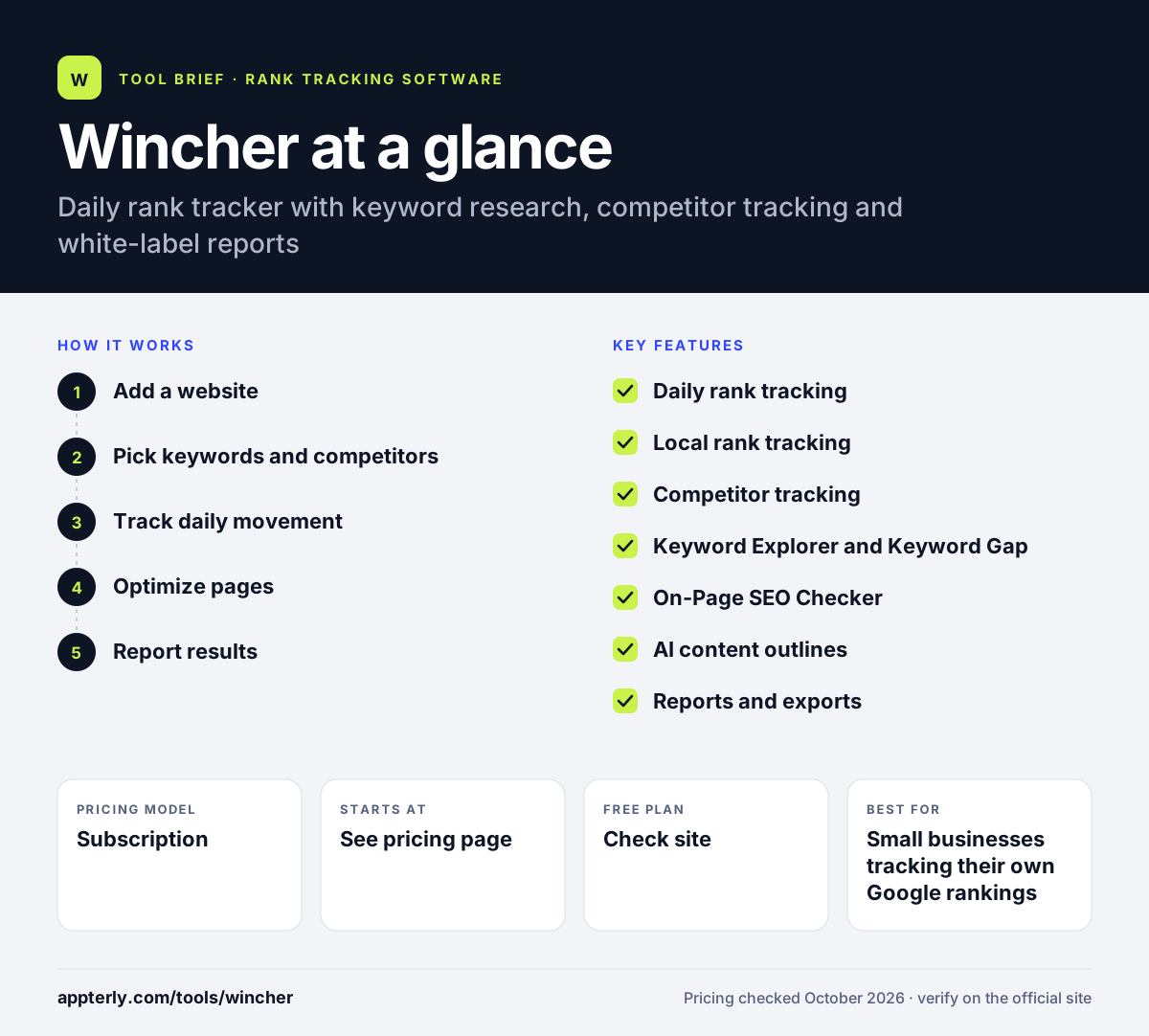
Wincher at a glance
How does Wincher work?
- Add a website
Create a project, connect Google Search Console and choose the search locations you care about.
- Pick keywords and competitors
Add keywords manually or from suggestions, then set competitors to compare against.
- Track daily movement
Wincher updates positions every day and lets you add annotations when you change a page.
- Optimize pages
Use the On-Page SEO Checker and SERP Benchmark to see how a page compares with the top results.
- Report results
Send scheduled PDF reports, white-label them on higher tiers, or feed data into Looker Studio.
Wincher key features
Daily rank tracking
Positions refresh every day, with on-demand updates and annotations on the history chart.
Local rank tracking
Weekly local tracking across unlimited locations using included credits.
Competitor tracking
Compare your rankings against chosen rivals over time.
Keyword Explorer and Keyword Gap
Research volume, intent and difficulty, and find terms competitors rank for that you do not.
On-Page SEO Checker
Page-level recommendations plus a benchmark against the current top 10 results.
AI content outlines
Generate an outline from a keyword, a short brief and a target length.
Reports and exports
Scheduled PDF reports, white-label options, and Excel or CSV exports.
API and Looker Studio
Programmatic access and a dashboard connector on the higher plans.
Why use Wincher?
- Daily updates on every plan mean you see ranking changes quickly.
- Keyword research and on-page checks sit beside tracking, so you need fewer separate tools.
- White-label reports help agencies send branded updates to clients.
- Search Console integration adds clicks and impressions to ranking data.
- History import makes it easier to switch from another tracker without losing data.
Who is Wincher best for?
A good fit for
- Small businesses tracking their own Google rankings
- SEO agencies managing many client sites
- In-house marketing teams that report to stakeholders
- WordPress and Wix site owners
Less suited to
- Users who need a full backlink database and site crawler
- Very tight budgets that only need occasional position checks
- Enterprises needing deep technical SEO auditing
Wincher pricing
| Pricing model | Subscription |
|---|---|
| Free plan | Not confirmed |
| Free trial | 7 days |
| Starting price | See the official pricing page |
Three tiers start from 500, 1,000 and 5,000 keywords; the upper two add unlimited websites, multiple users, API and white-label reports. Extra local tracking credits cost €10 per 500, and custom plans are quoted on request.
Prices checked October 2026. Vendors change plans often, so confirm on the official Wincher pricing page before you buy.
Wincher pros and cons
Pros
- Daily rankings on all plans
- Useful extras like keyword gap and on-page checks
- Agency-friendly reporting on higher tiers
- Clear, focused interface
Cons
- API, white-label and Looker Studio are limited to higher plans
- No full backlink index or site crawler
- Prices are shown in euros, which can confuse non-EU buyers
Wincher integrations and platforms
Works with
Available on
Wincher alternatives
See the full shortlist in Best Rank Tracker Tools.
Wincher FAQ
Is Wincher free?
Wincher is a paid tool, but it offers a 7-day free trial of the Pro plan so you can test daily tracking and the other features. After the trial you choose a plan based on how many keywords, websites and users you need. Custom plans are available for larger volumes.
What is Wincher used for?
Wincher is used to track daily Google rankings for keywords, compare them with competitors and report progress. It also helps with keyword research, keyword gaps and on-page optimization. Agencies use its white-label reports and Looker Studio connector to share results with clients.
Does Wincher work with WordPress?
Yes. Wincher lists WordPress among its integrations, along with Wix and Google Looker Studio. This lets site owners view ranking data closer to where they edit content. Google Search Console can also be connected so clicks and impressions appear alongside keyword positions.
Wincher vs SERPWatcher: what's the difference?
Wincher is a dedicated rank tracker with daily updates on every plan, keyword research tools, white-label reports and an API on upper tiers. SERPWatcher is part of the Mangools suite and updates weekly except on its Agency plan, but it comes bundled with keyword and backlink tools.
Is Wincher good for beginners?
Yes, Wincher is approachable for beginners. Setup involves adding a site, keywords and competitors, and the dashboard focuses on clear ranking charts. The on-page checker gives plain recommendations. More advanced users can still dig into share of voice, keyword gaps and API data on higher plans.
Sources
This overview is based on Wincher's official website and documentation, checked October 2026.