What is Talon.One?
Talon.One is an incentives technology platform that lets large brands design and run promotions, discounts, bundles and loyalty programs from one engine. It sits behind ecommerce sites, apps and point-of-sale systems and decides in real time which offers, coupons or points a customer should receive based on rules the marketing team sets.
Talon.One groups its product into three areas: enterprise loyalty management, offer management and execution, and personalized promotions. It is built for high-volume retailers, quick-service restaurants, travel, finance and grocery businesses. Customers listed on its site include Adidas, Sephora, Panera and Live Nation. Integrations cover commerce, CDP and messaging platforms such as commercetools, Salesforce Commerce Cloud, Braze, Klaviyo, Shopify and Twilio Segment.
Talon.One at a glance
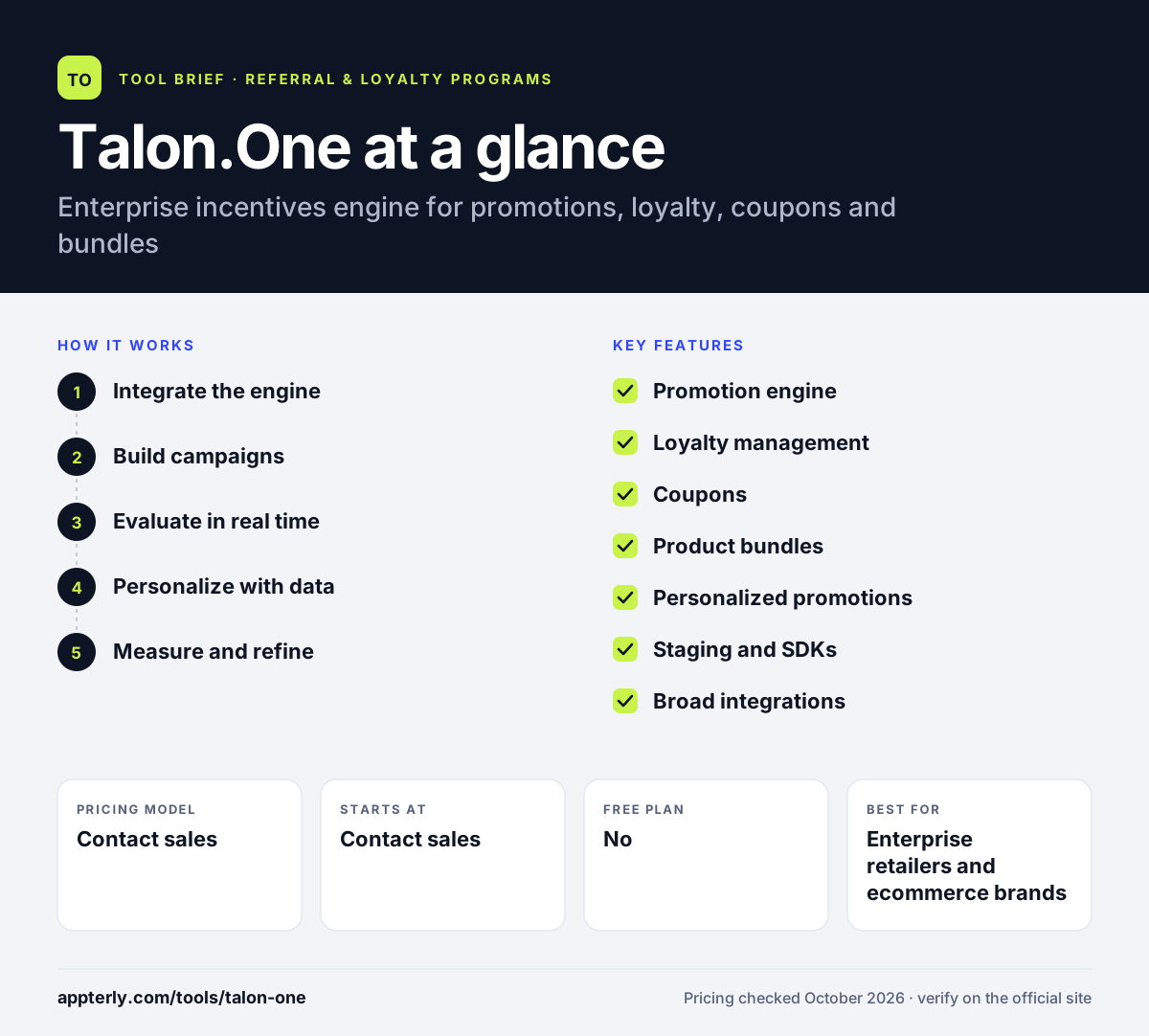
How does Talon.One work?
- Integrate the engine
Developers connect Talon.One to your commerce platform, app and POS using its API, SDK library and prebuilt connectors.
- Build campaigns
Marketers create promotions, coupon campaigns, bundles and loyalty rules in the campaign manager without code.
- Evaluate in real time
When a customer builds a cart or makes a purchase, the engine checks the rules and returns eligible discounts, rewards or points.
- Personalize with data
Customer data from CDPs and messaging tools lets brands target offers to segments or individuals.
- Measure and refine
Campaign analytics show redemptions and spend so teams can adjust budgets and rules.
Talon.One key features
Promotion engine
Runs discounts, cart-level offers and conditional promotions online and in store at scale.
Loyalty management
Supports points, tiers and more complex program designs than simple earn-and-burn models.
Coupons
Generates and validates large volumes of coupon codes, with the entry plan built around at least 500,000 coupons.
Product bundles
Creates bundle offers that combine products into a single deal.
Personalized promotions
Delivers one-to-one and gamified incentives across channels using customer data.
Staging and SDKs
Includes a staging environment, SDK library and audit logs with user roles on all plans.
Broad integrations
Connects with commercetools, Salesforce Commerce Cloud, SAP, Braze, Bloomreach, mParticle, Shopify and more.
Why use Talon.One?
- One engine replaces scattered discount logic across web, app and stores.
- Marketers can launch complex promotions without waiting on code releases.
- All plans include full feature access with no cap on API calls.
- Real-time rule evaluation supports large retail and QSR traffic.
- Prebuilt connectors cut integration time with common enterprise platforms.
- A staging environment and audit logs let large teams test campaigns and track changes safely.
Who is Talon.One best for?
A good fit for
- Enterprise retailers and ecommerce brands
- Quick-service restaurants and grocery delivery apps
- Travel, hospitality and finance companies running incentive programs
- Brands using composable commerce stacks such as commercetools
- Multi-brand groups that need one promotion engine across markets
Less suited to
- Small online stores that need a plug-in loyalty app
- Teams without developers to handle the integration
- Buyers wanting transparent, self-serve pricing
Talon.One pricing
| Pricing model | Contact sales |
|---|---|
| Free plan | No |
| Free trial | Not confirmed |
| Starting price | Contact sales |
Pricing is custom and based on data volume. Starter, Professional and Enterprise tiers differ by support level, dedicated infrastructure, webhooks, user limits and SLAs, not by feature access.
Prices checked October 2026. Vendors change plans often, so confirm on the official Talon.One pricing page before you buy.
Talon.One pros and cons
Pros
- Handles promotions, coupons, bundles and loyalty in one system
- Full feature access on every plan with unlimited API calls
- Wide set of enterprise integrations
- Used by large global brands in retail and food service
Cons
- No public pricing
- Requires engineering resources to implement
- Too heavy for small businesses
Talon.One integrations and platforms
Works with
Available on
Talon.One alternatives
See the full shortlist in Best Referral and Loyalty Software.
Talon.One FAQ
What is Talon.One used for?
Talon.One is used by large brands to run promotions, coupons, product bundles and loyalty programs from a single rules engine. It connects to ecommerce sites, apps and POS systems and decides in real time which discounts or rewards apply to each customer. Retailers, restaurants, travel and finance companies use it to manage incentives at scale.
How much does Talon.One cost?
Talon.One does not publish prices. Pricing is custom and based on data volume, and the entry Starter tier is designed around at least 500,000 coupons. All tiers include full feature access and unlimited API calls. Higher tiers add dedicated support, a dedicated database server, more webhooks and custom SLAs.
Does Talon.One integrate with Shopify?
Yes. Talon.One lists Shopify among its technology partners and integrations. It also connects with BigCommerce, commercetools, Salesforce Commerce Cloud and SAP, as well as engagement tools such as Braze, Klaviyo and Iterable. Most enterprise setups still involve developer work to connect the engine to checkout and apps.
Talon.One vs Open Loyalty: what's the difference?
Both are API-first platforms for enterprise brands. Talon.One focuses heavily on promotions, discounts, coupons and bundles, with loyalty as one part of the suite. Open Loyalty focuses on loyalty and gamification, with challenges, badges, leaderboards and games of chance. Both use custom pricing and need developer resources to integrate.
Is Talon.One good for small businesses?
Generally no. Talon.One targets high-volume enterprise brands and requires engineering work to integrate with storefronts, apps and POS. Pricing is custom and tied to data volume. Small online stores usually get better value from plug-and-play loyalty and discount apps built for Shopify or similar platforms.
Sources
This overview is based on Talon.One's official website and documentation, checked October 2026.