What is Open Loyalty?
Open Loyalty is an API-first loyalty engine that lets enterprise brands build gamified loyalty programs and plug them into their existing tech stack. Instead of a ready-made storefront widget, it gives development and marketing teams a loyalty backend with an admin panel, a campaign builder and a full REST API, so the program can appear in apps, websites, checkout and point of sale.
Open Loyalty supports points, tiers, rewards, wallets, referrals, challenges, badges, leaderboards, coupons and games of chance such as spin-the-wheel and lotteries. It runs as a cloud service on AWS with data hosting options in Europe, APAC and North America. Despite the name, the current product is sold as SaaS and is not open source. Open Loyalty is part of OEX SA, a group of companies.
Open Loyalty at a glance
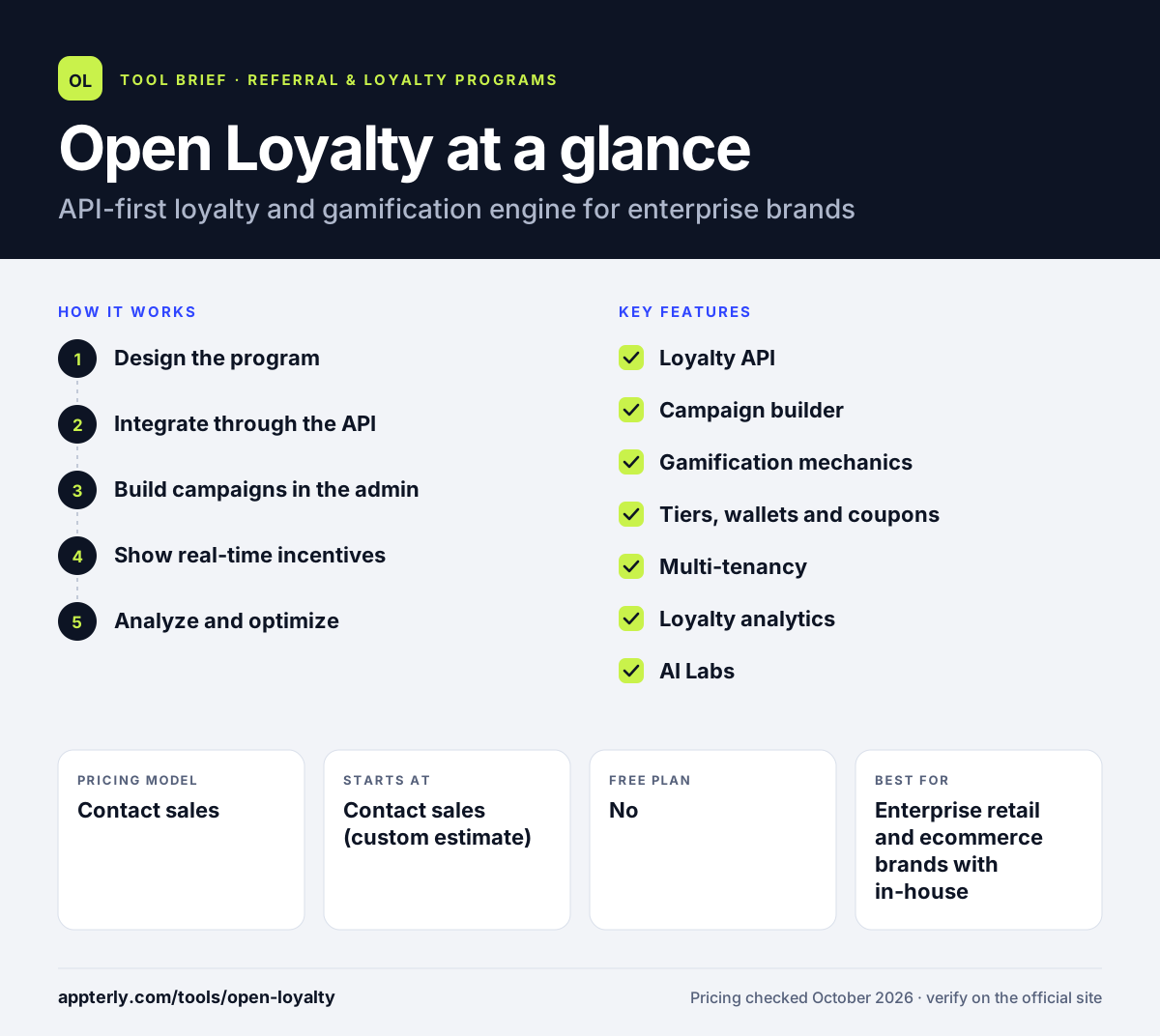
How does Open Loyalty work?
- Design the program
Work with the Open Loyalty team to define earning rules, tiers, rewards and gamification mechanics that fit your business model.
- Integrate through the API
Connect the loyalty engine to your ecommerce platform, mobile app, CRM, CDP and POS using the REST API and public documentation.
- Build campaigns in the admin
Marketers use the campaign builder to launch points promotions, challenges and rewards without code changes.
- Show real-time incentives
Your front end calls the API to display points, offers and progress at checkout, in the app or on confirmation pages.
- Analyze and optimize
Loyalty analytics show member activity and campaign results so the program can be refined after launch.
Open Loyalty key features
Loyalty API
A REST API exposes every loyalty function so teams can build custom member experiences on any channel.
Campaign builder
Marketers configure earning rules, bonus campaigns and rewards through an admin interface.
Gamification mechanics
Challenges, badges, leaderboards, lotteries and spin-the-wheel games add engagement beyond simple points.
Tiers, wallets and coupons
Supports multiple point wallets, tiered status levels, coupons and referral programs in one engine.
Multi-tenancy
One installation can serve several countries, brands or clients while keeping their data separate.
Loyalty analytics
Reporting tools track member behavior and campaign performance.
AI Labs
Includes an AI image verification tool, useful for receipt-based programs, and a Loyalty MCP server for AI assistants.
Why use Open Loyalty?
- An API-first design lets brands build the exact loyalty experience they want instead of accepting a fixed widget.
- Built-in gamification options help keep members engaged between purchases.
- Multi-tenancy suits groups running programs across several markets or brands.
- Enterprise support terms include 24/7 monitoring and a 99.99% uptime commitment.
- Regional data hosting and ISO 27001 certification help with compliance needs.
Who is Open Loyalty best for?
A good fit for
- Enterprise retail and ecommerce brands with in-house developers
- Quick-service restaurants, CPG and insurance companies running custom programs
- Sports clubs and finance brands wanting gamified engagement
- Groups running loyalty across multiple countries or brands
Less suited to
- Small Shopify stores that want a plug-and-play app
- Teams without developers to handle API integration
- Buyers who need public, self-serve pricing
Open Loyalty pricing
| Pricing model | Contact sales |
|---|---|
| Free plan | No |
| Free trial | Not confirmed |
| Starting price | Contact sales (custom estimate) |
Pricing combines a platform fee and an allowance fee, both based on the number of monthly active members. Support scope varies by package, and a proof of concept can be requested.
Prices checked October 2026. Vendors change plans often, so confirm on the official Open Loyalty pricing page before you buy.
Open Loyalty pros and cons
Pros
- Highly flexible API-first architecture
- Rich gamification mechanics in one engine
- Strong enterprise security, SLA and data residency options
- Hands-on loyalty experts help with design and launch
Cons
- No public pricing or self-serve plan
- Requires development work to integrate and display the program
- The name can suggest open source, but the product is commercial SaaS
Open Loyalty integrations and platforms
Available on
Open Loyalty alternatives
See the full shortlist in Best Referral and Loyalty Software.
Open Loyalty FAQ
Is Open Loyalty open source?
No. Open Loyalty states that its current platform is sold as SaaS and is not open source. Customers get an admin interface and full API access, and the service is hosted in the cloud on AWS with data location options in Europe, APAC and North America. Brands that need self-hosted open source software should look elsewhere.
How much does Open Loyalty cost?
Open Loyalty does not publish fixed prices. Pricing has two parts, a platform fee and an allowance fee, and both depend on how many active members the program has each month. An active member is someone who performs at least one loyalty event in a month. You request a custom estimate or a proof of concept from the sales team.
What is Open Loyalty used for?
Open Loyalty is used by enterprise brands to build custom loyalty and gamification programs. Teams use it to run points, tiers, rewards, referrals, challenges, badges and lotteries, then show those incentives in apps, websites, checkout and stores through the API. Common industries include retail, quick-service restaurants, CPG, insurance, finance and sports clubs.
Open Loyalty vs Talon.One: what's the difference?
Both are API-first engines for enterprise brands. Open Loyalty focuses on loyalty and gamification, with mechanics like challenges, badges, leaderboards and games of chance. Talon.One places more weight on promotions, discounts, bundles and personalized offers alongside loyalty. Both use custom pricing, so the choice usually depends on whether gamified loyalty or promotion management is the bigger need.
Is Open Loyalty good for small businesses?
Usually not. Open Loyalty is built for enterprise brands and requires developers to connect the API to storefronts, apps and point-of-sale systems. Pricing is custom and support is structured around enterprise SLAs. A small store on Shopify will typically get faster results with a plug-and-play app such as Smile.io or LoyaltyLion.
Sources
This overview is based on Open Loyalty's official website and documentation, checked October 2026.