What is listmonk?
listmonk is an open-source newsletter and mailing list manager that you install and run on your own server. It stores subscribers, builds campaigns from templates and hands each message to an SMTP provider you connect, such as Amazon SES or Mailgun. It ships as a single Go binary backed by PostgreSQL, with a web dashboard for lists, segments, campaigns and analytics.
The software itself is free under the AGPLv3 license, with no subscription, per-subscriber fee or paid edition. Your only costs are the server it runs on and the sending service that delivers the mail. listmonk also offers a transactional email API, so the same install can send password resets and receipts as well as newsletters.
listmonk at a glance
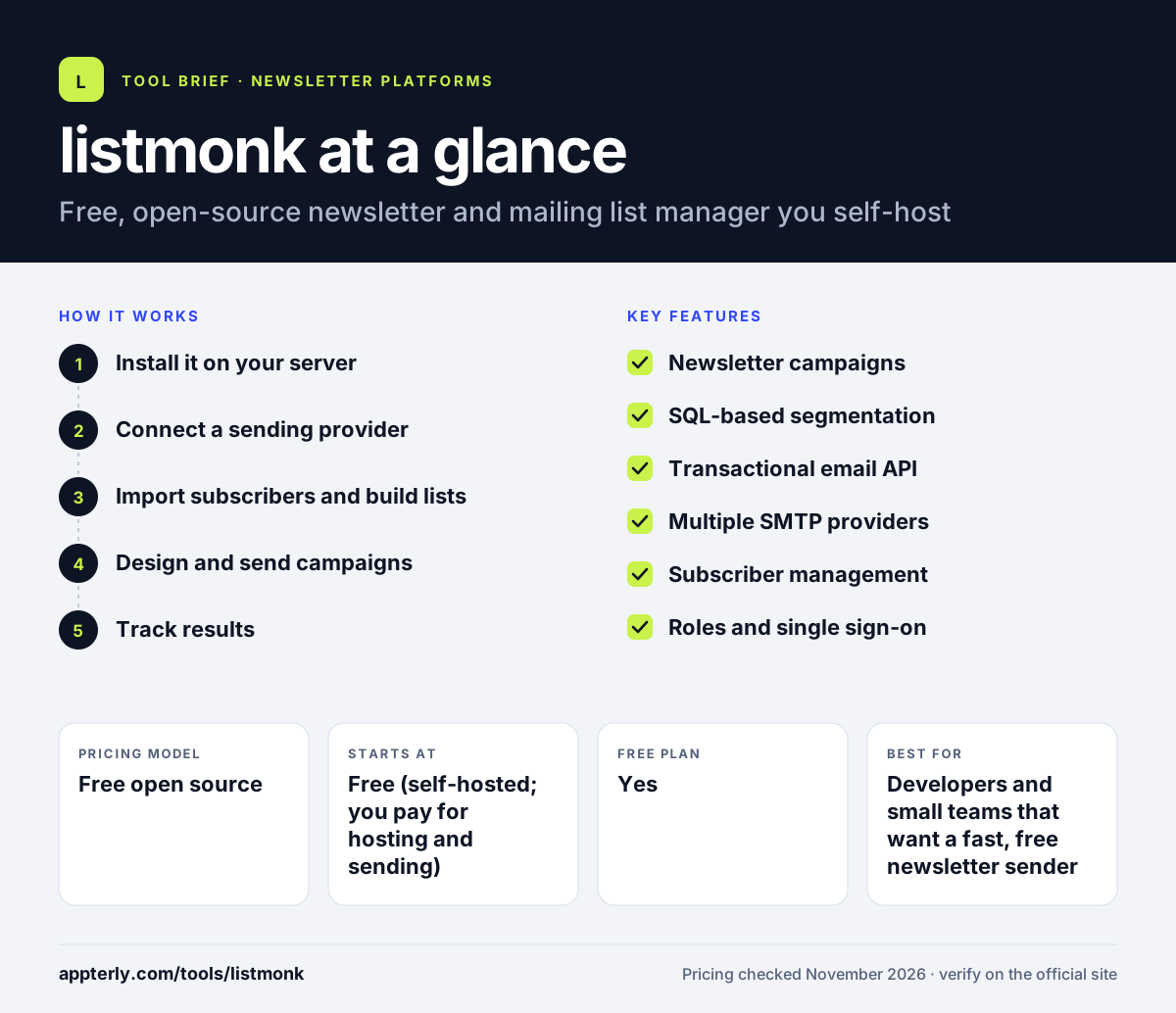
How does listmonk work?
- Install it on your server
Run the single Go binary or the official Docker Compose setup with PostgreSQL. No other application services are needed.
- Connect a sending provider
Add one or more SMTP servers or services, such as Amazon SES, so listmonk can deliver your mail.
- Import subscribers and build lists
Import contacts, organize them into lists and build segments with SQL-style queries.
- Design and send campaigns
Build campaigns from HTML templates, preview them and send to a list or segment.
- Track results
Check opens, clicks, bounces and unsubscribes in the dashboard, and use the API for transactional mail.
listmonk key features
Newsletter campaigns
Create and send campaigns to lists or segments, with templates, scheduling and analytics.
SQL-based segmentation
Build precise segments from subscriber attributes with SQL-style queries.
Transactional email API
Send one-off transactional messages through the same install, alongside bulk campaigns.
Multiple SMTP providers
Connect several SMTP servers and route mail through the provider of your choice.
Subscriber management
Manage lists, custom attributes, double opt-in and unsubscribes from the dashboard.
Roles and single sign-on
Control who can do what with roles, and sign in with single sign-on where supported.
Why use listmonk?
- The software is free under AGPLv3, with no per-subscriber or per-email charge from listmonk itself.
- A single binary with PostgreSQL keeps the install small and fast, even for large lists.
- SQL segmentation and a transactional API cover both newsletters and app mail in one tool.
- You keep full control of subscriber data on your own server.
- Active development, with stable release 6.2.0 in June 2026 and a 7.0 beta in October 2026.
Who is listmonk best for?
A good fit for
- Developers and small teams that want a fast, free newsletter sender on their own server
- Publishers with large lists who want to stop paying per subscriber
- Teams that also need a transactional email API in the same install
- Organizations that want full control of subscriber data
Less suited to
- Non-technical users who do not want to run a server
- Marketers who need visual automation journeys, which listmonk does not offer
- Teams that want an official hosted service, since listmonk has none
listmonk pricing
| Pricing model | Free open source |
|---|---|
| Free plan | Yes |
| Free trial | Not confirmed |
| Starting price | Free (self-hosted; you pay for hosting and sending) |
listmonk is free software under AGPLv3 with no paid edition or official hosted service. You pay for a server to run it and for the email service that delivers your messages, such as Amazon SES. Third-party hosts offer managed listmonk installs, but they are not affiliated with the project.
Prices checked November 2026. Vendors change plans often, so confirm on the official listmonk pricing page before you buy.
listmonk pros and cons
Pros
- Free under AGPLv3 with no subscriber or send limits from the software
- Fast, light install: one Go binary plus PostgreSQL
- SQL segmentation, transactional API and multiple SMTP providers
- Full control of subscriber data on your own server
Cons
- Self-hosting only, with no official hosted service
- No visual automation journeys
- You handle server setup, updates, deliverability and sending costs yourself
listmonk integrations and platforms
Works with
Available on
listmonk alternatives
See the full shortlist in Best Newsletter Platforms.
listmonk FAQ
Is listmonk free?
Yes. listmonk is free and open-source software under AGPLv3, and the project charges nothing for the application. You still pay for a server to run it on and for the email service that delivers your messages, such as Amazon SES.
What license does listmonk use?
listmonk uses the GNU Affero General Public License version 3.0 (AGPLv3). You can run it, modify it and use it commercially. If you modify it and offer the modified version to others over a network, the license requires you to share those changes.
Does listmonk have a hosted version?
No. The project offers no official hosted service. Third-party providers offer managed listmonk hosting, but they are not affiliated with the project. To use listmonk you normally install it on your own server with Docker or the single binary.
What do I need to run listmonk?
You need a server with PostgreSQL 12 or newer, plus an SMTP provider or service to deliver mail. The official Docker Compose setup ships both the app and the database, so the Docker route handles most of the setup.
Sources
This overview is based on listmonk's official website and documentation, checked November 2026.