What is DataHawk?
DataHawk is a marketplace analytics platform that combines Amazon, Walmart and other marketplace data in one place, with dashboards, alerts and AI-driven insights. It collects daily SKU-level sales, advertising metrics and profitability signals automatically, so teams no longer have to stitch together exports from seller and vendor portals. Amazon data comes through official partner integrations, and Walmart data through an approved Walmart Marketplace solution. The company says more than 1,200 brands and agencies rely on it.
DataHawk is built for brands and agencies that want reliable data rather than another research tool. It offers full data export with no lock-in, API access and connections to Snowflake, Power BI, Looker Studio and Google Sheets, so analysts can work in the tools they already use. Agencies get multi-account dashboards and white-label reports. Newer AI features include Sherlock, an agent that diagnoses performance changes, and an MCP connection for AI tools.
DataHawk at a glance
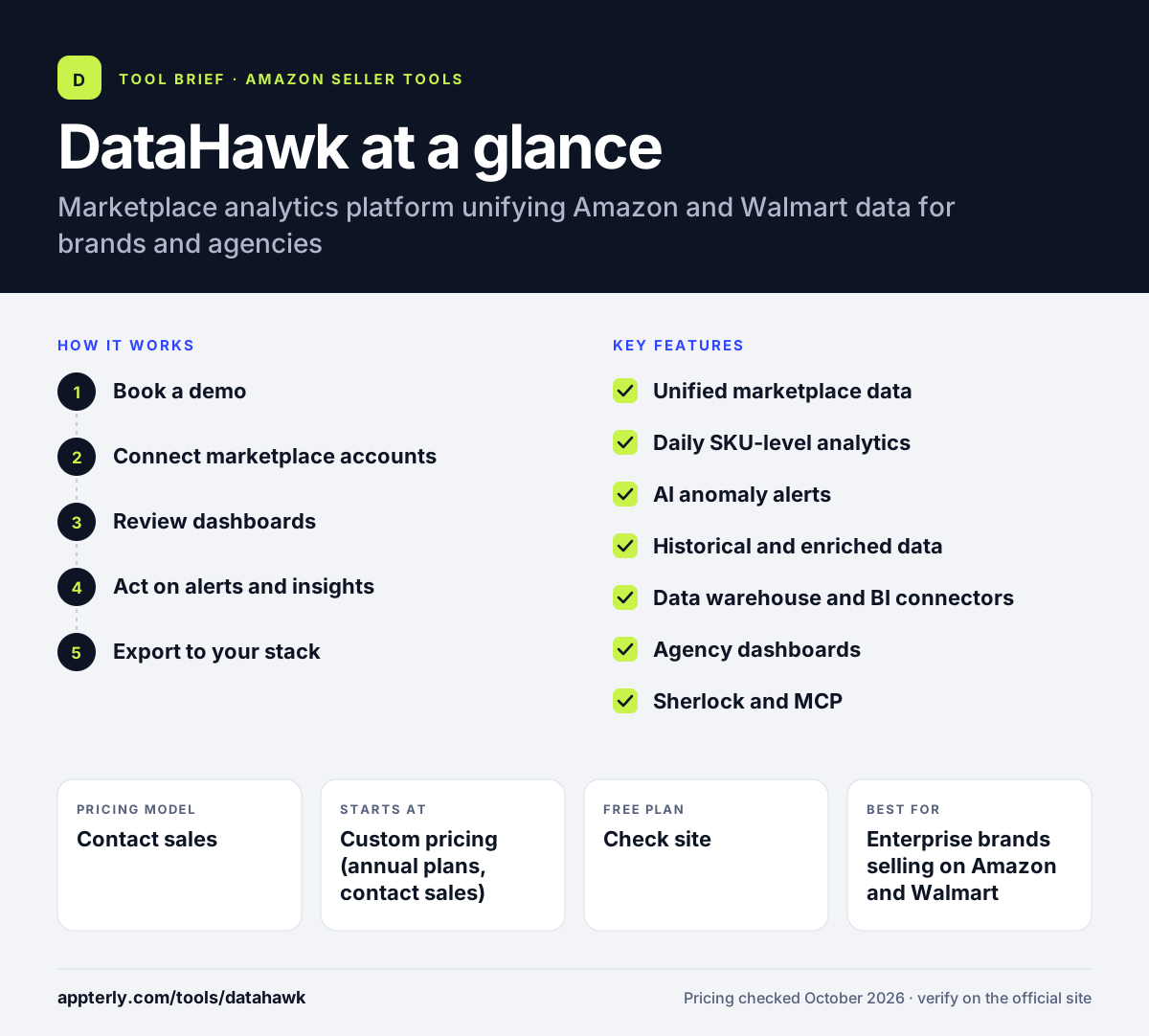
How does DataHawk work?
- Book a demo
Talk with DataHawk about your marketplaces, accounts and reporting needs to get a tailored annual plan.
- Connect marketplace accounts
Authorize Amazon and Walmart accounts through official integrations so data flows in automatically. Historical data is loaded so you can compare against past periods.
- Review dashboards
Use executive and SKU-level dashboards to track sales, ads, profitability and trends. Filters let you slice results by marketplace, brand or product.
- Act on alerts and insights
Daily anomaly alerts and AI guidance point to root causes and suggest next steps.
- Export to your stack
Send data to Snowflake, Power BI, Looker Studio, Google Sheets or your own systems through the API.
DataHawk key features
Unified marketplace data
Brings Amazon, Walmart and other marketplace data together in one consistent model.
Daily SKU-level analytics
Tracks sales, advertising and profitability for each product every day. Brands can spot which products drive growth or drag margins.
AI anomaly alerts
Flags unusual changes and explains likely causes with recommended actions.
Historical and enriched data
Keeps long-term history so you can analyze trends and seasonality.
Data warehouse and BI connectors
Connects to Snowflake, Power BI, Looker Studio and Google Sheets, with full export access.
Agency dashboards
Multi-account views and white-label reports for agencies managing many brands. Reports can carry the agency's own branding.
Sherlock and MCP
An AI agent for diagnosing Amazon performance (beta) and an MCP connection that lets AI tools query your data.
Why use DataHawk?
- It removes manual work of pulling and cleaning marketplace reports. Analysts can spend time on decisions instead of spreadsheets.
- Official Amazon and Walmart integrations improve data reliability.
- You own your data and can export it to any warehouse or BI tool.
- Daily alerts help catch sales or ad problems before they grow. Each alert comes with suggested causes and actions.
- Agencies can report across many client accounts from one platform.
Who is DataHawk best for?
A good fit for
- Enterprise brands selling on Amazon and Walmart
- Ecommerce agencies managing multiple marketplace clients
- Data and analytics teams that want marketplace data in their warehouse without building their own data pipelines
- Brands that need executive-level marketplace reporting
Less suited to
- New sellers looking for product research and keyword tools
- Small sellers who need low-cost monthly plans without annual commitments
- Sellers who want listing, keyword or advertising management tools rather than analytics
DataHawk pricing
| Pricing model | Contact sales |
|---|---|
| Free plan | Not confirmed |
| Free trial | Not confirmed |
| Starting price | Custom pricing (annual plans, contact sales) |
DataHawk offers custom annual plans tailored to each business; no tiers or prices are published. Professional services such as custom dashboards are a separate paid add-on.
Prices checked October 2026. Vendors change plans often, so confirm on the official DataHawk pricing page before you buy.
DataHawk pros and cons
Pros
- Reliable data through official marketplace integrations
- Strong export and BI connectivity with no lock-in, so data stays usable in your own stack
- AI alerts and root-cause guidance
- Built-in agency and white-label reporting
Cons
- No public pricing and annual commitments only
- Not a product research or listing tool
- Mainly suited to larger brands and agencies with dedicated analytics needs
DataHawk integrations and platforms
Works with
Available on
DataHawk alternatives
See the full shortlist in Best Amazon Seller Tools.
DataHawk FAQ
What is DataHawk used for?
DataHawk is used to analyze marketplace performance. Brands and agencies connect Amazon, Walmart and other marketplace accounts to see daily SKU-level sales, advertising and profitability data, get AI alerts about unusual changes, and export clean data to tools such as Snowflake, Power BI and Looker Studio.
How much does DataHawk cost?
DataHawk does not publish prices. It offers custom pricing on annual plans tailored to each business, so you need to book a demo or contact sales for a quote. Professional services, such as custom dashboards and dedicated project management, are available as a separate paid service.
Is DataHawk free?
DataHawk has a Start for Free button on its website, but it leads to a demo request rather than a clearly defined free plan. Pricing is based on custom annual plans. Teams interested in trying it should ask the sales team what trial or pilot options are available.
DataHawk vs Helium 10: what's the difference?
Helium 10 is an all-in-one seller toolkit focused on product research, keywords, listings, ads and operations, with published monthly plans. DataHawk is an analytics platform focused on unified, reliable marketplace data, dashboards and data exports for enterprise brands and agencies, with custom annual pricing.
Does DataHawk support Walmart?
Yes. DataHawk supports Walmart through an approved Walmart Marketplace solution and combines that data with Amazon in the same dashboards. This lets brands compare performance across marketplaces and spot trends without building their own data pipelines.
Sources
This overview is based on DataHawk's official website and documentation, checked October 2026.