What is cloro?
cloro is a search data API that collects answers from AI search engines and Google and returns them as structured JSON. It covers ChatGPT, Perplexity, Gemini, Microsoft Copilot, Google AI Overviews, AI Mode, Google Search and Google News, so developers and SEO platforms can build AI visibility tracking without running their own scrapers.
The company was founded in October 2025 by Ricardo Batista and is based in Valletta, Malta, with a remote team across Europe. Responses include parsed text, citations, sources, shopping cards and entities, with country targeting and US state-level targeting for several engines. cloro also offers a hosted MCP server, SDKs and connectors for automation tools, which makes it a building block rather than a finished dashboard for marketers.
cloro at a glance
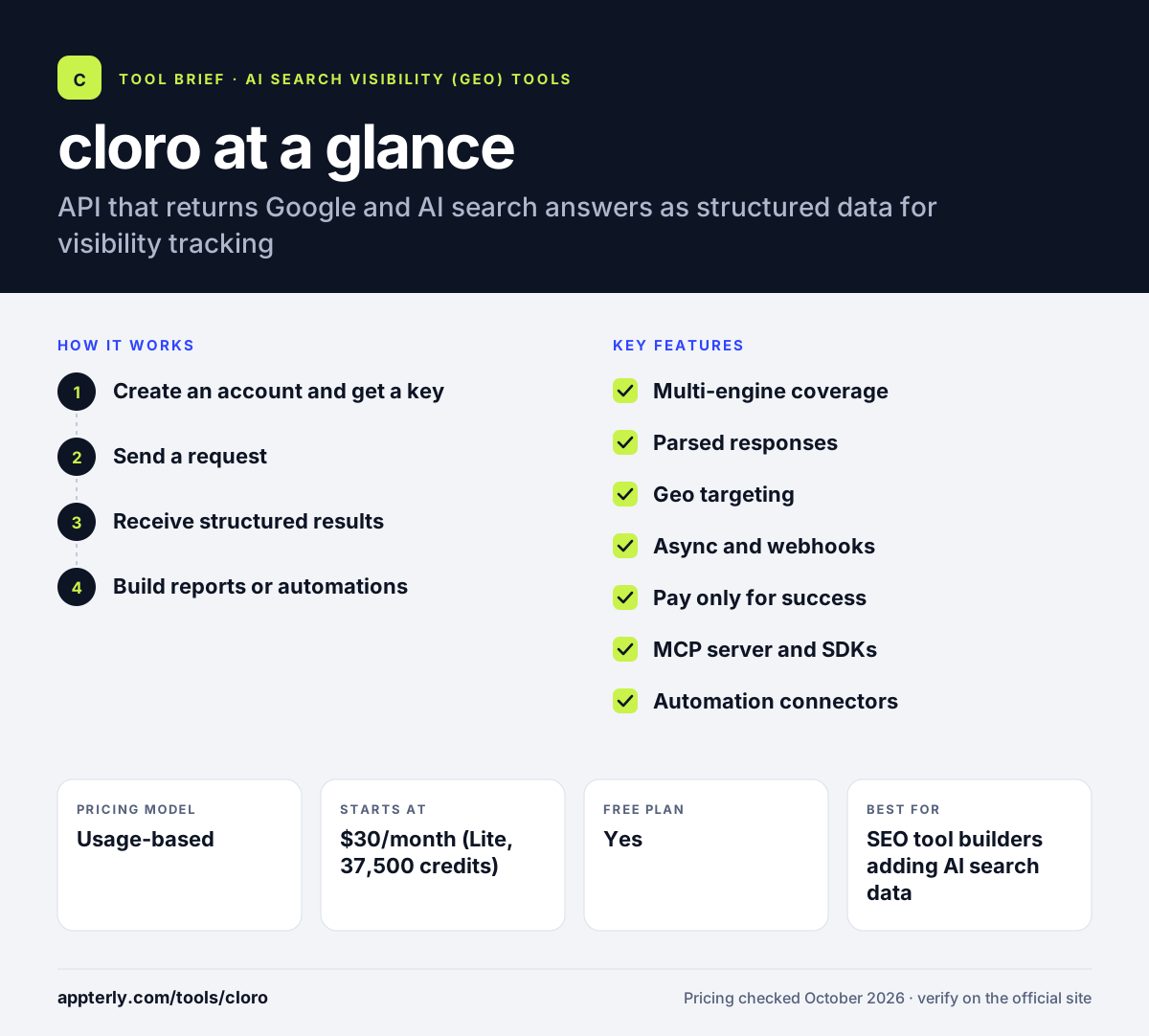
How does cloro work?
- Create an account and get a key
Sign up for the free plan, which includes 500 credits a month, and generate an API key.
- Send a request
Call the endpoint for an engine such as ChatGPT or AI Overviews with your prompt and target country.
- Receive structured results
Get the answer as JSON with text, markdown, citations and sources, either directly or through a webhook for async jobs.
- Build reports or automations
Store results, count brand mentions and citations, or pipe data into tools like n8n, Zapier or an AI agent through MCP.
cloro key features
Multi-engine coverage
One API for ChatGPT, Perplexity, Gemini, Copilot, AI Overviews, AI Mode, Google Search and Google News.
Parsed responses
Returns text, markdown or raw HTML along with citations, search queries, shopping cards and entities.
Geo targeting
Targets countries worldwide and US states for ChatGPT, Copilot, Perplexity and Gemini.
Async and webhooks
Runs batch jobs and delivers results by webhook, with automatic retries.
Pay only for success
Charges credits only when a response is extracted successfully.
MCP server and SDKs
Offers a hosted MCP server plus Python and JavaScript SDKs and REST access.
Automation connectors
Works with n8n, Zapier, LangChain and OpenClaw.
Why use cloro?
- It removes the work of building and maintaining scrapers for each AI engine.
- One credit balance covers every supported engine.
- A free monthly allowance makes prototyping cheap.
- Structured citations make it easy to count brand mentions and sources.
- Volume pricing lowers the cost per request as usage grows.
- Automatic retries and webhooks reduce the engineering work for large batch jobs.
Who is cloro best for?
A good fit for
- SEO tool builders adding AI search data
- Agencies building custom AI visibility dashboards
- Data and growth engineers
- Developers building AI agents that need search results
Less suited to
- Marketers who want a ready-made dashboard without coding
- Teams that need content recommendations or strategy
- Users who want pay-as-you-go billing
cloro pricing
| Pricing model | Usage-based |
|---|---|
| Free plan | Yes |
| Free trial | Not confirmed |
| Starting price | $30/month (Lite, 37,500 credits) |
Plans scale from Hobby at $100/month to Enterprise tiers above $5,000/month, with lower cost per 1,000 credits and higher concurrency. Requests cost 3 to 7 credits by engine, and unused credits do not roll over.
Prices checked October 2026. Vendors change plans often, so confirm on the official cloro pricing page before you buy.
cloro pros and cons
Pros
- Covers major AI engines through one API
- Free tier for testing
- Charges only for successful requests
- Developer-friendly SDKs and MCP
Cons
- Requires technical skills to use
- Not a full marketing analytics product
- Credits expire at the end of each month
cloro integrations and platforms
Works with
Available on
cloro alternatives
See the full shortlist in Best AI Search Visibility Tools.
cloro FAQ
Is cloro free?
cloro has a free plan with 500 credits each month and one seat, with no time limit. That is enough to test requests to each supported engine. Paid plans start at $30 per month for 37,500 credits and add unlimited seats, email support and higher concurrency.
What is cloro used for?
cloro is used to collect AI search answers and Google results programmatically. Developers and SEO platforms use the data to track brand mentions and citations in ChatGPT, Perplexity, Gemini and AI Overviews, build AI visibility dashboards, or feed live search results into AI agents and automations.
cloro vs Peec AI: what's the difference?
Peec AI is a finished analytics dashboard where marketers add prompts and view visibility, position and sentiment. cloro is a data API that returns raw, structured AI answers for developers to process. Choose Peec AI for a ready-to-use tool, and cloro if you want to build your own tracking.
How much does a cloro request cost?
Each request uses credits based on the engine. ChatGPT full responses use 7 credits, ChatGPT web search, Copilot and AI Overviews use 5, and Perplexity, Gemini and AI Mode use 4. Google Search and News start at 3 credits. Synchronous requests add 2 credits.
Does cloro work with Claude or other AI agents?
Yes. cloro offers a hosted MCP server, so Claude, Cursor and other MCP clients can request live AI search and Google results directly. It also has Python and JavaScript SDKs and connectors for n8n, Zapier, LangChain and OpenClaw, which makes it easy to add AI search data to automated workflows.
Sources
This overview is based on cloro's official website and documentation, checked October 2026.