What is AthenaHQ?
AthenaHQ is an answer engine optimization (AEO) and generative engine optimization (GEO) platform that tracks how often AI assistants mention, cite and recommend your brand. It monitors prompts across up to 11 models, including ChatGPT, Perplexity, Google AI Overviews, AI Mode, Gemini, Claude and Copilot, and compares your share of voice with competitors.
Beyond monitoring, AthenaHQ suggests on-page and off-page actions to close citation gaps and includes an AI agent called Ask Athena that answers questions about your own visibility data. It connects to Google Analytics 4, Google Search Console and Shopify to tie AI visibility to traffic and revenue. The company is backed by Y Combinator and other investors, and its team is spread across the US and Latin America.
AthenaHQ at a glance
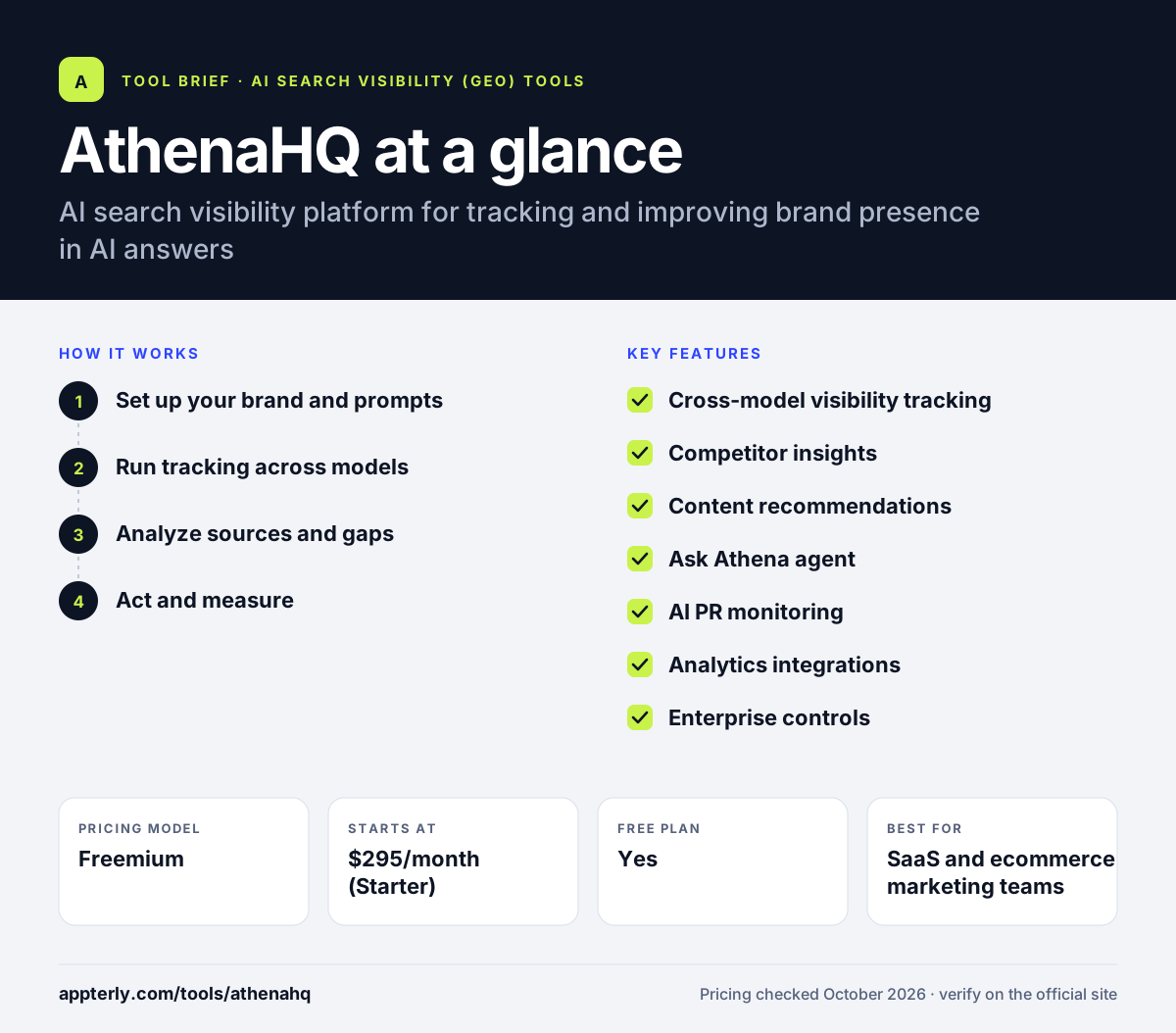
How does AthenaHQ work?
- Set up your brand and prompts
Add your brand, competitors and the topics or prompts customers might ask AI assistants. You can group prompts by topic to see which subjects drive the most mentions.
- Run tracking across models
AthenaHQ queries the selected AI engines and records mentions, citations, sentiment and position for each response, using credits. Starter adds country-level tracking and unlimited prompts and competitors.
- Analyze sources and gaps
Review which sources AI engines cite and where competitors appear but you do not. The platform highlights the domains and pages that AI engines rely on most for your category.
- Act and measure
Apply content recommendations, then connect GA4, Search Console or Shopify to see how AI visibility relates to traffic and sales.
AthenaHQ key features
Cross-model visibility tracking
Measures mentions, citations and share of voice across up to 11 AI models. Results can be filtered by engine and country on paid plans.
Competitor insights
Compares your presence in AI answers with named competitors.
Content recommendations
Identifies why pages are not cited and suggests on-page and off-page fixes.
Ask Athena agent
An AI assistant that answers questions using your own AEO and GEO data.
AI PR monitoring
Sends mention alerts and analyzes sentiment, with hallucination detection for incorrect claims.
Analytics integrations
Links GA4, Google Search Console and Shopify to connect visibility with traffic and revenue.
Enterprise controls
Adds SSO, audit logs, persona targeting, multi-region tracking and BI tool exports.
Why use AthenaHQ?
- It shows where your brand appears, or is missing, in AI-generated answers.
- A free tier with starter credits lets you test the platform before paying.
- Recommendations turn visibility data into concrete content tasks.
- Integrations connect AI search activity to real traffic and revenue.
- Unlimited users make it easy to share across marketing teams.
Who is AthenaHQ best for?
A good fit for
- SaaS and ecommerce marketing teams
- Shopify brands tracking AI-driven sales
- SEO agencies adding GEO services
- Enterprises that need SSO and BI reporting
Less suited to
- Solo creators with small budgets after the free credits run out
- Teams that only need classic Google rank tracking
- Users who want a fixed price without credit-based usage
AthenaHQ pricing
| Pricing model | Freemium |
|---|---|
| Free plan | Yes |
| Free trial | Not confirmed |
| Starting price | $295/month (Starter) |
The free Essential plan includes 300 credits across five AI platforms. Starter adds 3,600 credits a month and 11 models, while Enterprise is custom. Annual billing is 17% off.
Prices checked October 2026. Vendors change plans often, so confirm on the official AthenaHQ pricing page before you buy.
AthenaHQ pros and cons
Pros
- Broad coverage of AI engines
- Free entry plan with credits
- Actionable content recommendations
- Revenue attribution through Shopify and GA4
Cons
- Credit-based usage can be hard to forecast
- Paid plan starts at a high monthly price
- API access costs extra on Starter
AthenaHQ integrations and platforms
Works with
Available on
AthenaHQ alternatives
See the full shortlist in Best AI Search Visibility Tools.
AthenaHQ FAQ
Is AthenaHQ free?
AthenaHQ offers a free Essential plan that includes 300 credits, where one credit equals one AI response. It covers ChatGPT, Perplexity, AI Overviews, Gemini and Copilot. The paid Starter plan costs $295 per month and adds more credits, 11 models, unlimited prompts and integrations.
What is AthenaHQ used for?
AthenaHQ is used to monitor and improve how a brand shows up in AI assistants and AI search features. Marketing teams use it to track mentions and citations, compare share of voice with competitors, find content gaps and connect AI visibility to traffic and revenue.
AthenaHQ vs Profound: what's the difference?
Both track brand visibility in AI answers. AthenaHQ publishes a free plan and a self-serve Starter price, which suits smaller teams that want to start quickly. Profound focuses on enterprise buyers with custom pricing, AI marketing agents and agent analytics. Larger brands may compare both through demos.
Which AI engines does AthenaHQ track?
AthenaHQ tracks ChatGPT, Perplexity, Google AI Overviews, Gemini and Copilot on every plan. Paid plans add Google AI Mode, Claude, Grok, DeepSeek, Meta AI and Mistral, for 11 models in total. The company says additional models can be added on request.
Does AthenaHQ integrate with Shopify?
Yes. AthenaHQ integrates with Shopify so brands can publish AEO-optimized content and attribute revenue to AI search traffic. It also connects with Google Analytics 4 and Google Search Console to compare AI visibility with traffic and classic SEO performance, plus Webflow and Framer for publishing.
Sources
This overview is based on AthenaHQ's official website and documentation, checked October 2026.